Tuesday, May 28, 2013

Truth be Told


From: Walt Disney's Pinocchio
'Truth be told'  is a great phrase, and I love alliteration, but as Oscar Wilde so eloquently wrote in The Importance of Being Earnest, "The truth is rarely pure and never simple.

Poets, philosophers, statesmen and, well just about all of us, wrestle with the truth on so many levels. Here are a few of gems:
"There are no facts, only interpretations." - Friedrich Nietzsche
"If you would be a real seeker after truth, it is necessary that at least once in your life you doubt, as far as possible, all things." Rene Descartes
"Everything we hear is an opinion, not a fact. Everything we see is a perspective, not the truth." - Marcus Aurelius, Meditations
"Seldom, very seldom, does complete truth belong to any human disclosure; seldom can it happen that something is not a little disguised or a little mistaken." -Jane Austen, Emma
 “There's a world of difference between truth and facts. Facts can obscure truth.” - Maya Angelou
My concern now, is that 'truth' is becoming ever-more illusive with advancing photo-shop technology and our modern vehicles of 'news resources' and communication. Mark Twain's statement, "A lie can travel half way around the world while the truth is putting on its shoes" is now somewhat prophetic.

Here are a few of the issues that teachers, students, adults and all news consumers must keep in mind:

1. LESS-THAN-STRINGENT NEWS VERIFICATION IN THE RUSH FOR THE SCOOP: 

Part of the problem is that as we constantly download news there is increasing pressure for the 'scoop', often resulting in  less-than-stringent fact verification before publication. Furthermore, sources often come from 'citizen reporters' directly or indirectly involved in the event.  They are usually biased, and don't need to address accountability or review standards.

After the Boston Marathon bombing, for example, CNN first reported that an arrest had been made.  This was then picked up by the Associated Press, Fox and the Boston Herald, among others, when no arrest was yet to be made. Reporting errors were also made in the early hours following the Sandy Hill massacre. Many news outlets, for example, reported the shooter as Ryan Lanza rather than Adam.

This may be understandable when trying to cover fast-breaking news, but these mistakes occur with slower-paced news as well and remain 'accessable' to anyone in the future 'researching' these events.

Other examples: ABCNews OnLine reported 2/23/13 that "Vatican Furious over 'False' News Reports. " In another example, Forbes.com  (4/23/2013) reported in "Stocks Plunge, Then Recover After Falser Report of White House Attack" about what happened after the Associated Press' Twitter account tweeted a fake report of an attack on the White House. After Rep. Giffords was shot, NPR, Reuters, Fox News, CBS, CNN, The New York Times' website, and Huffington Post sent out tweets and other reports declaring her dead.  AP was one of the only major news organizations that held back.  She is still and slowly recuperating today.

In one final example (and there are many, many more), The Huffington Post noted how CNN and Fox News:
"...were left with egg on their Faces...as they got the Supreme Court's ruling on President Obama's health care law wrong...
The trouble started...[when]Congressional correspondent Kate Boulduan read out part of the Court's ruling, which said that the individual mandate could not be upheld using the Commerce Clause. Disastrously, though, it failed to pick up the other part of the ruling, which said that it could be upheld as a tax.
 Granted, the reporters in the film clip below do try to hedge their statements, but once out, they were 'blamed' and ridiculed for false or premature reporting of the ruling which in fact, upheld Obama Care.

2. USE OF PHOTOGRAPHS IN THE NEWS THAT HAVE BEEN PHOTOSHOPPED (some with and some without the knowledge of those posting/using them

One recent example (blaze.com 4/18/2013 "New York Daily News Criticized for Doctoring Photo of Bombing Victim's Gruesome Leg Wound - Should They Be?) can be seen below where an original photo (left) taken by Boston Globe photographer John Tlumacki was deemed too graphic for cover publication by The Daily News. They decided to still use it, photo-shopping the victim's severely damaged leg.

B Image 3881 ‘Daily News’ Photoshops Boston Bombing Photos on Front Page (NSFW)
The original photo (left) by Boston Globe photographer John Tlumacki was photoshopped by The Daily News (right)


New York Daily News Criticized for Doctoring Graphic Image of Boston Bombing Victim Wound
Here is the origianl photo by John Tlumacki, Boston Globe via Boston Big Picture Blog
New York Daily News Criticized for Doctoring Graphic Image of Boston Bombing Victim Wound
Front page of the New York Daily News showing the edited photo. (Image via Charles Apple/Copydesk.org)
The Daily News was subsequently criticized by many who felt that IF The Daily News felt this image was too graphic for their readers, they should have simply chosen a different one.

Cnet.com has a gallery of 26 photo-shopped images that have been integrated into "the news." They note, for example, that "in the immediate aftermath of the death of Osama bin Laden...several fake photos of his body appeared online..."

A more troubling example, however, can be seen in numerous instances of doctored war images, many of which continue to come out from Lebanon, Syria, Iran, Iraq, North Korea, and Hezbollah. While this doctoring is not new, it is becoming a mainstream issue due to availability, access, and photoshop technology. As these are doctored for political purposes to manipulate the opinions, ire and/or sympathies of viewers of all ages and are being picked up through news and social networks interchangeably, we have to be extremely careful when reading and evaluating 'the news.'

In August, 2006, for example, Liz Marlantes (abcnews.go.com) reported on "'Doctored' War Photos Ignite Controversy (8/8/2006, http://abcnews.go.com/US/story?id=2288892&page=1#.UaTBw-thKw8):
From: drezner.foreignpolicy.com
"...Adnan Hajj, the freelance photographer for Reuters...was fired... for doctoring two photographs from Lebanon...One was a picture of Beirut after an Israeli air strike on which Hajj imposed additional and darker plumes of smoke. The other showed an Israeli fighter jet dropping what appeared to be three flares, when the original image had just one...
It's also the story of Brian Walski, a Los Angeles Times photographer... fired in 2003 for merging two images of a British soldier and a crowd of Iraqis (in the altered image, the soldier appears to be pointing his gun at a man holding a child).
Photo manipulation has occurred since the days of the Civil War...But in recent years, media experts say they've seen an alarming rise in the frequency of doctored pictures making their way into the mainstream journalism.
...Experts say the trend is fueled by a range of factors. Growing pressure in newsrooms to compete with a growing array of media outlets...New and widely available Photoshop technology has also created...a slippery slope.
...When altered photographs are coming from a war zone, the sensitivities-- and the stakes-- are even higher.
...A similar problem may be looming with the growing use of 'citizen journalists.' As mainstream media organizations become increasingly willing to publish a cell phone photo or video taken by a random bystander...the opportunities for fraud are likely to multiply dramatically.

 On July 11, 2008, David Folkenflik (http://www.npr.org/templates/story/story.php?storyId=92454193) reported in "On the Smoky Trail of a Faked Missile Photo" that:
"...Earlier this week, the Iranians tested missiles..[intending]...to flex a little military muscle...Unfortunately for them, only three missiles made it off the ground. The fourth - despite photographic evidence...appears to have stayed put...

An image of four missiles being launched.
Sephanews.com/AP

An image showing three missiles being launched.
Sephanews.com/AP


One final example comes from last week's New York Times post "Israeli Report Casting Doubts on Shooting in Gaza  (5/19/2013)   http://www.nytimes.com/2013/05/20/world/middleeast/israel-casts-new-doubt-on-muhammad-al-dura-episode.html?_r=0
 
France 2, via Agence France-Presse

Isabel Kershner reported that:
"The images seen around the world were shocking: a young boy being shot dead as he crouched behind his father at a dusty junction in Gaza in September 2000. But the facts behind the images have been disputed almost from the start ...the Israeli government asserted that there was no evidence for the original account ...that the boy was hit by Israeli bullets — and that it was even possible that neither the boy nor his father had been struck by any bullets at all.
The original television report — [was] filmed by France 2 by a Gaza correspondent, Talal Abu Rahma, and narrated by the station’s Jerusalem bureau chief, Charles Enderlin, who was not at the present at the scene....France 2, a public television channel, at the outbreak of the second Palestinian intifada — had a powerful impact, galvanizing the uprising and fueling international criticism of Israel.
... The Israeli government review suggested, as other critics have, that the France 2 footage might have been staged. It noted anomalies like the apparent lack of blood in appropriate places at the scene, and said that raw footage from the seconds after the boy’s apparent death seem to show him raising his arm..."
-------
Clearly the list goes on. Please go to this link for more on a taxonomy of fraud with a comprehensive overview of four types of photo fraud.

The issue is that with the pressure for continuous news streams, with the ever-available and easy-to-use photo shop technology, and with more "citizen reporting" we have to be both aware of the issues and risks of faulty, premature reporting and slanted reporting which is subjective and manipulative rather than objective and informative.

PARENT AND TEACHER RESPONSIBILITIES

With news items available and retrievable for the unforeseen future, we have to train our kids and students to critically evaluate verbal and visual texts.

Solutions and strategies to battling "truth" in our social and news media:
 -------

 Thank you as always for your visit.

In the comments, please leave your opinions and suggestions on visual censorship, monitoring news sources,  how you navigate 'truth' and/or your favorite quotes on "truth."

Tuesday, May 21, 2013

Space Oddities and Sensations: Inspiring Teaching and Learning

In honor of  Col. Chris Hadfield's revised version of David Bowie's Space Oddity recorded on board the International Space Station [Published on May 12, 2013), the new Star Trek movie (which I haven't seen yet but look forward to - no spoilers, please) and "S" week at ABCWednesday,  this post presents ideas for teaching, learning, and inspiring students of all ages about the oddities and sensational aspects of space.


Commander Hadfield commanded the International Space Station (ISS) for six months and along with his colleagues oversaw hundreds of biological and physical experiments that will pave the way for future space exploration. Hadfield has done extensive tweeting, and posted hundreds of original photographs and numerous videos. 

For more on Commander Chris Hadfield, please see:
Here are just a few of his photographs (and his captions) taken from the ISS (International Space Station):
Col. Chris Hadfield (5/12/13) Dr. Seuss-inspired swirls in the Black Sea
Col. Chris Hadfield: Moonset, one of 16 per day on ISS (5/7/2013)
Col. Chris Hadfield: Mississippi delta - heartland topsoil flowing relentlessly into the Gulf of Mexico (5/7/13)
Col. Chris Hadfield: The starkest of beauty, in Saudi Arabia (5/3/2013)
Col. Chris Hadfield: A splash of dry white salt on seared red in Australia's agonizingly beautiful Outback (4/18/13)
Col. Chris Hadfield: Mt. Etna pouring heat and steam up through the snowcap (3/25/2013)

Col. Chris Hadfield: The Florida Keys look especially vulnerable from orbit (3/29/2013)
Inspired yet!?!  


HERE ARE SOME MORE TEACHING TOOLS, BOOKS, VIDEOS, LINKS AND SUGGESTIONS TO CONTINUE TO MAKE SPACE EXPLORATION AND SCIENCE COME ALIVE:

1. NEXT GENERATION CREW SPACE  TRANSPORTATION AND  EXPLORATION VEHICLE -  ORION - an ongoing NASA project has multiple educational ramifications.

A brief overview: The Orion MPCV (Multi-Purpose Crew Vehicle) is new-generation manned spacecraft for space travel and exploration beyond-low-earth-orbit. It will serve as the exploration vehicle that will carry crews to space - to the moon, to near-Earth asteroids and eventually to Mars. It is capable of conducting regular in-space operations (such as rendezvousing and docking) and has the capability to be a backup system for  International Space Station cargo and crew delivery.

What makes this so special aside from the state-of-the-art mechanics and technology incorporated into the vehicle and its intended missions, is that it also represents a departure for NASA as much of its construction is being done by private companies.  Below is the short list, for details consult this NASA link:
  • Lockheed Martin is building the Orion Crew Module;
  • Boeing developed a vehicle management computer system based on integrated modular avionics technology;
  • The European Space Agency is constructing the service module
  • Alliant Techsystems (ATK) facilities in Utah and Maryland tested the abort and attitude control motors for Orion's launch and abort system;
  • The UltraFlex solar array concept was developed by ATK
  • Hamilton Sundstrand's engineers in Connecticut, Illinois and Houston have developed Orion's intricate life-support and power systems;
  • Honeywell has developed intelligent avionics and software that support data, communications and navigation;
  • Ball Aerospace Technologies Corporation are working with NASA and Lockheed Martin on the STORRM (Sensor Test for Orion Relative Navigation Risk Mitigation) rendezvous and docking sensor assembly with a docking camera that has 16 times the resolution of the current shuttle sensors;
  • Aerojet was awarded the jettison motor design and development contract for the LAS (Launch Abort System)
Click here for details of the Orion engineering and building - the details, diagrams and photographs are absolutely breath-taking.

According to a NASA Orion Spacecraft Overview:
Image courtesy of www.nasa.gov
Orion features dozens of technology advancements and innovations...unique life support, propulsion, thermal protection and avionics systems in combination with other elements will enable extended duration deep space missions... Orion will utilize advances in ...  communications, life support, structural design, navigation and power...With destinations including near-Earth asteroids, our own Moon, the moons of Mars and eventually Mars itself....
This May and June, tests are being run (in various phases) simulating launch, ascent, launch abort, launch abort system separation, reentry and landing. Lockheed Martin is conducting the tests based on a set of prototype flight requirements.  Lisa Kalis in The Wall Street Journal (Saturday/Sunday Review 5/18-19, 2013) reported on the latest test:
As it sped toward Earth from a height of 25,000 feet...one of its parachutes failed and another malfunctioned...and the model of NASA's Orion spacecraft landed safely in the Arizona desert.  The mishaps were planned and there are...more tests to come. Orion's big trial arrives next year, when it will fly unmanned 3,600 miles into space and then....[return] to Earth...The ultimate goal: to send people to deep space in 2021.
Please go to this link for an awesome info-graphic that just didn't copy well. It discusses the various physical components of Orion and compares it to the Apollo project: http://online.wsj.com/article/SB10001424127887324216004578483482868153310.html?KEYWORDS=exploring+Orion#articleTabs%3Dinteractive

TEACHING IDEAS AND SUGGESTIONS around NASA's ORION Project :
  •  Video: NASA's Orion Space Capsule (from space.com) - This video provides the history of background of this project along with current testing and construction details. TEACHING IDEAS: 
    • Have students write press releases following (or predicting) the progress of Orion
    • Have students create fiction and non-fiction stories around the construction, launching and exploration projects of Orion based on research they do for background details.
  • Students can follow, chart, report, present, and analyze data on ongoing progress of Orion projects at: http://www.nasa.gov/exploration/systems/mpcv/index.html - (addressing Common Core State Standards such as "Research to build and Present knowledge, Range of reading and level of text complexity; Comprehension and collaboration, presentation of knowledge and ideas, and Key ideas and details" - to name just a few).
  • Here is a link at NASA that focuses on Orion's Monthly Progress 
  • Students can explore the pros and cons of NASA's strategy to involve multiple private and international partners (addressing many of the Common Core State Standards such as "Research to build and Present knowledge, Range of reading and level of text complexity; Comprehension and collaboration, presentation of knowledge and ideas, and Key ideas and details" - to name just a few).
  • Students can compare structure and technologies of the new Orion vehicle versus the older Apollo crew vehicle.
  • Discuss budgetary issues and how have influenced and might continue to effect this project. Here is an article from The Wall Street Journal you might use to begin the lesson:  NASA Budget Priority: Asteroid Defense.
----------

2. What it Feels like to Fly Over Planet Earth - a whirl-wind tour in one minute and two seconds taken from the front of the International Space Station as it orbits Earth at night. It moves over the Pacific Ocean, continuing over North and South America, before entering daylight near Antarctica. Pay attention to the lightning storms and the earth's ionosphere (the thin yellow line)!!

Teaching suggestions: Have students describe this 'trip around the world' writing travel logs, advertisements for space travel, or produce running commentary voice-overs for the video.  You may integrate this with a science project on clouds and what storms look like from above.


-------
3. What Earth will look like 100 Million Years from now this video shows Earth as it was 100, million years ago, how it has changed to date, and how it will look in another 100 million years.

Teaching suggestions: Have students describe the changes over time.  Discuss global warming and tectonic pressure, and other factors that effect Earth's continents and water shelves.


 -------

4. A Modern View of Cosmology (or... as the conference director wanted to name it: We're All F***ed) -  is a talk for high-school and above by Lawrence Krauss (author of The Physics of Star Trek). Krauss talks about how modern day cosmology (studying the cosmos) has changed our perception of the past and future.  It is an hour lecture filled with facts, fables, and photos that make the laws of quantum physics understandable and interesting. Here is a synopsis:
While the star clusters on a clear night can blow you away, the really cool stuff are "the things you can't see - the mysterious stuff that dominates nature." The talk opens with Einstein's theory of relativity (1916) which stated that space curves in the presence of matter, or as Krauss puts it "gravity sucks" - as it pulls rather than pushes everything in. But this theory clashed with observation, that the universe was static - it was there and would be there - the way we saw it - forever. This clashing of science/math and observation bothered physicists at that time. We now know (thanks to Edward Hubble) that Einstein's theory was correct - the universe is expanding (and not static) and are now asking questions such as: Will the universe continue to expand forever? Or is it more like a closed sphere that will expand to a point and then explode upon itself?  Or, is it a flat, curved entity that will expand forever but eventually slow down or maybe eventually speed up? If it speeds up, the longer we wait, the less we'll see (except for our galaxy).

-------
5. OTHER TEACHING RESOURCES:
  •  NASA has a super link: Teaching From Space that includes lessons, resources, video links and more
  • Another resource, also sponsored by NASA is Amazing Space which uses the Hubble Space Telescope's discoveries to inspire and educate us all.  They have resources from "The Hubble Gallery", astronomy materials under their "Capture the cosmos" section, "Tonight's Sky", even Homework Help!
  • NASA and Fermi Labs have an AWESOME website devoted to black holes that has videos, FAQ sheets, Educator workshops, black hole science web sites, black hole activities for classrooms of all levels,  cool black hole games for all ages, and other black hole resources
  • http://www.space.com/video/  Some of their videos include:
    • How to bake a Mars Pellet - Curiosity's Drill Sampling
    • Bring Some Asteroid to Earth
    • The Back Hole - An Eruption in Space-Time
    • How Black Holes Got Super-massive
    • How Black Holes Build a Universe

This is just the tip of the iceberg and demands more space and time (which I hope to continue in future posts). In the meantime, please leave us with your favorite space images, inspirations, or space teaching/learning moments in the comments.

Thank you, as always, for your visit.

Sunday, May 19, 2013

Astronaut Academy

Dave Roman's Astronaut Academy
Inspired by Commander Chris Hadfield's tweets and posts (including his rendition of David Bowie's Space Oddity), here is a treat for kids of all ages by Dave Roman and First Second Books. While it takes place in space,  isn't about space or science but it is a lot of fun and worth the read.

Dave Roman's Astronaut Academy began as a webcomic before First Second Books expanded and transformed it into two books. The first, introduces the characters' backgrounds, friendships, arch rivals, and passions. It also vaguely introduces a student "threat" hiding within the school that somehow feeds off of human emotion. In Book 2, the pace picks up as we meet the monster who disguises itself as different people to steal hearts. [In Dave Roman's world, people have multiple hearts to survive physical and emotional threats, and at the same time empowers them to express their love to others by giving them one of their many hearts. Parents give hearts to kids, friends give each other hearts, etc. Just one example of his use of language and metaphor.]

Both books are filled with wisdom, humor, word-play and puns, dinosaur car races and the exciting sport of Fireball.

BOOK ONE - ASTRONAUT ACADEMY: ZERO GRAVITY  (First Second Books, 2011) introduces the school through their "Official Promotional Guide" and once at the Academy, we learn about the various students - their passions, friendships,  secrets and motivations, and in many cases, their rivalries. So for example, Hakata Soy just wants to forget his past and fit in. Marcos Stamatis has a broken heart and wants to impress a girl from his Rocket Science class. Hakata Soy's roommate,Tak Offsky, eats, lives and breathes Fireball.  Maribele Mellonbelly the richest kid ever (whom everyone wants to befriend), is still lonely and finding ways to unseat her "arch rival" Miyumi San, who wants to learn everything she can.

Below are two pages to show you the feel and genius of this book.

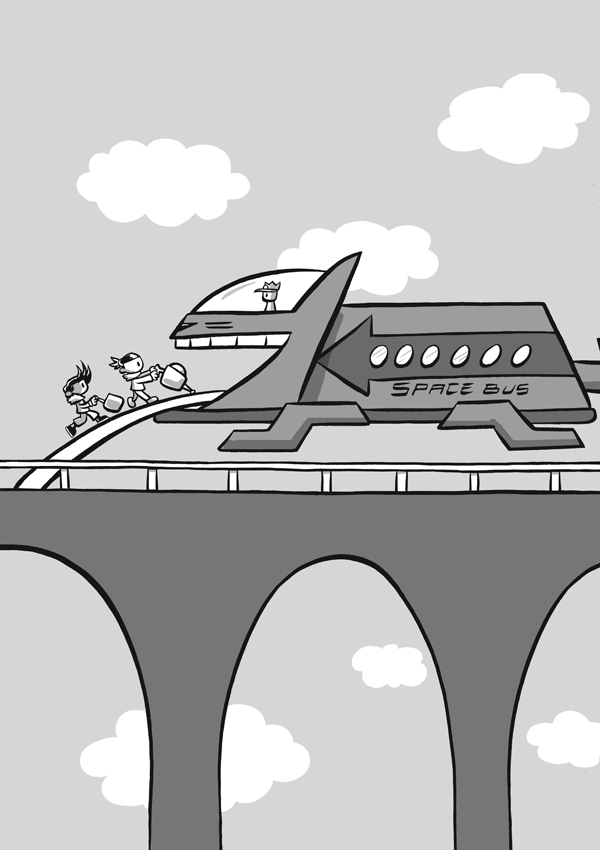
In the first image, we see a page from the school's  "Official Promotional Guide." On this page, we're introduced to three of their very talented staff.

The second image illustrates how Roman introduces just one of his many characters.
      From Astronaut Elementary by Dave  Roman, Courtesy First Second Books (2011


      Cybert is a robot that was built for destruction but prefers to play card games.
      Sample page from  Astronaut Elementary by Dave Roman Courtesy of First Second Books (2011)


    There are a lot of characters in this story, and the genius of Dave Roman and Astronaut Academy  is that he introduces their stories and voices in an organized manner.  Mini-chapters are introduced with the name of the character 'talking,' along with a brief snippet about the character, and each has his or her own unique look and manner. So for example in the page above we see that this chapter will be told from Cybert the cyborg's perspective, and that Cybert is somewhat 'confused' and has "no idea what I'm doing at Astronaut Academy."  

    When discussing how he set up the characters, Roman commented (in an interview with ComicBookResources.com):
    I try to think about archetypes I might be playing to or against. For example, Hakata Soy is introduced as a  mysterious hero with a troubled past, so he wears a high collared jacket and has wild hair, sort of like a sci-fi James Dean...
    Aside from the brilliant way we meet the characters, here are some of my favorite examples of Roman's word-play, humor, and 'words of wisdom':
    • The "fabric of time" is a worn-torn garment;
    • One of the characters notes, "A few years ago on the far planet of Hoppiton I lived hoppily with my family..."
    • Another character talks about how he got a "crush" on a girl - after literally being crushed by her;
    • The Guidance Chancellor B or Bee advises a renegade cyborg whose only goal (at that time) is  destroying Hakata Soy that, "You could spend your WHOLE LIFE searching for an exclusive chase card...and no matter how many booster packs you buy, never find the one you seek. Diversify your interests. Don't let one card game consume your ambitions."
    • Mr. Taketo Sky is one of the Astronaut Academy teachers and Tak Offsky is a student;
    • Students are told by Mr. Taketo Sky to "...start ADDING two and two together by solving these QUESTIONABLE EQUATIONS.
    For more 'goodies' please see:

    Teaching suggestions for Astronaut Academy: Zero Gravity:
    •  Addressing Common Core State Standards (CCSS) this book is full of advanced vocabulary, and tells the story verbally and visually, addressing multi-modal teaching.
    • This book is full of wordplay, acronyms, puns and metaphors.  Have your students go on a scavenger hunt through the book looking for examples. (CCSS: Vocabulary Acquisition and Use, Conventions of Standard English, Range of Reading and Level of Text Complexity)
    • The book opens with a new student arriving late in the semester.  This is a great way to start a new term, reading this aloud to help students feel more comfortable in their new class.
    • This book is about stereotyping, rivalry and friendship - important learning points for all kids.
    • Since students are continuously meeting new students as the characters are introduced, you can have them work in groups constructing character maps of each one (CCSS: Vocabulary Acquisition and Use, Craft and Structure, Key Ideas and Details, Comprehension and Collaboration, Presentation of Knowledge and Ideas.)  Then meet as a whole, comparing and contrasting character traits.

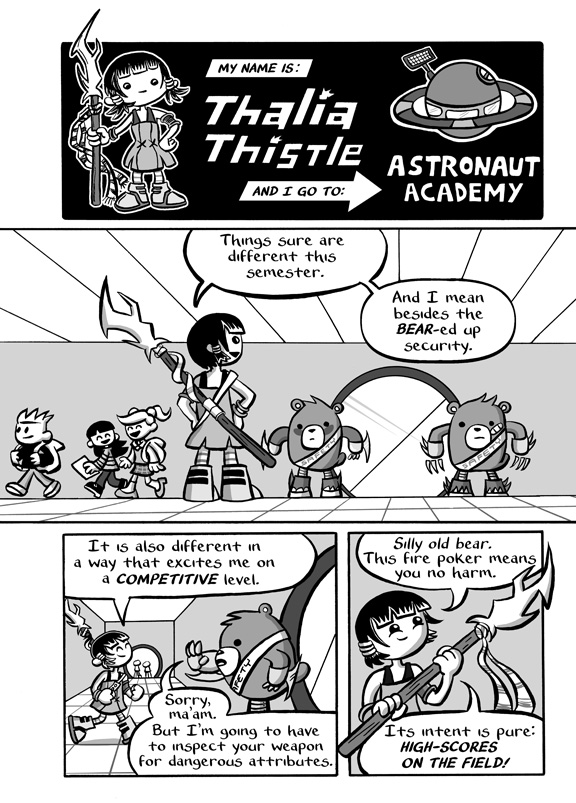
    BOOK TWO - ASTRONAUT ACADEMY: RE-ENTRY (First Second, 2013) begins as the students return to school after semester break and find security is "beared-up" because the monster feeding on their emotions is now a serious threat. With their kids' safety at jeopardy (many have 'heart attacks' as they are tricked to give one of their hearts to the heart-eating monster), the school goes into lockdown mode searching for robots and later banning love. The action centers on an epic Fireball championship and the mysterious heart-stealing monster. After ineffective teacher/parent interventions, students learn that they must rely on themselves. There are space ninjas, dinosaur cars, security 'bears' and the story is told through inspiring images, and page design, with puns and wordplay galore to relieve the stress and tension.
    • Here is a "Re-Entry Book Trailer""
    • Here are some sample pages, courtesy of First Second Books 
    • And, for readers who grew up with Where's Waldo and love searches and scavenger hunts, Dave Roman in the same interview, mentioned above tells us that:
    "Here's a (possibly incomplete) list if anyone wants to go on a pop culture scavenger hunt through "Astronaut Academy: Re-Entry!" Some of the other things possibly referenced include "My Neighbor Totoro," "THX 1138," My Chemical Romance, Harry and the Potters, All Girl Summer Fun Band, The Knitting Factory, "Bill and Ted's Excellent Adventure," "Doctor Who," "A Wrinkle in Time," "Back to the Future," "The Girl Who Leapt Through Time," "The Halloween Tree," "Sweeney Todd," "Star Wars," "Mystery Science Theater 3000," "The Aquabats," "Digimon," "The Ewok Movie," "Santa Claus is Coming to Town," "The Black Hole," "The Great Pumpkin Charlie Brown," Sega Saturn games, "Dark Side of the Moon," "Pinocchio," "Sailor Moon," Kiss, "Avatar: The Last Airbender," "Gatchaman," Cobra Commander, Tales of Ribaldry, Pom Poko, "Transformers," "Say Anything," "Voltron," "The Fly," MC Hammer, Depeche Mode, "Sonic The Hedgehog," Bum Equipment, Ub Iwerks, Bumper Boy, Monticello, "The Secret of Nimh," ShamWow, Team Rocket, "Super Mario World" and "Flight of the Navigator."
    Students traveling to school after semester break. Courtesy of Dave Roman and First Second Books, 2013
    In addition to these goodies, Roman continues to include wordplay, wisdom and fun. Here are some examples:
    • Thalia Thistle, ace Fireball player has an aversion to acronyms and in one instance, two 'security bears' try to figure out what "BFF" means;
    • A wounded student is taken to Dr. Nursen;
    • One of the 'security bears' announces that he "hates to be the bear of bad news... "
    • A student notes that after a science-project gone awry by his scientist parents, they became less-visible, ""My parents' visits were increasingly short and trans-parent"
    • Another character who finds he cannot compete on the Fireball team becomes interested and words and spelling bees saying, "...something about the way they were constructed always intrigued me. I liked the way they looked and sounded."
    • Words of wisdom: "I know Dad is worried about my safety...but life involves scrapes and bruises, especially if I want to play the game..."
    Here is a page from Astronaut Academy: Re-Entry:
    http://yaytime.com/academy/aa2_preview/pages/aa2_025_thalia1.jpg
    Courtesy: Dave Roman and First Second Books http://yaytime.com/academy/aa2_preview/pages/aa2_025_thalia1.jpg

    Teaching suggestions for Astronaut Academy: Re-Entry:
    • Have students go on a scavenger hunt for acronyms, puns and word-play.  Have them create their own that might easily fit into the book and story as well. (CCSS: Vocabulary Acquisition and Use, Conventions of Standard English, Range of Reading and Level of Text Complexity)
    • Discuss the themes of this book: teamwork, forgiveness, rivalry. Map their development.  (CCSS: Key Ideas and Details, Integration of knowledge and Ideas, Comprehension and Collaboration)
    • Compare the different style of story-telling in the two books (CCSS: Conventions of Standard English, Craft and Structure, Key Ideas and Details, Integration of Knowledge and Ideas, Range of Reading and Level of Text Complexity, Text Types and Purposes, Presentation of Knwoledge and Ideas.)
    • Meeting CCSS, have students practice different forms of writing, creating "Rules of Play" for Fireball.  You may want them to brainstorm on ways the game can be played in school/ recess.  They can also write/review the game as it is being played. (CCSS: Vocabulary Acquisition and Use, Conventions of Standard English, Craft and Structure, Key Ideas and Details, Text Types and Purposes, Presentation of Knowledge and Ideas.)

    These books are wonderful entertainment for kids of ALL ages.  I hope you take a closer look yourselves. For more from Dave Roman, check his website:http://yaytime.com/ 
    For more teaching ideas please go to: http://yaytime.com/resources/teachers-guides/

    In the meantime, thank you for your visit, and please leave your reactions, reviews, and creative ideas in the comments.

    Monday, May 13, 2013

    Reviewing Rust

    Having recently presented at Chicago's C2E2, I came back with some awesome graphic novels and thought I would use ABC Wednesday's "R" Week to Review one them - RUST by Royden Lepp (Archaia). To date, there are two (of four) volumes of Rust, and here is a review along with teaching suggestions:

    Archaia Property Featured Art--Rust
    By Royden Lepp courtesy of Archaia.com
    Rating: These books have been rated appropriate reading for all ages - although I would say they will be enjoyed by readers Grade 4 through adult. While younger readers will easily focus on Roman and Oswald his younger brother along with their responsibilities to their farm and family, and their relationship with Jet Jones,  older readers will comprehend the larger issues of artificial intelligence, and drone warfare.

    While there are now two Rust books, it appears there will be four volumes and a possible movie with 20th Century Fox. In an interview with Comic Book Resources, Lepp reveals that Joe Cornish (Attack the Block, The Adventures of Tintin, Ant-Man) will be the director, working with Aline McKenna (The Devil Wears Prada) as screenwriter.

    Overall impressions: Both volumes are brilliantly illustrated in sepia tone which gives the story a Dust Bowl and post World War I feeling and both are in hardcover.  Both tell a compelling story of discovery, war, responsibility, and empowerment. Both really make you think about the characters, their stories, and the challenges of "coming of age."

    And, while both books open up with war scenes between jet-propelled 'boys,' large 30-foot mechanical drone monstrosities, and men; and while both contain a super-hero aspect, the story is more about family than about war, robots, or superheroes. In both books, Roman (and in the second book Roman's little brother Oswald) write letters to their dad who is still away (we assume at war), and both books emphasize Roman and Oswald's sense of responsibility to the farm, family and to each other. There are subplots:
    • Addressing life with advancing technologies in AI (artificial intelligence) and the balancing roles of humans vs. machines (including farm work and drone warfare). For more on this, please read a post by Stuart Warren (3/14/2013 at sequart.org) "A Unwlecomed Visitation: A Treatment of Drone Warfare in Royden Lepp's Rust"
    • Furthermore, while RUST takes place on a farm in what looks like Dust Bowl Oklahoma, the reader is unsure if the land became barren because of environmental issues or as the result of neglect and drone infantry combat.

    Volume 1 Rust: Visitor in the field is about a teenager, Roman Taylor who, while living in an alternate world/time, lives in what looks like the Dust Bowl Oklahoma (in an alternate world)  in the 1930's that is recovering from what looks like World War I.  His father was called to war and Roman is struggling to keep their small farm solvent. Then one day, Jet Jones crash-lands on the farm. As Roman learns more about Jet, discovering how Jet works and Jet's past, Roman becomes more hopeful about his future and the welfare of his family and their farm. So hopeful, that he tends to overlook nagging questions about Jet that remain unanswered.

    When Jet Jones first appears, he is fighting a larger rogue machine. Roman helps Jones defeat the larger drone and secures him as a farm hand helping with the harvest and with rebuilding a disabled Model-C robot (which in turn will add more helping hands on the farm) so Oswald can return to school. Oswald is beginning to ask questions of the past, of war, and is questioning who Jet Jones is.
    Jet Jones escapes his creators in "Rust: Secrets of the Cell." (Archaia)
    Rust: Secrets of the Cell by Royden Lepp; courtesy of Archaia

    Rust: Secrets of the Cell. Royden Lepp, Archaia
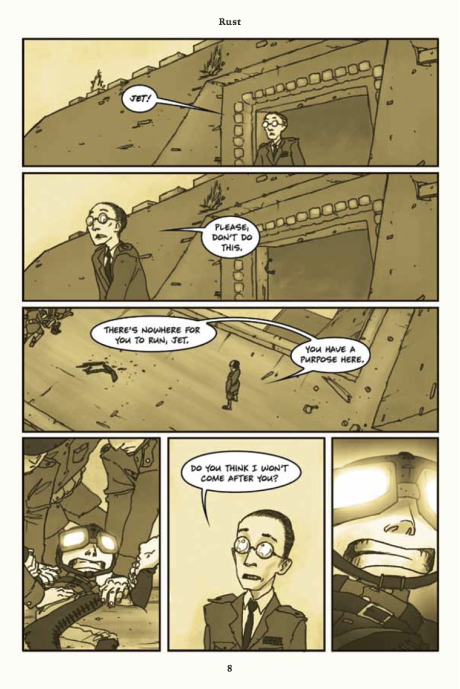
    Volume 2 Rust: Secrets of the Cell begins by revealing et Jones' past, filled with difficulties he had to overcome (and may still be wrestling with). Roman is still wrestling to get the farm back up, still sees Jet Jones and the re-tooling of Model C's as the key, and still is willing to overlook unanswered questions about Jet Jones. We also begin to question if there might be a budding romance between Roman and Jesse Aicot. But in this volume, the plot focuses on revealing more about Oswald, Jet Jones and Mr. Aicot's ability to shed some answers.  Here is a free preview from Archaia.

    The book opens 48 years in the past where we get a glimpse of Jet Jones as he 'escapes' his past (as seen in the panels above and to the right).  Oswald questions Jet Jones' role and motives, and when talking with neighbor (and retired soldier) Mr. Aicot, Oswald learns more about the war, its use of drones and about Models C's and Jet Jones.  The story is beautifully layered and is full of intrigue, tension, and heart as we begin to truly question each of the characters, their roles in the farm, in the war, and with each other.


    Classroom Suggestions: As these books are appropriate for all ages, classroom suggestions become more layered.   I would recommend that these volumes be used by students grades 4+

    For middle-school learners:
    • Discuss what it was like living in Dust Bowl of the 1930's.  
      • You may want to compare this book to Karen Hesse's Out of the Dust [by Karen Hesse is about a girl, living in the Dust Bowl who suffers a debilitating accident shortly after the death of her mother, and must learn to face life's harsh lessons with patience and grace.  This novel is written solely in prose and poetry and the author's use of language is breathtaking]. 
      • You can discuss the different story-telling aspects of prose, poetry and image.]or to the famous and powerful photographs of Dorothea Lange
    • Discuss the role of family, responsibility and issues of 'coming of age'
    • Discuss the role of heroes vs. anti-heroes

    For high school learners these books might be read when discussing
    • War and its effect on families, farms, civilians;
    • AI - Artificial intelligence: where we are today, its possibilities, the pros and cons of using AI in our daily lives;
    • Drone warfare
    • The changing roles of heroes and anti-heroes;
      Visitor In the Field. Royden Lepp (Archaia)

    Common Core State Standards that can be addressed when reading these books:
    • Key Ideas and Details
      • Recount details;
      • Quote accurately from the text when explaining content;
      • Compare and contrast character motivations or plot development between the two volumes;
      • Discuss the central versus secondary themes;
      • Analyze how particular elements of the story's drama interact, and/or the role of dialogue versus visual story-telling. 
      • With limited text this may help weak readers, although the limited text also expands inference making as readers must gather their data by analyzing and integrating visual messages along with text.
    • Craft and Structure: in this graphic novel, we are experiencing the story as it unfolds from each character's perspective.  This is a wonderful tool for teaching the difference betweeen 1st-person and 3rd-person perspectives.
    • Integration of Knowledge and Ideas: interpreting information presented visually and explain how the information contributes to understanding the text (gr. 4), drawing information from multiple print sources (gr. 5), Comparing these books to others on similar topics also falls under the CCSS for this area.
     Common Core State Standards with Writing exercises:
    • Roman and Oswald write letters to their father.  You might have students write letters to members of their own families who are far away, or you may have them write letters to "Mr. Taylor" from Roman and/or Oswald's perspective (Conventions of Standard English, Knowledge of Language, Vocabulary Acquisition and Use, )
    • Have students write a research paper on drone warfare and/or artificial intelligence (Research to Build and Present Knowledge all grades) 
    • Have students write an opinion piece addressing the pros or cons of using drone warfare (addressing Text Types and Purposes of the CCSS for all grades)
    • Range of Reading and Level of Text Complexity -can be addressed when pairing these books with other fiction and non-fiction works about artificial intelligence, the Dust Bowl, and/or drone warfare.
    Common Core State Standards for Speaking and Listening:
    • Have students role play, acting out important parts or decisions of the book (Comprehension and Collaboration)
    • Have students present and discuss their research projects (see above) (Presentation of Knowledge and Ideas)


    Thanks, as always, for your visit.  

    Please leave your impressions and reactions, or other pairing/lesson suggestions  in the comments.

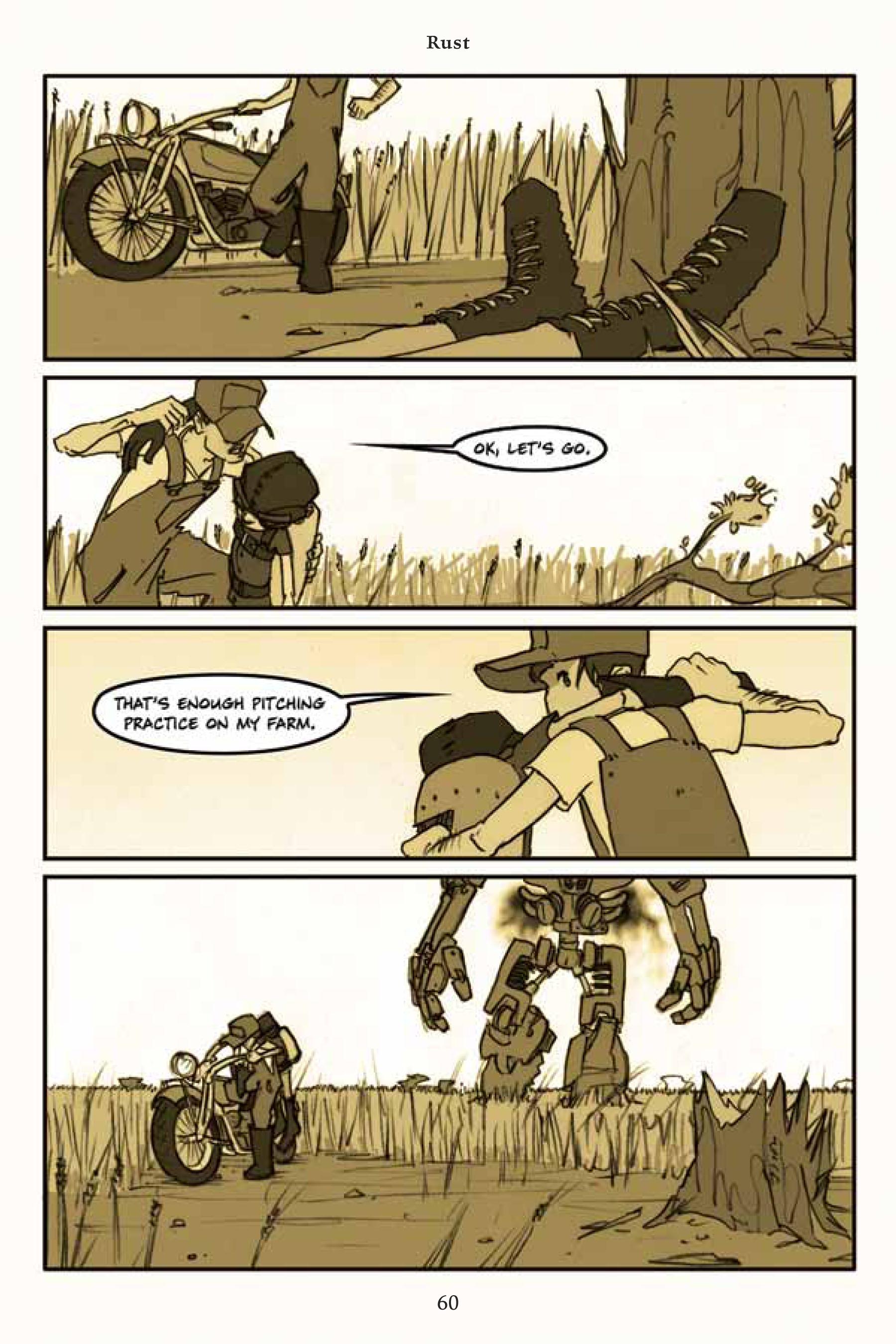
    From Rust: Secrets of the Cell.  By Royden Lepp, Archaia


    Sunday, May 5, 2013

    The Quest for Quality Education: An Open Dialogue

    Maybe the problem we have with developing the key to quality education is that we still haven't quite defined what that is.  Or, maybe the problem is that because each of our students is different, with his or her unique blend of skills, affinities, strengths and weaknesses, one set of definitions and /or goals just doesn't work for everyone. Or, maybe the reason why the United States is falling behind in  national educational rankings is that we don't even know what it is we need to measure.

    On the other hand, each and every one of us know what a good teacher is when we meet them. For more on this please go to "Great Teacher" Judgment Call or Objective Evaluation" and to read about the economic value of a good teacher, please see "Teachers' Worth."

    Art by Viktor Hachmang courtesy of The New York Times 5/4/2013 "A Talent for Teaching"

    Quality teachers are those who respect their students, take learning profiles and affinities into account while keeping the bar of expectations high.  Good teachers talk with their students not to them, and good teachers find ways to make learning meaningful and exciting - their classes are ALIVE!!!

    One such teacher, taught my husband Shakespeare in high school.  He developed a course called "Beatles and Shakespeare" where he got the bodies for his class by teaching about the Beatles but then moved to Shakespeare where songs of old and new came alive, and hooked his students on the Bard's work. This teacher, Eph Gerber, is now working on teacher development research and training where he hopes to find ways to help teachers  find the "ARTIST" within them. Through art - in its various forms - Eph believes teachers while keeping the expectations high will make the material more memorable and meaningful.

    So, in my own personal quest to define quality education and with Eph's project in mind, I devote this post to quality teachers and their classroom contributions from articles and posts I've recently found. Below are three examples of teachers who have creatively found ways to reach students while raising the bar:

    1. Peter Nonacs talks about letting his class "cheat." Nonacs, a professor in the Ecology and Evolutionary Biology Department at UCLA teaches juniors and seniors about animal behavior.  According to an article he posted "Cheating to Learn: How a UCLA Professor Gamed a Game Theory Midterm" he notes:

    Animals and their behavior have been my passions since my Kentucky boyhood and I strive to nurture this love for nature in my students...Much of evolution and natural selection can be summarized in three short words: "Life is games." In any game, the object is to win...Game Theory, is devoted to mathematically describing the games that nature plays...
    So last quarter I had an intriguing thought while preparing my Game Theory lectures. Tests are really just measures of how the Education Game is proceeding...What if I let the students write their own rules for the test-taking game? Allow them to do everything we would normally call cheating?
    A week before the test, I told my class that the Game Theory exam would be insanely hard...but as recompense, for this one time only, students could cheat.  They could bring and use anything or anyone they liked, including animal behavior experts...surf the Web... talk to each other or call friends who'd taken the course before...Only violations of state or federal criminal law such as kidnapping my dog, blackmail, or threats of violence were out of bounds...
    On the day of the hour-long test they faced a single question: "If evolution through natural selection is a game, what are the players, teams, rules, objectives and outcomes?"
    One student immediately ran to the chalkboard and she began to organize the outputs for each question section. The class divided tasks. They debated. Whey worked on hypotheses...A schedule was established for writing the consensus answers...

    In the end,  the students learned what social insects like ants and termites have known for hundreds of millions of years. To win at some games, cooperation is better than competition. Unity that arises through a diversity of opinion is stronger than any solitary competitor.
    For more please press the links above for the article as well as for a KCRW interview. 

    2. In the New York Times Sunday Dialogue: A Talent for Teaching (May4, 2013) David Greene a staff writer for WISE Services, treasurer of Save Our Schools, and former teacher mentor for Teach for America writes that:
    Seasoned professionals know what works: being creative, independent, spontaneous, practical and rule-bending. Often it is the least orthodox teacher who most engages and excites students. Scripts and rules and models strictly followed cannot
    replace what the best teachers have: practical wisdom...
    The practical wisdom of good teaching is more than being creative or spontaneous. It is knowing when and how to use best practices. It includes how to prepare and use great questions, and knowing when to veer to places students take us. It includes when and how to use the science of teaching as well as the art. Practical wisdom is not following a script prepared by others who do not know your students and how they work.  Teaching is both an art and a science...a great teacher inspires.
     3. Sue Mellon teachers poetry to 7th and 8th graders by integrating science, technology, engineering math and art with Robert Frost's poetry. As Barbara Ray writes in Mind/Shift's "Combining Robotics With Poetry? Art and Engineering Can Co-Exist" (4/4/13):
    Poetry isn't always easy for students. But with hands-on engagement, they gain new understanding. Take Robert Frost's "Pasture." Instead of just reading and discussing the work in a typical classroom setting, students make 21st-century dioramas with robotic tool kits containing sensors, motors, LEDs, and a controller...


    A lot of kids aren't crazy about poetry," Mellon said. "But we have to help them engage with it. After spending two weeks analyzing the poem and creating visual imagery and symbolism for their dioramas, they really understand the work and get quite passionate."
    Stories like Mellon's can be found all around the Allegheny School District these days as the area, already renowned for its groundbreaking work in STEM, takes on STEAM. STEM stands for science, technology, engineering and math...But as STEM took hold, some began to wonder if there was a component missing. Enter the STEAM movement...STEM needs to include art and design...the A is the creative ART element...[and the Congressional STEAM Caucus was launched.]


    For those loyal readers who have read my other posts, I prefer not repeating some of the other inspiring teachers I've already spoken about. But for the uninitiated visitor, I urge you to read about the inspiring slam poetry of Taylor Mali - Part I  and  Part II , and the real-life math lessons of Lockhart's Lament.  They too are inspired and inspiring teachers.

    Finally, there are the fictional teachers from movies.  And, while they may be fictional, their characters and lessons spark and inspire teachers and students alike:
    • Mr. Glenn Holland (from Mr. Holland's Opus)
    • Professor John Keating (from Dead Poet's Society)
    • Mr. Mark Thackeray (from To Sir With Love)
    • Miss Riley (from October Sky)
    • Mr. Forrester (from Finding Forrester)
    • Professor Melvin Tolson (from The Great Debaters)

    In closing, the teachers and lessons above do involve a confidence and 'artistic' twist.  Successful teachers and lessons pull on passions in acting, gaming, performance skills, even cooking.  So maybe Eph is on the right track.  What do you think?  

    Please leave your impressions, experiences and reactions in the comments below.

    And as always, thank you for your visit!