“Earth. Our planet hosts a rich diversity of life…from lush rain
forests to dry deserts. Bun underneath this world lies another one. A
microscopic world. This is the home of the amoeba...” - Jennifer and
Matthew Holm, Squish (Random House)
pp.7-9

So begins the adventures of Squish and his friends, Pod and
Peggy (two amoebas and a paramecium) in their microscopic world of Small Pond.
This month, at Using Graphic Novels In Education, I take a closer look at Squish, written by Jennifer and Matthew
Holm, (Random House), reviewing it and making suggestions for the first four
books. Here are some of the highlights:
 |
| Squish by Jennifer and Matthew Holm, Random House |
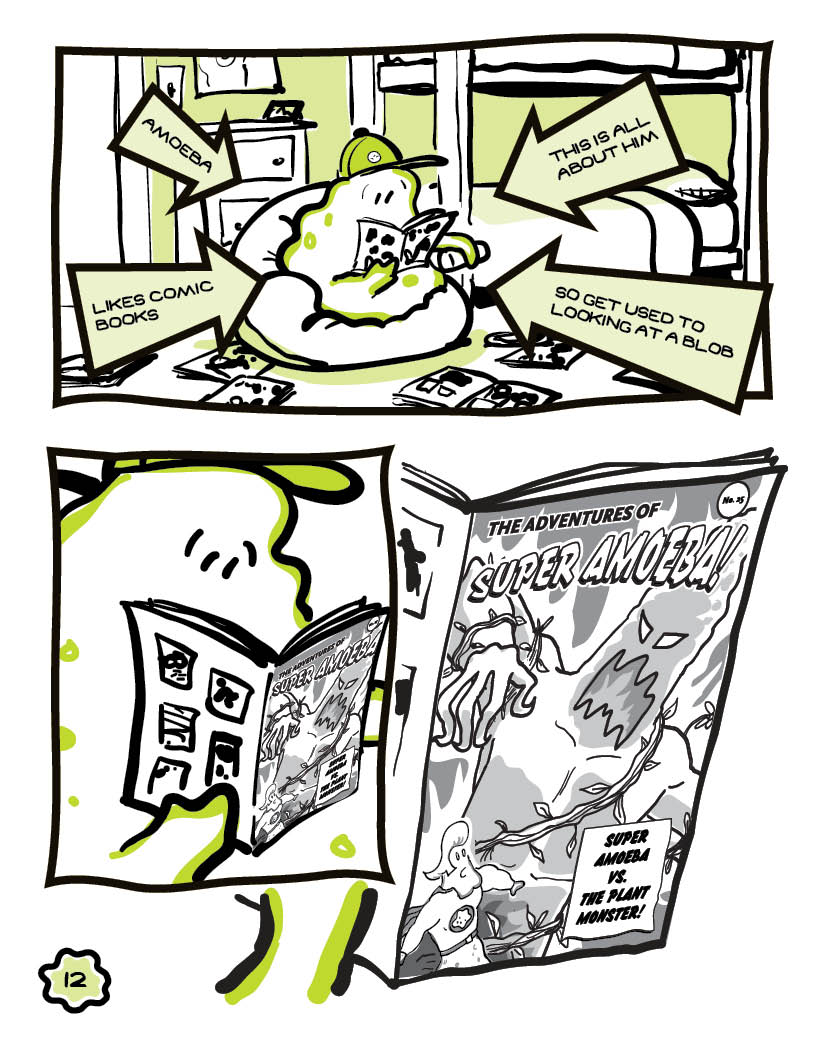
Squish
is a comic book-loving, Twinkie-eating, blubbery, super-swell amoeba “kid” who wrestles
with good and evil in life around him, and learns about life’s
responsibilities. He faces all sorts of challenges with his friends Pod (a
nerdy, mooching amoeba who’s always working on some lay-brained science scheme to
help him tame his world), and Peggy (a clueless, huge-hearted, super-sweet,
happy-go-lucky loving paramecium). In the first four books they face challenges
in school, summer camp, soccer games, and much more. While Squish is a beloved
series in its own right, he was first brought to life and introduced in Babymouse #14: Mad Scientist (another
award-winning series by Jennifer and Matthew Holm about a spunky young mouse).
We highlight Squish this month because it’s a WONDERFUL series full of fun,
humor, and real-life problems facing middle school “microorganism kids.” And while
each volume is under 100 pages and geared for kids ages 7-12, they will be
enjoyed by older readers as well with their compelling themes and sharp
sophisticated humor. These endearing pond-dwelling microorganisms deal with
issues of friendship, bullies, overcoming fears, and learning that doing the
right thing is one of life’s greatest challenges (and rewards)- whether you’re
a superhero like Super Amoeba, or a plain kid like Squish.
SERIES SUMMARY
Squish’s volumes
are packed with puns, alliteration, wordplay, humor, and hyperbole. In each
book, Squish and his friends deal with real-life conflicts (handled with
insight and compassion), issues of right and wrong, and the power and value of
friendship. Furthermore, as Squish is an avid Super-Amoeba comic book fan, each
issue contains a parallel Super Amoeba comic book story, adding greater depth,
humor, and insight. As an added bonus, at the end of each book there’s a cool “Fun
Science Project with Pod” along with guidelines on how to draw one of the
characters. Finally, the visually literate
and the visually challenged can all have fun following the many faces on Squish’s
baseball cap that change with his mood and given situation.
Squish #1: Super
Amoeba introduces Squish, his (supportive but
seemingly useless) dad, and Squish’s favorite comic book character, Super
Amoeba. In this volume, we also meet
Squish’s best friends Pod and Peggy, the principle of their school, Principle
Planarian, and Peggy’s pet “Fluffy” an ever-growing slime mold.
 |
| Squish by Jennifer and Matthew Holm, Random House |
Pod
is a science genius who mooches off of Squish – getting Squish to give him his
lunch money for Tacos (or his Twinkies) while Squish ends up with Pod’s vile
lunch. Peggy is a super-cute, super-clueless, super-sweet, supportive friend
who unwittingly gets Squish into trouble.
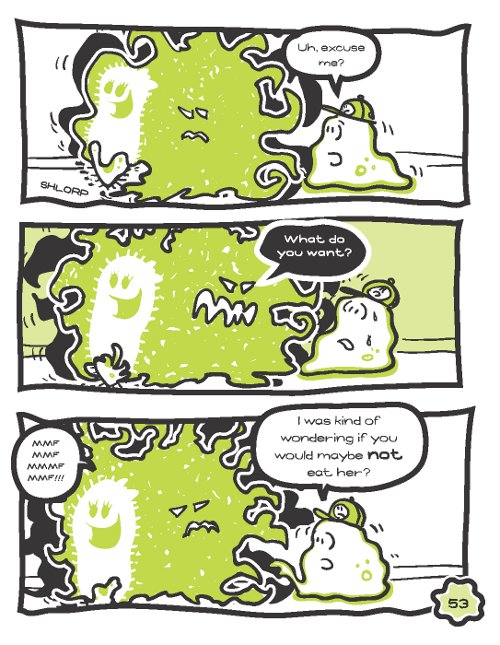
In
this volume, Squish, Peggy, and Pod have to deal with the school bully Lynwood
who threatens to devour Peggy if Squish doesn’t let him cheat off of his
science test. As squish wrestles with
this moral dilemma, Super Amoeba’s poster stares back at him as Super Amoeba
says, “Have the courage to do what’s
right!” Thanks to conviction and sheer luck, Lynwood is taken care of by
the end of the book. The “Fun Science Project with Pod” is how to grow mold,
and after that have some fun learning how to draw Squish.
 |
| Squish by Jennifer and Matthew Holm, Random House |
Squish #2: Brave New
Pond begins with Super Amoeba reading his Small Pond Gazette with the headline “A
Hero is Born” (with some nice foreshadowing) and introduces a brand new school
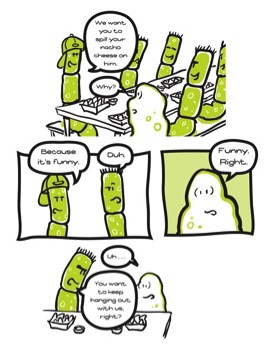
year for Squish. Squish is hoping for a “fresh start” and has made a list of
what he wants to accomplish: no trading food with Pod, no detention, not
letting Peggy embarrass him, getting picked for kickball, sitting with the cool
kids at lunch, and simply being cool. While things, unfortunately, start off a
bit rocky for Squish (he gives in to Pod’s mooches for starters), he does get
to sit with the “cool Algae Brothers.” Super Amoeba is also starting the year
with some “friends” in the Big City as they battle LEECHES, but things rarely
turn out the way you think! This book is all about what makes a real hero, and
how the pressure to be cool might make you do things that really aren’t cool at
all. The “Fun Science Project with Pod” is how to make slime, and after that,
have some fun learning how to draw the Algae Brothers.
 |
| Squish by Jennifer and Matthew Holm, Random House |
Squish #3: The Power
of the Parasite takes place in the summer. Squish’s mom signs him up for swim lessons in
the hope that he’ll overcome his fear of swimming, while Pod and Peggy go to
ballet camp. At the pool, Squish meets a new friend, Basil, a hydra whose
tentacles can paralyze living things, and Super Amoeba finds himself a sidekick
named Parasite…or does he? Squish and Basil both find ways to not get into the
water and still have fun, but in doing so things get out of hand. In this
issue, both Super Amoeba and Squish have to figure out how far they will let a
friend go, when they know that the friend is wrong. The “Fun Science Project with
Pod” is all about how to “teach” an egg to swim, and after that, have some fun
learning how to draw Basil.
Squish #4: Captain
Disaster is all about what being a leader
means. In this particular issue, Squish
must learn what it means to be the Captain of his soccer team (trying to
observe his players and help them play to their strengths), and how to balance
the thrill of winning with the need to keep the game fun. Meanwhile, Super Amoeba has to find more
effective ways of fighting Worms and tries the enlist the help of an old friend
while teaching his fans that “Small Pond needs to remember that every hero has
a part to play.” The “Fun Science Project with Pod” is an experiment on air
pressure, and after that, have some fun learning how to draw Pod.
Squish #5: Game On - Squish becomes soccer captain and has to balance the responsibility of bringing in wins with having fun and allowing all kids to play and enjoy the game.
Squish #6: Fear the Amoeba (Going
on Sale July, 2014)
Throughout the Squish
series, Jennifer and Matthew Holm relate:
·
What it takes to be a hero;
·
How to juggle your dreams with the realities
facing you;
·
How to overcome and face your fears;
·
The importance of friendship and of standing up
for your friends;
·
The struggle of trying to fit into social
groups;
·
The struggle of knowing and doing what is right;
FUN SCIENCE FACTS
PACKED IN ISSUES 1-4: While these books are pure fiction and tons of fun,
there is some science packed into them.
Part of the fun is learning to distinguish the fact from the fiction,
which I discuss in greater detail below. I want to relay here, however, what
students will learn about the intriguing world of microscopic organisms.
In Squish
#1: Super Amoeba readers learn:
·
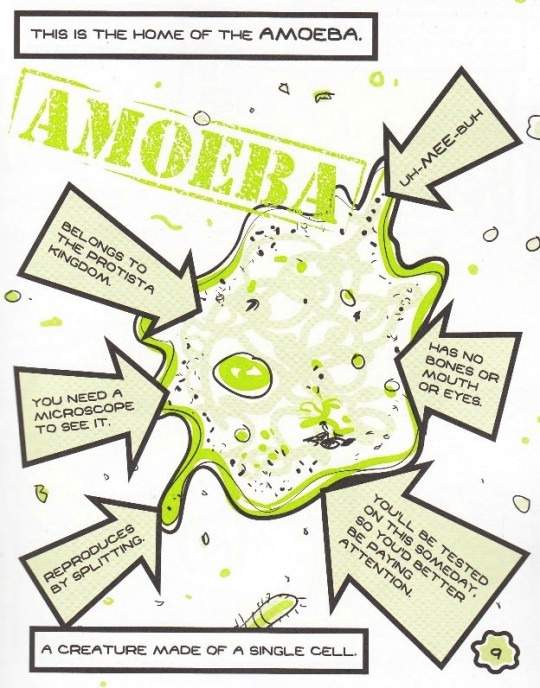
That amoebas belong to the Protista kingdom, are
single-cells, microscopic, reproduce by splitting, come in all shapes and
sizes, and move using pseudopods;
·
That planaria are flatworms;
·
That photosynthesis is the process by which
plants turn sunlight into sugar;
·
That E. Coli, bacteria, slime mold, and algae
are also microorganisms found in a pond;
 |
| Squish by Jennifer and Matthew Holm, Random House |
In Squish
#2: Brave New Pond readers learn:
·
That paramecia don’t like negative stimuli;
·
That planaria can regenerate when cut in half;
·
That protozoans are single-celled microscopic
organisms that live in water; and
·
That algae live in ponds and are “the coolest
microorganisms in the pond” because they produce oxygen;
In Squish
#3: The Power of the Parasite readers
learn:
·
That hydras are also microorganisms found in
ponds;
·
That hydra have tentacles that can paralyze
living things and can grow/regenerate body parts;
In Squish
#4: Captain Disaster readers learn:
·
That a cyclops is a crustacean (related to
shrimp and lobster), and that they have one eye;
·
That instead of hands and feet, paramecia use
cilia to move;
TEACHING/DISCUSSION
SUGGESTIONS:
Plot, Themes, and
Values Related: Chart and discuss the different themes relayed
(i.e. friendship, identity, popularity, being a "winner" see above) in each of the books.
· Read about and discuss the microorganisms found in
ponds.
·
The insides of Pod, Peggy and Squish are green (indicating
nuclei and other cell structures). Talk about what is really found inside amoebas - see links below for resources.
·
Evaluate and analyze science facts from science
fictions.
·
Assign a creative writing project where kids
can take “Something to Research Further” from the table above, and create their
own stories around it. Discuss their use
and balancing of fact and fiction in their stories. You may also want to
brainstorm and have them create their own sequels integrating science facts and
fictions.
·
You may want to discuss and focus on the
following science topics found in the Squish series: global warming, photosynthesis, regeneration, role of slime in ponds, and different microorganisms found in ponds.
Modes of Storytelling and Visual
Literacy
In graphic novels, images are used to relay messages with
and without accompanying text, adding additional dimension to the story. Compare
and contrast the authors’ use of verbal versus visual imagery. Discuss with
students how images can be used to relay complex messages. For example:
·
As noted above, there are various voices telling
the Squish story. Discuss how the
authors use art and text to help distinguish between the different voices and
stories.
·
Evaluate and discuss how the authors relay
scientific information versus while keeping the story light, interesting and
funny.
·
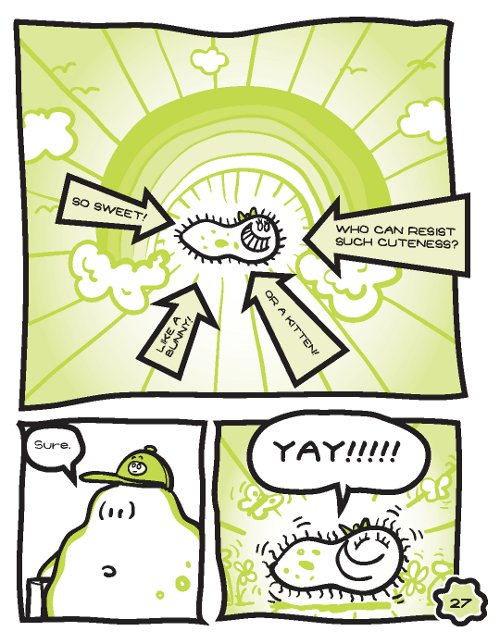
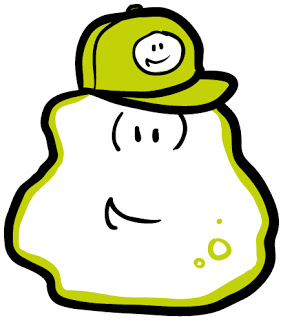
Squish’s hat has awesome ‘powers’ – the face on
the front changes with Squish’s moods and obstacles. Discuss how this helps relay information and
cues for the reader. Is it helpful or
distracting? Why/why not?
 |
| Squish by Jennifer and Matthew Holm, Random House |
·
Discuss the power of an image and how much it
can relay and foreshadow. For example, in Squish
#3: The Power of the Parasite, p. 12, evaluate and discuss how Parasite is
relayed in the top image versus how he is relayed in the bottom one. Are the authors trying to tell us
something? If so, what?
Suggested Prose and
Graphic Novel Pairings
For greater discussion of literary style, and non-fiction
texts you may want to read the following suggestions with Squish:
·
Babymouse by
Jennifer and Matthew Holm: a series about a spunky young mouse who, like Squish
deals with real-life issues such as friendship, following one’s dreams, dealing
with defeat and challenges in and out of school, and about embracing one’s
strengths and weaknesses.
·
Protozoans, Algae & Other Portists by Steve Parker – a great nonfiction book for kids
with fascinating images and details.
·
Astronaut
Academy by Dave Roman: a graphic novel series about kids who go to school
in space. When pairing this with Squish
you may compare and contrast the author’s incorporation of science (space)
facts and fictions. You may also want to compare/contrast their use of image
and text, character development, and themes.
·
Diary of a
Wimpy Kid by Jeff Kinney: a series about life for Greg Heffley and his
friends in middle school as told by him and his journal entries. You may want
to compare/contrast the story telling in his illustrated prose book with its
movie and/or with the graphic novels suggested above.
·
Pippi
Longstocking by Astrid Lindgren: about Timmy, his sister Annika and the
adventures they take with Pippi. Their stories feel like exaggerated tales,
much like Squish’s and can be excellent pairings regarding storytelling and
character development.
·
Charlottes
Web by E.B. White: a classic about a talking pig who befriends a literate
spider. Here too, there are some animal
facts and fictions to compare and contras
ADDITIONAL RESOURCES:
·
Guide to
identification of fresh water microorganisms – a wonderful chart with
images, characteristics, and taxonomies for fresh water organisms including
algae, protozoa, plankton, and arthropods.
Excellent resource to use when reading Squish.
·
Growing with Science blog post “Exploring
the Protists with Squish: Super Amoeba” with a slew of wonderful images and
facts about amoebozoans, slime molds, ciliates (paramecium), and planaria;
videos highlighting these microscopic organisms; and related science activities
(“grow bread mold,” “hay infusion,” and “purchase protozoan cultures,”
·
http://www.microscope-microscope.org/applications/pond-critters/pond-critters.htmPond
Water Critters and what they look like with a microscope; with additional
links.
·
Science
games for kids: microorganisms – information on microorganisms and games to
see them at work under a ‘microscope’.
·
Microorganisms for Kids (from
NeoK12) – explains what microorganisms are, how they are classified, where
they are found/ has pictures and suggestions for school presentations; has
videos and Lesson plans; and lots of games.
·
http://science.lotsoflessons.com/pondlife.htmlLesson
plans for teachers on pond life, pond scum, biodiversity of ponds, along with
games for kids.
·
Kid’s
Biology: Amoebas – animal facts and links all about amoebas
·
Britannica
Kids: Hydra – excellent information and links.
·
http://animal.discovery.com/worms/planarian-info.htm
- all about planaria
Well, that's it for this week. Please tell me what you think of amoebas, Squish or pond scum (one of my son's favorite topics a few years back....)
And, as always, thanks for your visit.


