Showing posts with label Squish. Show all posts

Sunday, January 12, 2014

Amoebas Galore!!!! And Tons of Fun...


“Earth. Our planet hosts a rich diversity of life…from lush rain forests to dry deserts. Bun underneath this world lies another one. A microscopic world. This is the home of the amoeba...” - Jennifer and Matthew Holm, Squish (Random House) pp.7-9
So begins the adventures of Squish and his friends, Pod and Peggy (two amoebas and a paramecium) in their microscopic world of Small Pond. This month, at Using Graphic Novels In Education, I take a closer look at Squish, written by Jennifer and Matthew Holm, (Random House), reviewing it and making suggestions for the first four books.  Here are some of the highlights:
Squish1
Squish by Jennifer and Matthew Holm, Random House
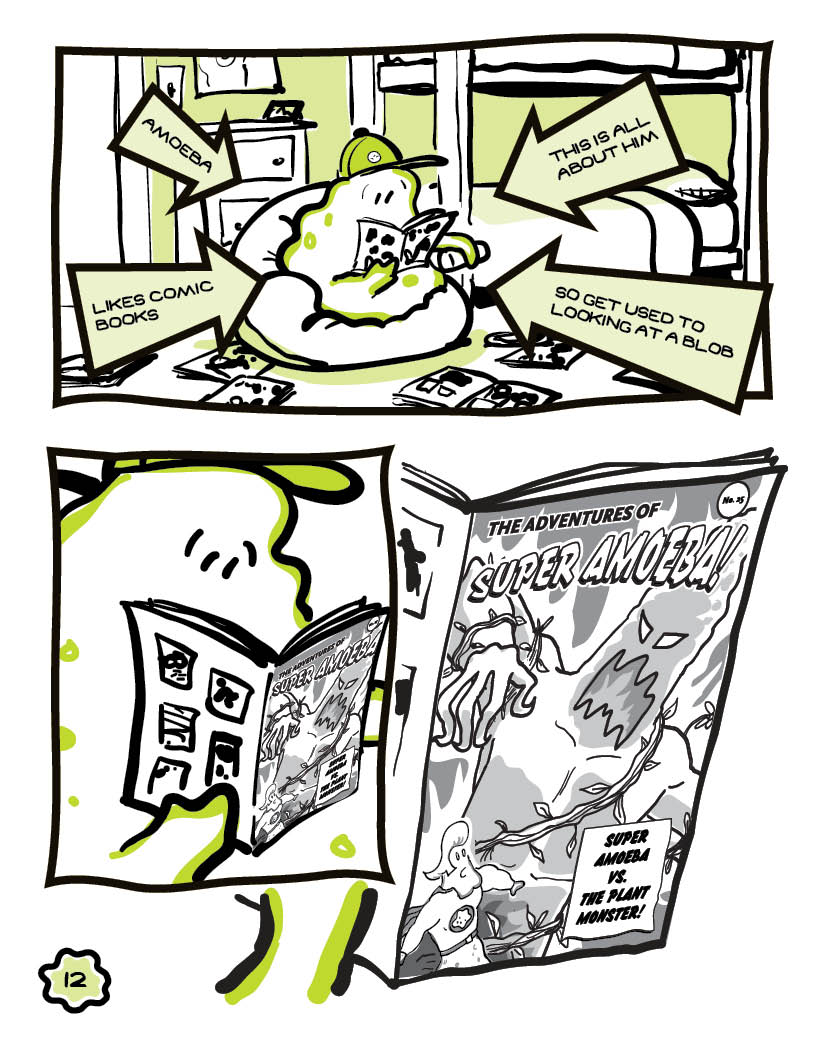
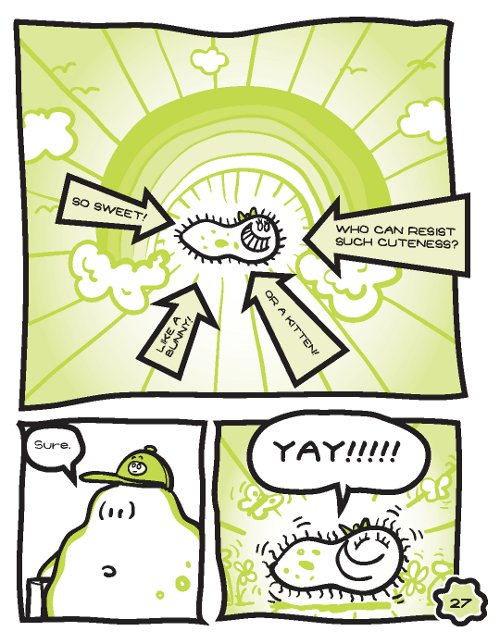
Squish is a comic book-loving, Twinkie-eating, blubbery, super-swell amoeba “kid” who wrestles with good and evil in life around him, and learns about life’s responsibilities. He faces all sorts of challenges with his friends Pod (a nerdy, mooching amoeba who’s always working on some lay-brained science scheme to help him tame his world), and Peggy (a clueless, huge-hearted, super-sweet, happy-go-lucky loving paramecium). In the first four books they face challenges in school, summer camp, soccer games, and much more. While Squish is a beloved series in its own right, he was first brought to life and introduced in Babymouse #14: Mad Scientist  (another award-winning series by Jennifer and Matthew Holm about a spunky young mouse).
We highlight Squish this month because it’s a WONDERFUL series full of fun, humor, and real-life problems facing middle school “microorganism kids.” And while each volume is under 100 pages and geared for kids ages 7-12, they will be enjoyed by older readers as well with their compelling themes and sharp sophisticated humor. These endearing pond-dwelling microorganisms deal with issues of friendship, bullies, overcoming fears, and learning that doing the right thing is one of life’s greatest challenges (and rewards)- whether you’re a superhero like Super Amoeba, or a plain kid like Squish.

SERIES SUMMARY

Squish’s volumes are packed with puns, alliteration, wordplay, humor, and hyperbole. In each book, Squish and his friends deal with real-life conflicts (handled with insight and compassion), issues of right and wrong, and the power and value of friendship. Furthermore, as Squish is an avid Super-Amoeba comic book fan, each issue contains a parallel Super Amoeba comic book story, adding greater depth, humor, and insight. As an added bonus, at the end of each book there’s a cool “Fun Science Project with Pod” along with guidelines on how to draw one of the characters.  Finally, the visually literate and the visually challenged can all have fun following the many faces on Squish’s baseball cap that change with his mood and given situation.

Squish #1: Super Amoeba introduces Squish, his (supportive but seemingly useless) dad, and Squish’s favorite comic book character, Super Amoeba.  In this volume, we also meet Squish’s best friends Pod and Peggy, the principle of their school, Principle Planarian, and Peggy’s pet “Fluffy” an ever-growing slime mold. 
squish3
Squish by Jennifer and Matthew Holm, Random House
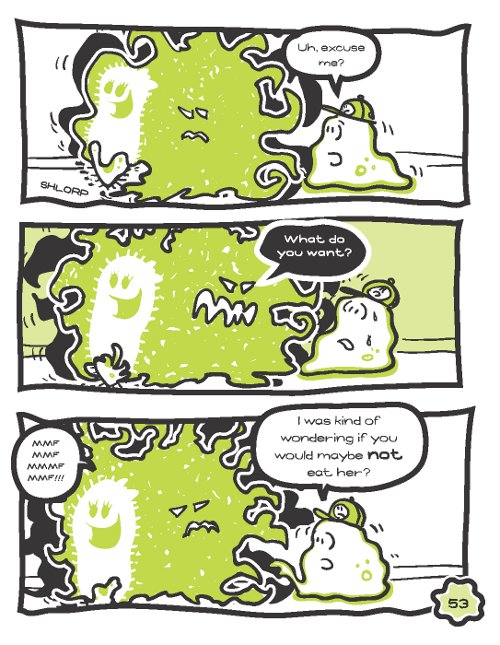
Pod is a science genius who mooches off of Squish – getting Squish to give him his lunch money for Tacos (or his Twinkies) while Squish ends up with Pod’s vile lunch. Peggy is a super-cute, super-clueless, super-sweet, supportive friend who unwittingly gets Squish into trouble. 

In this volume, Squish, Peggy, and Pod have to deal with the school bully Lynwood who threatens to devour Peggy if Squish doesn’t let him cheat off of his science test.  As squish wrestles with this moral dilemma, Super Amoeba’s poster stares back at him as Super Amoeba says, “Have the courage to do what’s right!” Thanks to conviction and sheer luck, Lynwood is taken care of by the end of the book. The “Fun Science Project with Pod” is how to grow mold, and after that have some fun learning how to draw Squish.
squish4
Squish by Jennifer and Matthew Holm, Random House
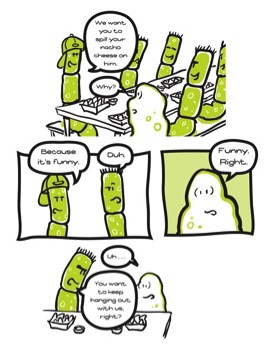
Squish #2: Brave New Pond begins with Super Amoeba reading his Small Pond Gazette with the headline “A Hero is Born” (with some nice foreshadowing) and introduces a brand new school year for Squish. Squish is hoping for a “fresh start” and has made a list of what he wants to accomplish: no trading food with Pod, no detention, not letting Peggy embarrass him, getting picked for kickball, sitting with the cool kids at lunch, and simply being cool. While things, unfortunately, start off a bit rocky for Squish (he gives in to Pod’s mooches for starters), he does get to sit with the “cool Algae Brothers.” Super Amoeba is also starting the year with some “friends” in the Big City as they battle LEECHES, but things rarely turn out the way you think! This book is all about what makes a real hero, and how the pressure to be cool might make you do things that really aren’t cool at all. The “Fun Science Project with Pod” is how to make slime, and after that, have some fun learning how to draw the Algae Brothers.


Squish5
Squish by Jennifer and Matthew Holm, Random House
Squish #3: The Power of the Parasite takes place in the summer.  Squish’s mom signs him up for swim lessons in the hope that he’ll overcome his fear of swimming, while Pod and Peggy go to ballet camp. At the pool, Squish meets a new friend, Basil, a hydra whose tentacles can paralyze living things, and Super Amoeba finds himself a sidekick named Parasite…or does he? Squish and Basil both find ways to not get into the water and still have fun, but in doing so things get out of hand. In this issue, both Super Amoeba and Squish have to figure out how far they will let a friend go, when they know that the friend is wrong. The “Fun Science Project with Pod” is all about how to “teach” an egg to swim, and after that, have some fun learning how to draw Basil.

Squish #4: Captain Disaster is all about what being a leader means.  In this particular issue, Squish must learn what it means to be the Captain of his soccer team (trying to observe his players and help them play to their strengths), and how to balance the thrill of winning with the need to keep the game fun.  Meanwhile, Super Amoeba has to find more effective ways of fighting Worms and tries the enlist the help of an old friend while teaching his fans that “Small Pond needs to remember that every hero has a part to play.” The “Fun Science Project with Pod” is an experiment on air pressure, and after that, have some fun learning how to draw Pod.

Squish #5: Game On - Squish becomes soccer captain and has to balance the responsibility of bringing in wins with having fun and allowing all kids to play and enjoy the game.
 
Squish #6: Fear the Amoeba (Going on Sale July, 2014)

Throughout the Squish series, Jennifer and Matthew Holm relate:
·      What it takes to be a hero;
·      How to juggle your dreams with the realities facing you;
·      How to overcome and face your fears;
·      The importance of friendship and of standing up for your friends;
·      The struggle of trying to fit into social groups;
·      The struggle of knowing and doing what is right;
FUN SCIENCE FACTS PACKED IN ISSUES 1-4: While these books are pure fiction and tons of fun, there is some science packed into them.  Part of the fun is learning to distinguish the fact from the fiction, which I discuss in greater detail below. I want to relay here, however, what students will learn about the intriguing world of microscopic organisms.
In Squish #1: Super Amoeba readers learn:
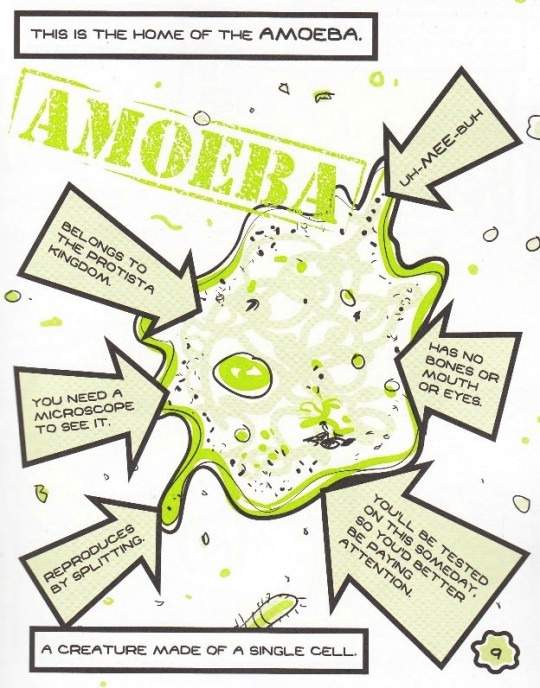
·      That amoebas belong to the Protista kingdom, are single-cells, microscopic, reproduce by splitting, come in all shapes and sizes, and move using pseudopods;
·      That planaria are flatworms;
·      That photosynthesis is the process by which plants turn sunlight into sugar;
·      That E. Coli, bacteria, slime mold, and algae are also microorganisms found in a pond;
squish7
Squish by Jennifer and Matthew Holm, Random House
In Squish #2: Brave New Pond readers learn:
·      That paramecia don’t like negative stimuli;
·      That planaria can regenerate when cut in half;
·      That protozoans are single-celled microscopic organisms that live in water; and
·      That algae live in ponds and are “the coolest microorganisms in the pond” because they produce oxygen;

In Squish #3: The Power of the Parasite readers learn:
·      That hydras are also microorganisms found in ponds;
·      That hydra have tentacles that can paralyze living things and can grow/regenerate body parts;

In Squish #4: Captain Disaster readers learn:
·      That a cyclops is a crustacean (related to shrimp and lobster), and that they have one eye;
·      That instead of hands and feet, paramecia use cilia to move;

TEACHING/DISCUSSION SUGGESTIONS:
Plot, Themes, and Values Related: Chart and discuss the different themes relayed (i.e. friendship, identity, popularity, being a "winner" see above) in each of the books.
Science in Squish
·      Read about and discuss the microorganisms found in ponds.
·      The insides of Pod, Peggy and Squish are green (indicating nuclei and other cell structures). Talk about what is really found inside amoebas - see links below for resources.
·      Evaluate and analyze science facts from science fictions.
·      Assign a creative writing project where kids can take “Something to Research Further” from the table above, and create their own stories around it.  Discuss their use and balancing of fact and fiction in their stories. You may also want to brainstorm and have them create their own sequels integrating science facts and fictions.
·      You may want to discuss and focus on the following science topics  found in the Squish series: global warming, photosynthesis, regeneration, role of slime in ponds, and different microorganisms found in ponds.


 Modes of Storytelling and Visual Literacy
In graphic novels, images are used to relay messages with and without accompanying text, adding additional dimension to the story. Compare and contrast the authors’ use of verbal versus visual imagery. Discuss with students how images can be used to relay complex messages. For example:
·      As noted above, there are various voices telling the Squish story.  Discuss how the authors use art and text to help distinguish between the different voices and stories.
·      Evaluate and discuss how the authors relay scientific information versus while keeping the story light, interesting and funny.
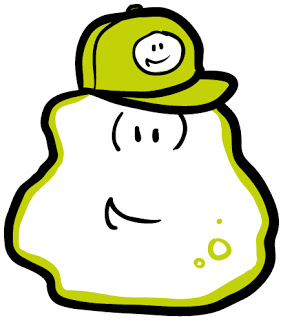
·      Squish’s hat has awesome ‘powers’ – the face on the front changes with Squish’s moods and obstacles.  Discuss how this helps relay information and cues for the reader.  Is it helpful or distracting?  Why/why not?
squish8
Squish by Jennifer and Matthew Holm, Random House
·      Discuss the power of an image and how much it can relay and foreshadow. For example, in Squish #3: The Power of the Parasite, p. 12, evaluate and discuss how Parasite is relayed in the top image versus how he is relayed in the bottom one.  Are the authors trying to tell us something?  If so, what?


Suggested Prose and Graphic Novel Pairings
For greater discussion of literary style, and non-fiction texts you may want to read the following suggestions with Squish:
·      Babymouse by Jennifer and Matthew Holm: a series about a spunky young mouse who, like Squish deals with real-life issues such as friendship, following one’s dreams, dealing with defeat and challenges in and out of school, and about embracing one’s strengths and weaknesses.
·      Protozoans, Algae & Other Portists by Steve Parker – a great nonfiction book for kids with fascinating images and details.
·      Astronaut Academy by Dave Roman: a graphic novel series about kids who go to school in space. When pairing this with Squish you may compare and contrast the author’s incorporation of science (space) facts and fictions. You may also want to compare/contrast their use of image and text, character development, and themes.
·      Diary of a Wimpy Kid by Jeff Kinney: a series about life for Greg Heffley and his friends in middle school as told by him and his journal entries. You may want to compare/contrast the story telling in his illustrated prose book with its movie and/or with the graphic novels suggested above.
·      Pippi Longstocking by Astrid Lindgren: about Timmy, his sister Annika and the adventures they take with Pippi. Their stories feel like exaggerated tales, much like Squish’s and can be excellent pairings regarding storytelling and character development.
·      Charlottes Web by E.B. White: a classic about a talking pig who befriends a literate spider.  Here too, there are some animal facts and fictions to compare and contras

ADDITIONAL RESOURCES:
·      Guide to identification of fresh water microorganisms – a wonderful chart with images, characteristics, and taxonomies for fresh water organisms including algae, protozoa, plankton, and arthropods.  Excellent resource to use when reading Squish.
·      Growing with Science blog post “Exploring the Protists with Squish: Super Amoeba” with a slew of wonderful images and facts about amoebozoans, slime molds, ciliates (paramecium), and planaria; videos highlighting these microscopic organisms; and related science activities (“grow bread mold,” “hay infusion,” and “purchase protozoan cultures,”
·      http://www.microscope-microscope.org/applications/pond-critters/pond-critters.htmPond Water Critters and what they look like with a microscope; with additional links.
·      Science games for kids: microorganisms – information on microorganisms and games to see them at work under a ‘microscope’.
·      Microorganisms for Kids (from NeoK12) – explains what microorganisms are, how they are classified, where they are found/ has pictures and suggestions for school presentations; has videos and Lesson plans; and lots of games.
·      http://science.lotsoflessons.com/pondlife.htmlLesson plans for teachers on pond life, pond scum, biodiversity of ponds, along with games for kids.
·      Kid’s Biology: Amoebas – animal facts and links all about amoebas
·      Britannica Kids: Hydra – excellent information and links.
·      http://animal.discovery.com/worms/planarian-info.htm - all about planaria
squish10
Well, that's it for this week.  Please tell me what you think of amoebas, Squish or pond scum (one of my son's favorite topics a few years back....)
And, as always, thanks for your visit.

Monday, July 16, 2012

Anti-Heroe's...Is it Time for Superman to Roll Over?

The San Diego Comi-con 2012 is over and it was an awesome event and my panel "Transforming Graphic Novel Readers into Graphic Novel Writers" was a blast! Leading kids/adult graphic novelists Jenni and Matt Holm (Babymouse  and Squish),  Jimmy Gownley (Amelia) and Joe Kelly (I Kill Giants, Superman vs. The Elite, Ultimate Spider-Man, and many more) all spoke about tools and skills they needed to successfully publish their works and gave suggestions for aspiring graphic novelists. Educators Katie Monnin, PhD., and James Bucky Carter, PhD., related how education can help. What sticks out most is that:
  • Written work is rarely successful the first draft, or even the first try.  NEVER get discouraged.  Just stay open to constructive criticism and constant editing;
  • Structure is really important in writing graphic novels.  Writers/illustrators must structure the story, the panels, the pages, and they must structure their working time and day;
  • Panelists agreed that developing 'real' characters was the trick to successful work and readers must be able to relate to them;
  • While writing the story is important, equally important is being able to 'lay out the story' so art, text and panels flow smoothly.
  • Classroom attention should be directed not only to literacy building (both visual and verbal literacy), but to teaching executive functions such as structure and organization, attention to detail, and the encouragement of creativity and creative alternatives.
We also discussed the changing role of 'hero' in popular culture, and how the anti-hero is growing in importance and popularity. The big question which was posed by Joe Kelly years ago and developed in his new film, Superman vs. The Elite:   
  •  Is Superman out of date? Has his role of super-hero been replaced by awesome but ego-centric, crime-fighting anti-heroes?
  • Why is it that we frequently ask about  Superman's place in our culture today, but Spidey, Batman ("The Dark Knight"), XMen, and so many other superheroes' 'potency' in our world of fantasy and fiction are rarely questioned?
According to http://en.wikipedia.org/wiki/Antihero
In fiction, an antihero[1] (sometimes antiheroine as the feminine) is generally considered to be a protagonist whose character is an "everyman" type of character, in contrast to the larger-than-life qualities of an archetypal hero. The term dates to 1714,[2] although literary criticism identifies the term in earlier literature...[3]
Unlike traditional heroes, antiheroes are not as fabulous as the traditional ones. They may be corrupt, oppressive, etc., or may merely have no unusual qualities whatsoever (the common definition). They are not villains but not necessarily heroes. They may do bad things but are not evil. They may fight villains, but not for the reason of justice, or if it is for the cause of justice will take an "ends justify the means" stance. Their actions are motivated by their own personal desires, such as revenge. 

In my teaching (and as a parent) I have found that kids do like heroes.  They like heroes such as Harry Potter .... but, they also enjoy villains.

But by age 12, I think something happens, young adults today, in my experience, actually are drifting more towards the anti-heroes.  The Twilight characters, Hunger Games, are full of anti-heroes. Furthermore we love Spidy and Batman who are vigilates - who take punishing crime into their own hands and have no qualms about murdering 'the bad guys' without trial by jury. For further thought and discussion, please leave your opinions in the comments and go watch Joe Kelly's Superman vs. The Elite which addresses this question with grace and humor, action and reflection.

Joe Kelly's Superman vs. The Elite, which came out last month and is available on Blue Ray  and streaming on the web. It puts the question of hero vs. anti-hero out in the open for full question and evaluation. He empowers Superman to wrestle with his goody-two-shoes image and enables him to rise as a more modern but true-to-self hero.

To whet your taste buds, here's a super interview with Joe Kelly - a truly AWESOME superhero in my humble opinion - who claims his work is dark, while I find it wonderfully empowering and uplifting:
And, a trailer...
As a leaning optimist, I'd like to think Superman and true-blooded "good" heroes are not dead.  And, while some flaws are essential to make them real, I believe that not only is there a place for these role models, there is a vital need for them.  I find so many of us floundering in lives of  cynicism, frustrated with our leaders, with politics and economics and need the larger-than-life fluffy role models to aspire to.... That's my take...what's yours?
Both the interview and the film are well worth the visits and views and I'd love to hear what you think about them and the changing role of today's super-heroes.  Please leave your views and takes on this subject (and tell us who your favorite heroes/anti-heroes are) in the comments.
Thanks for the visit, please come again!


Thanks for

Tuesday, May 24, 2011

Science Fiction: Skills, Chills, and Thrills it Offers our Kids

I discovered science fiction in my teens, but it was as a parent and teacher that I realized how rich this genre is in creative opportunities. Science fiction reflects scientific thinking of the time period in which it is/was written, and has proven a rich springboard for future research.

Skills and Thrills it Offers Our Kids: Science fiction weaves story lines with real or imagined innovations in science and/or technology, often commenting and exploring the consequences of such innovations.  It is an exercise in alternative possibilities.  And, as my last post was on reasoning, this seems like a logical follow up.  Science fiction presents options, possibilities, and alternatives - encouraging its audience to brainstorm, imagine, and analyze technologies while offering scintillating scenarios and satisfying reads.

Ender's Game, Asimov's Foundation trilogy, Flatlands and Dune were the classics that hooked me.  What were/are yours? Here are some examples of how you and your child can 'depart' science fiction texts while sharpening reasoning and abstract thinking:

Squish #1Squish: Super Amoeba (by Jennifer & Matt Holm [authors of Babymouse].  Random House, 2011- grades 2-5). Squish is a graphic novel about amoebas Squish and Pod and their friend Peggy a paramecium- as they navigate school,  Principal Planaria, deal with bullies and dream of superheroes and "doing what's right." The book presents wonderful twists and lessons on single-celled organisms with humor and sensitivity.
Text-departing discussions: How do the characters move and propel themselves on different types of surfaces? What happens if the floors are polished, wet, or dirty? What kind of sports might Squish, Pod, and Peggy play? What might life in school be like if other single celled organisms were there?  How do single-celled organisms actually fight other single-celled organisms in our bodies or on our desk tops? Talk about social issues in school.


2095 (Time Warp Trio)2095 - Time Warp Trio (book #5) (by Jon Scieszka - grades 2-5) is about three boys who while on a school field trip to the American Museum of Natural History, contemplate life in New York City in 2095. With the help of Uncle Edward's magic book, they find out, meeting new and old relatives and strange ironies and alternatives.
Text-departing science related discussions: Explore where science technology and space / time travel.  Talk about what life in New York City or in your neighborhood might be like in 100 or 1000 years? What might change and what, if anything, would remain the same? Discuss the paradoxes of time travel.  How might seeing the future effect the boys' life when they return?  Might they change history and the time line story as a result of knowing the future? Below are some interesting time travel links you can watch and discuss with your kids.

Mrs frisby and the rats of nimh.jpgMrs. Frisby and the Rats of NIMH  (by Robert C. O'Brien - grades 3-8) relates how Mrs. Frisby seeks the aid of a group of former laboratory rates in rescuing her home from destruction by a farmer's plow.  It also relates the rats' escape story and how these rats can read, write, and operate the technology and machines they've developed. 
Text-departing science related discussions: What are the ethical issues (pros and cons) of animal rights and medical research? How do animals communicate and might they have their own languages? How do animals of different species cooperate with each other for survival? Research rat facts. You may also want to check out these sites for lesson plans and games:http://www.mrsdell.org/nimh/; http://library.thinkquest.org/J002079F/; http://www.kyrene.org/schools/brisas/sunda/mrs_frisby/home.htm

WrinkleInTimePBA1.jpg
A Wrinkle in Time (by Madeleine L'Engle - grades 4-8) is about teenager Meg Murry, who is transported through a "tesseract" (a fifth-dimensional wrinkle in time) with her younger brother Charles Wallace and friend Calvin O'Keefe to rescue her father (a gifted scientist) from evil forces holding him captive on another planet.  These three kids learn from Mrs. Whatsit (a celestial being who can read Meg's thoughts), Mrs. Who and Mrs. Which that the universe is threatened by "The Dark Thing" which has taken the form of a giant cloud and engulfed the stars around it.  Several planets have already succumbed to its evil force. The three Mrs. W.'s transport the three kids through time and space, and their search for Mr. Murry begins.
Text-departing science related discussions: Discuss time /space travel and the paradoxes it presents (see the links below). Einstein postulated (and it has now been proven) that when objects fly in space - time passes much slower.  Given this, what would happen in real life to Meg, Charles Wallace and Calvin's relationships with the friends they left behind (who would be much older upon their return)?  What about their relationship with Mr. Murry - would he be older/younger than the kids? Here is a link with lesson plans: http://drb.lifestreamcenter.net/Lessons/Wrinkle/index.htm

Flatland cover.jpgFlatland (by Edwin A. Abbott, 1884 grades 6+) In Flatland, women are simple line segements, men are regular polygons and the narrator is a square.  The square has a dream about a visit to a one-dimensional world (Lineland) inhabited by "lustrous points" and attempts to convince these points that a second dimension exists. Then one day a three-dimensional sphere passes through Flatland and shakes the narrator's world as it tries to convince him of a three-dimensional world.  The square is convinced only after he is transported to Spaceland and together he and the sphere contemplate life in a fourth dimension (and more). This book has sparked tremendous thought and scientific research since it's publication in 1884.  And, while it's fun for for middle schoolers, I recommend revisiting it in high school as well to further appreciate the mathematical, scientific and philosophical issues it offers. The first read will spark their interest and imagination.  The later read can be used when studying higher levels of math and physics.
Text-departing science related discussions: Discuss what life might look like in two dimensions.  Try to imagine what the fourth or fifth dimensions might look and feel like.  Discuss what different threats or dangers exist in worlds of other dimensions.  What might a vacation be like in a two or four dimensional world?  What might you study in school in a two or four dimensional world?

Tribes:  The Dog Years (by Michael Geszel & Peter Spinetta, ary by Inaki Miranda  - grades 11+ for some violence and the fact that one tribe of kids are cannibals) This is a brilliantly illustrated graphic novel about life on earth after a medical lab's research goes terribly wrong.  The story opens in the year 2038 to a world recoiling from a nano-tech virus that reduced himan life span to 21 years. In 2038, civilization is organized in tribes.  This is a story of life in 2038 and the promise of a cure.  I think it is an excellent companion to Mary Shelley's Frankenstein as it makes a powerful statement about the responsibilities of medical research.  Please see my blog "My Jaunt at C2E2 2001..Departing the Text:  Teaching Inference with Graphic Novels" for details http://departingthetext.blogspot.com/2011/03/my-jaunt-at-c2e2-2011departing-text.html
Text-departing science related discussions: Discuss how science can not only save lives, it can also break them.  Discuss the roles of regulation, research design and the responsibilities of researchers in protecting the population.  Discuss nano-technology today - what it offers and what it promises.


The Science behind and beyond science fiction: 


A Note on Einstien and Time/Space Travel:  Time is not a constant but is changeable.  He suggested that objects objects accelerated at higher speeds would shrink and grow heavier and time would pass slower for these space traveling objects than for those left behind.  As a result, those traveling in space with age much slower than his or her friends and family. This has been proven as fact and is no longer fiction. You might want to discuss these paradoxes with your child when reading time-travel books.

Other highly recommeded classics:
The Giver (by Lois Lowry - grades 5-9) When twelve year old Jonas comes of age, he and his friend recieve 'assignments' for their future.  Jonas is the only one selected to be the receiver of memories shared by "The Giver."   Jonas then discovers the terrible truth about their society.

Ender's Game (by Orson Scott Card - grades 5+)- Ender, a boy who is an expert at simulated war games is recruited by the government for a special space/defense school.  He and others are being trained as soldiers by engaging in war and computer games. But, are they just games?

His Dark Materials Trilogy (by Phillip Pullman- grades 6+)- blends of fastasy, religion and science fiction as Lyra must travel between parallel universes to save her friends and father.

The Foundation Trilogy (Isaac Asimov - grades 9+)