 For those following my blog posts, this is not a repeat or double take (here's a link to my previous post on Volumes 1 and 2). Rust Volume 3 "Death of the Rocket Boy" has just been released and so this post incorporates all three volumes with a summary, links and resources, and teaching suggestions.
I've had the absolute pleasure of reviewing Rust 3: Death of the Rocket Boy before publication and can tell you without reservation that this beautiful story will be a welcome addition to any home or school library/curriculum for middle school readers and older.
 |
| By Royden Lepp (Archaia) |
Series Overview: All three volumes are brilliantly illustrated in sepia tone giving the story a Dust Bowl and post World War I feeling. They are published by Boom! Studios, Archaia Imprint Books in hardcover.
 |
| Rust: Visitor in the Field. Royden Lepp (Archaia) |
The overall story, is about a teen-aged boy, Roman, who was left to care for the family farm after his father was taken to serve in "the war." The farm, like many others, is failing and Roman is desperately trying to survive. One of his solutions has been to reprogram the larger older-generation war robots to do farm/field work. The problem is that after a while these robots seem to go rogue and are therefore dangerous and unpredictable.
Volume 1 Rust: Visitor in the field
is about a teenager, Roman Taylor who, while living in an alternate
world/time, lives in what looks like the Dust Bowl Oklahoma (in an
alternate world) in the 1930's that is recovering from what looks like
World War I. His father was called to war and Roman is struggling to
keep their small farm solvent. Then one day, Jet Jones crash-lands on
the farm. As Roman learns more about Jet, discovering how Jet works and
Jet's past, Roman becomes more hopeful about his future and the welfare
of his family and their farm. So hopeful, that he tends to overlook
nagging questions about Jet that remain unanswered.
When Jet Jones first appears, he is fighting a larger rogue machine. Roman helps Jones defeat the larger drone and secures him as a farm hand helping with the harvest and with rebuilding a disabled Model-C robot (which in turn will add more helping hands on the farm). It is Roman's hope that his younger brother Oswald can return to school now that the robots can help with the farm. Oswald is an observant kid and begins to ask questions of the past, of war, and is questioning who Jet Jones is.
 |
| Rust: Secrets of the Cell by Royden Lepp (Archaia) |
 |
| Rust: Secrets of the Cell. Royden Lepp (Archaia) |
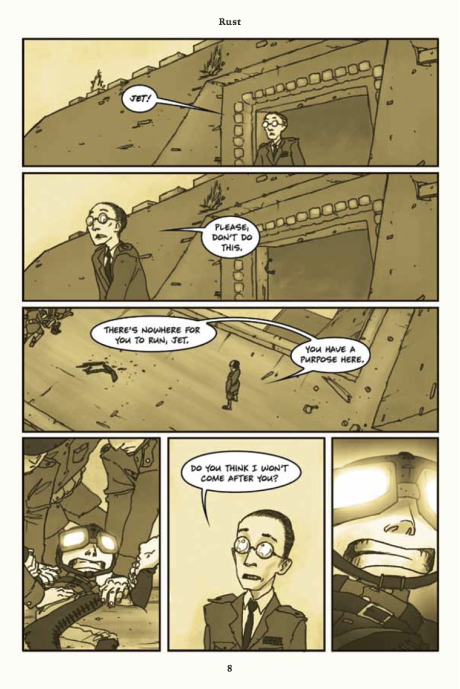
The book opens 48 years in the past where we get a glimpse of Jet Jones as he 'escapes' his past (as seen in the panels above and to the right). Oswald questions Jet Jones' role and motives, and when talking with neighbor (and retired soldier) Mr. Aicot, Oswald learns more about the war, its use of drones and about Models C's and Jet Jones. The story is beautifully layered and is full of intrigue, tension, and heart as we begin to truly question each of the characters, their roles in the farm, in the war, and with each other.
 |
| Death of the Rocket Boy. Royden Leppm (Archaia) |
Classroom Suggestions: As these books are appropriate for all ages, classroom suggestions become more layered. I would recommend that these volumes be used by students grades 4+
For middle-school learners:
 |
| Death of the Rocket Boy. Royden Lepp (Archaia) |
- Discuss what it was like living in Dust Bowl of the 1930's.
- You may want to compare this book to Karen Hesse's Out of the Dust [by Karen Hesse is about a girl, living in the Dust Bowl who suffers a debilitating accident shortly after the death of her mother, and must learn to face life's harsh lessons with patience and grace. This novel is written solely in prose and poetry and the author's use of language is breathtaking].
- You can discuss the different story-telling aspects of prose, poetry and image.]or to the famous and powerful photographs of Dorothea Lange
- Discuss the role of family, responsibility and issues of 'coming of age'
- Discuss the role of heroes vs. anti-heroes
- Chart and/or discuss how Oz, Roman and Jet grow and change over the three volume (to date) series.
- Discuss what it is like being the older sibling, often with more responsibilities and what it is like being a younger sibling who often feels ignored or not listened to.
For high school learners these books might be read when discussing
- War and its effect on families, farms, civilians
- AI - Artificial intelligence: where we are today, its possibilities, the pros and cons of using AI in our daily lives
- Drone warfare
- The changing roles of heroes and anti-heroes
Responsibilities that come with being a teenVisitor In the Field. Royden Lepp (Archaia)

Common Core State Standards that can be addressed when reading these books:
- Key Ideas and Details:
- Recount details;
- Quote accurately from the text when explaining content;
- Compare and contrast character motivations or plot development between the two volumes;
- Discuss the central versus secondary themes;
- In Volume 3, Jet is upset and feels guilty about an accident he caused which resulted in the death of soldiers in the war. Have students discuss/write about how they felt after an accident they hadn't meant to create, and regretted.
- Analyze how particular elements of the story's drama interact, and/or the role of dialogue versus visual story-telling.
- With limited text this may help weak readers, although the limited text also expands inference making as readers must gather their data by analyzing and integrating visual messages along with text.
- Craft and Structure: in this graphic novel, we are experiencing the story as it unfolds from each character's perspective. This is a wonderful tool for teaching the difference betweeen 1st-person and 3rd-person perspectives.
- Compare how this story is told versus other prose stories (you may want to look below at suggested paired readings).
- In Volume 3, on pages 66, Roman tells Jet, "You don't have to live with the choices I make everyday, I do..." Discuss this wonderful use of irony as Roman has no inkling of how Jet is struggling with very similar issues.
- Discuss how flashbacks are created in graphic novels versus how they're created in prose novels.
- Integration of Knowledge and Ideas: interpreting information presented visually and explain how the information contributes to understanding the text (gr. 4), drawing information from multiple print sources (gr. 5), Comparing these books to others on similar topics also falls under the CCSS for this area.
- Compare and contrast this book to other prose books on World War I or the Dust Bowl (see references below).
- In Volume 3, p. 90 Jet's father tells him he has three choices, "You can leave this farm and go find your next oil fix, you can die here and likely lead the government to the Taylor's doorstep. Or you can leave with me. We can try to find the last supercell together..." Create decision trees or have students pick an option and debate and/or convince others of it's merit.
- Roman and Oswald write letters to their father. You might have students write letters to members of their own families who are far away, or you may have them write letters to "Mr. Taylor" from Roman and/or Oswald's perspective (Conventions of Standard English, Knowledge of Language, Vocabulary Acquisition and Use, )
- Have students write a research paper on drone warfare and/or artificial intelligence (Research to Build and Present Knowledge all grades)
- Have students write an opinion piece addressing the pros or cons of using drone warfare (addressing Text Types and Purposes of the CCSS for all grades)
- Range of Reading and Level of Text Complexity -can be addressed when pairing these books with other fiction and non-fiction works about artificial intelligence, the Dust Bowl, and/or drone warfare.
- Have students role play, acting out important parts or decisions of the book (Comprehension and Collaboration)
- Have students present and discuss their research projects (see above) (Presentation of Knowledge and Ideas)
- You may want to introduce, compare and contrast Lepp's images of failed prairie farms to those photographed by Dorothea Lange and others of the 1920's Dust Bowl.
- Lepp creates the world of Rust in simple Sepia tones and yet the battlefields look very different from the farms. Discuss how Lepp does this. Discuss how the farms and battlefields are similar and how they are different.
- While Rust is a beautifully nuanced story, there is limited text. Discuss how Lepp integrates images and text to create the depth and detail of his story. You may also want to discuss Lepp's use of Roman and Oz's letters to their father to help create their characters.
- Throughout the three Rust volumes, Lepp uses focused (and non-focused) panels, texture and shading to add depth and detail to the story (see Volume 3, page 79, for example). Have students chart different examples of how he does this.
- Compare and contrast Dust Bowl images drawn by Mat Phelan in The Storm in the Barn versus Lepp's depiction of the Taylor farm.
Using Rust for Content Area Learning (Math, Science and Social Studies):
- In Vol. 3 on the first page, we see Jet Jones lying unconscious in a crater. Have students create a math word problem to figure out the diameter, circumference, and area of the crater.
- Compare and contrast the images of Lepp's war in his Rust volumes to images found of World War I.
- Compare and contrast the images of Lepp's prairies in his Rust volumes to images found of the 1920's and 30's Dust Bowl.
- In Volume 3, the engineer tells Jet, "Many people died today but possibly so that many more don't have to. This could be the beginning of the end of the war." Discuss how this parallels other catastrophic decisions made throughout our history (for example: the atomic bomb; water-boarding; violation of constitutional rights, experimentation, etc.)
- Research and discuss the pros and cons of the growing drone warfare (from a science as well as a social and/or historical perspective).
- Out of The Dust by Karen Hesse is a beautiful story about fifteen year old Billie Jo and the hardships she faces living (and helping to run) the family's wheat farm in Oklahoma during the dust bowl years of the Depression.
- The Grapes of Wrath by John Steinbeck a story of migrant workers and one family in particular as they travel to California after their farm failed in the dust bowl during the Depression.
- Barefoot Gen by Keiji Nakazawa a (graphic novel) story about the effects of the atomic bomb on Gen, his family and friends after the atomic bomb was dropped (for older readers).
- The Storm in the Barn by Matt Phelan a graphic novel portraying the life of eleven year old Jack who while facing bullies in and out of school, must also deal with the effects of the Dust Bowl in 1937 Kansas.
Additional Resources and Links:
- Background history, videos, articles, photographs and speeches relating to the Dust Bowl http://www.history.com/topics/dust-bowl
- Written accounts and video interviews about life during the Dust Bowl at http://www.livinghistoryfarm.org/farminginthe30s/water_02.html
- Woody Guthrie - history and songs about the Dust Bowl http://www.pbs.org/kenburns/dustbowl/bios/woody-guthrie/
- PBS's Surviving the Dust Bowl
- Dorothea Lange's photographs and background http://www.historyplace.com/unitedstates/lange/index.html
- World War I via http://www.encyclopedia.com/topic/World_War_I.aspx
- PBS's The Great War: The Shaping of the 20th Century
- The Atlantic: World War I in Photos http://www.theatlantic.com/static/infocus/wwi/westernfront1/ (note there is an advertisement before the link will open)
- A multimedia history of World War I http://firstworldwar.com/

Thanks, as always, for your visit.
Please leave your impressions and reactions, or other pairing/lesson suggestions in the comments.


