[SPOILER ALERT: This post will detail how we learn to see and illustrate the power of optical illusions...but if you don't have time for all of it, skip to the final video clip which will blow your minds - at least it blew mine.]
Understanding Optical Illusions and the Power of Visual Literacy:
When learning to see, read, or interact with the world around us, context is integral to understanding. Context helps prime the brain to anticipate what is coming, usually making processing faster and more efficient. We do this all the time with reading. While research now shows that we 'look at' and process each letter as we read, our brains process the shape evaluating "probable' letters and constructing 'probable' words and content. This is why it is so important to preview new materials when teaching. When we our brains 'think' it is one letter or word and it doesn't make sense, more attention is given to the visual cues and reading slows down. Context is also essential when viewing/interpreting images and it is context that creators 'twist' with optical illusions.
Here's how CONTEXT helps us learn how to see:
You can take identical squares and surround them in different colors and they will 'look' different. In this example, the surface color of squares A and B are identical. Cover the seam where squares A and B meet, and you'll see (wait a few seconds for your eyes/brain to adjust).
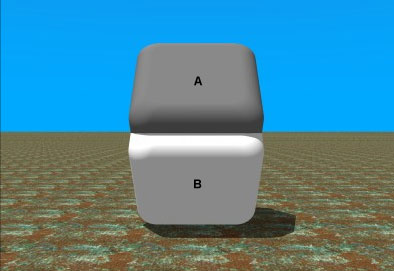 |
| From: http://brainden.com/color-illusions.htm |
- Color Casts Powerful Messages: Learn How to USE it!
- Light Contrast Illusions
- Color Illusions
- Color Context and Simultaneous Contrast
- Beau Lotto: Optical Illusions show how we see
But, there's a lot more to context and learning to see than color cues.
Gestalt theory addresses many of these issues formulating that the unified whole of an object we 'see' is more than the sum of its individual parts. Gestalt theorists originally identified five key principles (and later added a sixth) that influence how we 'see' when we look at images:
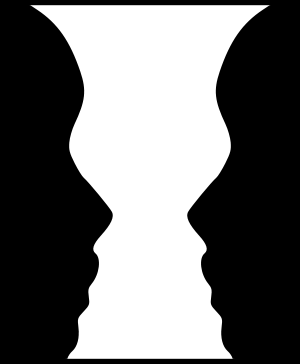
- Figure/Ground - we tend to separate forms in an image, focusing on "dominant wholes" while pushing other parts of the image into the background. We do this with the optical illusion of the "old hag/young woman" for example. In this image we can push the old hag's face and white hair forward or place the young woman's brown hair and hat with feather forward pushing the old hag's features in the background. Camouflage works under this principle as well. The material's meandering lines of mottled-colored patterns disrupt our brains by trying to hide the contour or outline of the body or vehicle.
 |
| From: http://kids.niehs.nih.gov/games/illusions/ |
 |
| From:http://jeffbrew.com/2012/02/26/howto-gestalt-principles-and-photography/ |
- Proximity - we tend to group objects together based on their placement or proximity. So, objects or shapes that are close to one another appear to form groups. Fruit in a bowl is perceived of as "fruit" and not "one banana, one apple, one apple, grapes, one orange, and one more apple." In the example above, the proximity of dots and dark spots become a 'dog':
 |
| From: http://gestalttheorysam.blogspot.com/2011/02/6-principles-of-gestalt-theory.html |
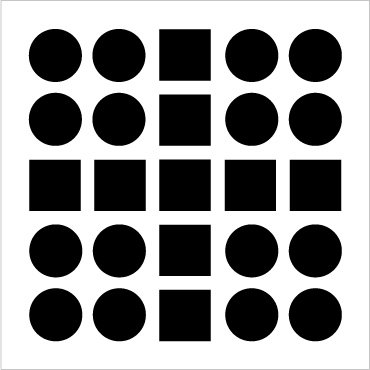
- Similarity - we tend to perceive forms with similar characteristics (size, color, shape, etc.) as a group. The more alike the items are, the more likely they are to form groups. As dissimilar as they are, our minds will conversely resist grouping them together. In the image here, there are two different shapes that are grouped to form a pattern. We group the squares together to form a cross surrounded for four groups of circles. In this case, the square is the figure and the sets of circles are the ground.
- Closure - we tend to 'fill in' information in images which appear incomplete to us. We do this when reading or writing (and unfortunately sometimes when editing): we often won't recognize if letters were missing because we tend or prefer to see words as complete entities and not as individual letters. Scott McCloud (Understanding Comics) discusses how our brains automatically want to make shapes into human (or recognizable) forms. In the image here, we see the swirls of 'people' as a tree because our minds focus more on the continuous 'movement' of the people, and close them into one complete image

- Continuance or Continuity- we tend to continue shapes beyond their ending point as the edge of one shape will continue into the space and meet up with other shapes or edges of the picture plane. Continuance in the form of a line, an edge, or a direction from one form to another creates a fluid connection among compositional parts. Here are three factors that contribute to continuance:
- Perspective
- Eye direction of a subject - if an object in a photo or image is looking in a particular direction, our eyes will follow the gaze of that subject;
- Paths or rivers draw effectively use 'line' to draw the viewer's eyes in a particular direction.
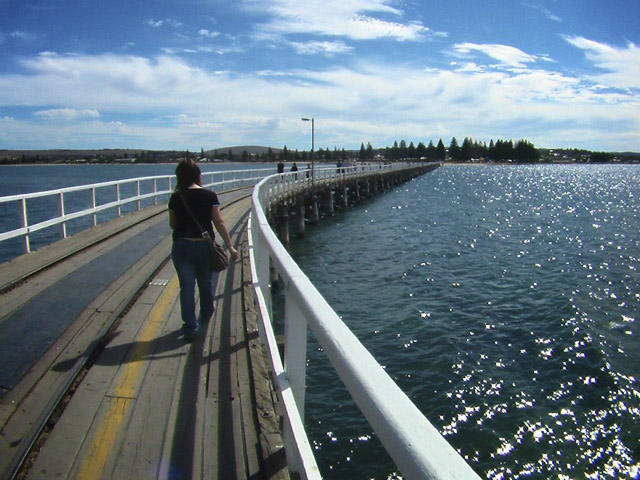
- Some have added a sixth principle of Symmetry - when we perceive objects we tend to perceive them as symmetrical shapes that form around their center. Furthermore, the principle of symmetry work particularly well when framing photos and images. People are accustomed to receiving information in a systematic and organized manner and tend to avoid material that requires too much work to process and comprehend. A symmetrical design will create a sense of equilibrium and balance while an asymmetrical design will cause tension. Often, however (especially with images), the tension created makes the image more interesting and less 'boring'(see the photo below). The goal is to structure you images (and your text) to be easy to follow but not overly predictable and engaging with some nuance, twist, or hook to keep your audiences attention.
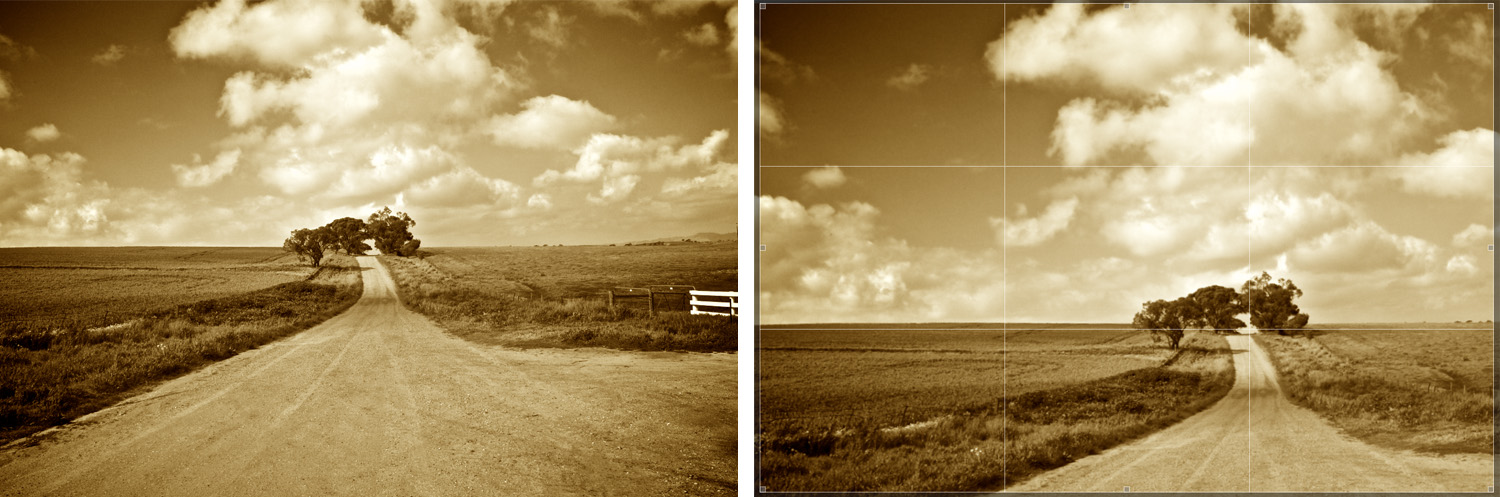 | |||||
| From: http://jeffbrew.com/2012/02/26/howto-gestalt-principles-and-photography/ |
NOTE that while I have given you visual examples of each of the gestalt principles, many images use multiple principles to successfully work as optical illusions.
For fun, here is a link of optical illusions in photos from Bored Panda with some of my favorites below:
1. Camouflage art by Wilma Hurskaninen (link)

2. French landscape astrophotographer Laurent Laveder shows how some simple props and a bit of imagination can turn the moon into anything you like. (link)

3. A work by Japanese artist Makoto Aida titled AZEMICHI (a path between rice fields). (link) which clearly illustrates the principle of continuance.

The artist Maurits Cornelis Escher is famous for his optical illusions which integrate most of the gestalt princiiples:
 |
| Relativity, 1953 |
Drawing Hands, 1948

But there is even more to learning to see than gestalt and color... some images become so familiar and universal, they become symbols or icons. Just the way we learn to use the alphabet and sight words to help us read, we use icons, signs and symbols to help us see. A car's dashboard, for example will show an icon to tell us to change the oil, close our doors, secure our seat belts, when we need gas (and on what side of the car we will find the gas tank) and so much more:
| From: depositphotos.com |

Playing with optical illusions provides us with experience in learning HOW to interpret complex images. The more we experience, the more flexible we are in interpreting what we see.
 |
| From: http://kids.niehs.nih.gov/games/illusions/ |
The Hering illusion is an optical illusion discovered by the German physiologist Ewald Hering in 1861. The two horizontal lines are both straight, but they look as if they were bowed outwards. The distortion is produced by the lined pattern on the background that simulates a perspective design, and creates a false impression of depth. Note that the thinner line appears more bowed than the thicker line.

In closing, here is a literally 'mind-blowing' video illustrating HOW are minds are trained to interpret images a certain way, and how confusing it is for us when we 'see' one thing but our mind 'understands' what we see in another way entirely. Below is a video that the mind (at least my addled mind) just can't grasp - illustrating how important the 'literacy' segment is of visual literacy
For more fun, brain blasting and brain training please visit these cites:
- National Institute of Environmental Health Sciences Kids' Pages: Illusions
- Principles of Gestalt Theory
- How to: Gestalt Principles and Photography
- Gestalt Principles
- Visual Phenomena and Optical Illusions
- Visual Neuroscience: Optical Illusions
Thanks for your visit this week. Please leave your favorite optical illusions or any other reactions, suggestions, and/or questions in the "Comments."


