Reflecting on 2013, I thought I'd share my favorite non-fiction and historical fiction kids' grapic novels with you, hoping you'll find ways of incorporating them in your homes, libraries, and classrooms. For those of you interested in a wider reading list, I have also included links by other librarians, educators, and graphic novel aficionados who have listed their 2013 favorites as well. I've included a few outstanding "honorable mentions" in fiction (I just couldn't resist sharing them with you).
Before getting to my lists, I'd also like to thank you all for your visits this past year and wish for all of us that 2014 be a year of peace, prosperity, good health, happiness and success.
Nonfiction
March: Book One (Top Shelf), by Rep. John Lewis, Andrew Aydin, and Nate Powell. Gr. 6-10. Congressman John Lewis reflects upon his own life, the struggles of black men and women during
the 1950s, and how he became involved in the
student nonviolent movement in Nashville, Tennessee. [NOTE: Nate Powell also illustrated another book on the Civil Rights Movement, The Silence of Our Friends, which I placed on 2012's Best Graphic Novels list).
Primates: The Fearless Science of Jane Goodall, Dian Fossey, and Birute Galdikas (First Second), by Jim Ottaviani and Maris Wicks tells how these three women began and followed their careers studying primates and the lessons they learned.
Relish by Lucy Knisley. One thing I loved about Knisley's 2008 memoir, French Milk, was her ability to write and draw about food in a delightful, mouth-watering way. With Relish, she explores her life in the kitchen while sharing some of her favorite recipes!
Historical Fiction
Dogs of War(Scholastic), by Sheila Keenan and Nathan Fox. Gr. 3-7 consists of three different stories set in three different wars: World War I,
World War II, and the Vietnam War. While the stories are fiction, they've been meticulously researched and relayed in rich
detail. Each vignette relates the trails and traumas,and dangers the dogs, their handler and fellow soldiers risk in battle, and the tolls the wars took on all concerned.
Bluffton: My Summers with Buster Keaton (Candlewick), by Matt Phelan. Gr. 4-7 is a story molded on silent film star Buster Keaton's early life, while
telling a story of young Henry, a boy from Bluffon, Michican and his
love for the girl next door. Henry meets the aloof and enigmatic Buster
and a friendship ensues when a vaudeville
troupe comes to town. While Henry is enchanted by the glamorous strangers, Phelan
hints that Keaton sees something that he longs for in his friend’s more
settled life.
Boxers and Saints (First Second) by Gene Yang - National
Book Award finalist and two-book set that recounts the Boxer Rebellion
(1900) from both sides - that of the Boxers (Chinese peasants who
believed they could invoke ancient Chinese Gods/heroes to help them
battle Western Imperialism and the Chinese Catholics they converted) and
the Saints (the Chinese converts who wanted to bring peace to war-torn
China.
Honorable Mention - Fiction
Monster on the Hill: Book One (Top Shelf), by Rob Harrell. Gr. 4-7
Every town has its own monster in Harrell’s delightful version of
Victorian England, and the townspeople enjoy the thrill of being
scared. All the towns, that is, except in Stoker-on-Avon. At the Town Council's bequest, an eccentric doctor agrees to help "fix" their dragon in the efforts of restoring his lost license. The town crier/street urchin yearning for adventure hides away and joins him and together they set out to help their monster find his voice and calling terrifying people again.
Battling Boy - an action-packed story about a 12-year-old demigod whose rite of passage is to save the monster-pocked city of Acropolis before he can return home, 'a man.' He's up against some overwhelming monsters and odds.
In closing I want to thank you for your visits and comments this past year and send you my sincerest wishes for a happy, healthy, successful 2014 - may it bring us all peace and prosperity to us all.
HERE'S TO A HAPPY NEW YEAR AND ALL THE BEST WISHES FOR 2014
I highlight Boxers and Saints here for two reasons: first, in
honor of its prestigious nomination (2013 National Book Award sort list for Young Peoples Literature); but even more importantly, because
this two-book set illustrates the importance of understanding and
analyzing conflict from multiple perspectives, in the hope of teaching
and reaching greater understanding and tolerance. This post is an abridged version of an article I wrote for Comic Book Legal Defense Fund: Using Graphic Novels in Education: Boxers and Saints. Please visit that link for more teaching suggestions, more background history, paired fiction and non-fiction reading suggestions, and details of how these suggestions meet Common Core State Standards.
Boxers and Saints’ double volumes revisit the Chinese Boxer
Rebellion (1899-1900), sensitively and evenhandedly relating Chinese
peasants’ perspectives from each side of the conflict. Boxerstells
the story of the illiterate peasants tired of being hungry, tired of
failing farms, and tired of Chinese Christian ruffians who would steal,
cheat and beat them while under Western protection. It is young Bao who
leads them as they turn into vengeful warrior gods, supporting fellow
villagers and ridding China of the “white devil’s” influence. Saints
tells the story of Four-Girl a peasant girl, who shunned by her family
finds compassion and belonging with Christian converts. Both Four-Girl
(who later assumes the Christian name Vibiana) and Bao believe it is
their life’s mission to fight their foes and unite their divided and
beloved China.
BACKGROUND
Factors Leading to Rebellion: Towards the end of the 19th century, China was
experiencing a series of political, environmental and economic
challenges, severely weakening the Ch’ing (Qing) dynasty. In addition to
natural disasters (floods, famine and droughts), China fo
Gene Yang, Boxers and Saints. First Second Books
und itself
shattered by a century of wars and could no longer defend its borders.
Western powers, with advanced weapons and modernized military, along
with their profitable opium trade, were pushing China to accept foreign
control over its economic affairs. Foreigners came and gained
concessions from the Qing dynasty, and parcels of land were placed under
their jurisdiction and functioned as colonies. Furthermore, missionaries came to China to
convert the masses and merchants came looking for gold and trade
opportunities.
While the Qing dynasty welcomed Western trade, opium infected China’s
citizens affecting the country’s national defense and agricultural
production. The ensuing Opium Wars (with Britain, 1839-42, and the
Anglo-French, 1865-60) arose from China’s attempts to suppress the opium
trade. A few decades later, the Sino-Japanese War (1894-95) weakened
China even further. Japan in the late 19th century fought
China for control over Korea, which was a Chinese tribute state. Under
the Tientsin Convention of 1885, both China and Japan had the right to
send troops into Korea. In 1894 a rebellion broke out in Korea (the
Tonghak Rebellion) and Japan used this as a pretext for war,
successfully gaining control in the area.
Severe drought, famine, and flooding, coupled with
the growing spheres of foreign influence and dominance, led the
struggling, starving peasants (primarily from the Shandong Province) to
revolt. Furthermore, as their economic situation worsened, foreign
soldiers and gangs of roaming bandits victimized peasants and villagers,
and many citizens were deeply embarrassed by their nation’s weakness.
Traveling Chinese opera troupes would go from village to village
attempting to relieve the pressure and relive Chinese glory. These
operas (an extension of their pop-culture) inspired many of the young
men to relive these stories and myths and return China to its former
prosperity and grandeur.
1989-1900 The Boxer Rebellion: The Boxer Rebellion was led by the Society of the Righteous and
Harmonious Fist, a secret society of peasants whose goals were to rid
China of foreign influence (political, religious, social, and economic)
and to unite China, restoring it’s honor, long-held customs, and
prosperity. The believed that
martial arts training, discipline, and prayer would empower them to
perform extraordinary feats of fight and flight, and that spirit soldiers
would descend from the heavens empowering them to defeat the white devils,and the ”secondary hairy ones” ( Chinese
Christian converts) and protect
them from foreign bullets.
Gene Yang, Boxers. First Second Books
After several months of growing local violence and the increasing
Christian presence in Shandong and the North China plain, Boxer fighters
united and converged on Beijing (then called Peking) in June 1900 with
the slogan “Support the Qing, exterminate the foreigners.” They
destroyed churches and railroad stations and attacked the Dagu Forts
along their way, massacring missionaries and Chinese Christians. The
Empress Dowager Tzu’u Hzi initially supported the Boxers, and on June 21st
authorized war on foreign powers. Foreign diplomats, civilians,
soldiers, and Chinese Christians sought shelter and protection in the
Legation Quarter, put under siege for 55 days. Chinese soldiers and
Boxers set fire to areas north and west of the British Legation Quarter
and the Hanlin Academy (a complex housing irreplaceable Chinese books
and scholars) was destroyed. The Eight-Nation Alliance (Italy, France,
Austria-Hungary, Japan, Germany, Russia, the United Kingdom, and the
United States) brought 20,000 troops — armed with advanced weapons and
training — to China and defeated the Imperial Army and captured Beijing
on August 14.
On September 7, 1901 the Boxer Protocol went into effect, calling for
the execution of Chinese government officials who supported the Boxers
and providing provisions for foreign troops stationed in Beijing and
reparations of $330 million — more than the government’s annual tax
revenue — to be paid to the eight nations over the next 39 years. The
Qing dynasty, established in 1644, came to an end and China became a
republic in 1912.
BOOK OVERVIEW
In Boxers, Yang deftly relates the Boxers’ perspective through
the stories of Bao, an illiterate peasant boy who, like the Chinese
gods of the opera and China past, fights for Chinese culture and honor.
In Saints, Yang relates the Chinese Christians’ perspective through
Four-Girl/Vibiana, who believes that she must become a “maiden warrior”
like Joan of Arc, defending her home and country against the Society of
the Righteous and Harmonious Fist.
Both Vibiana and Bao have dreams and visions of gods, both want
Gene Yang. Boxers. First Second Books
to
help China, and both struggle with finding and maintaining their chosen
paths. And, while their stories are separately told, they intersect, and
complement each other. Bao’s story is somewhat longer and told in
pastel colors, while dreams and meetings with Ch’in Shih-huang (the
patron god he becomes when invoking the martial arts incantation)
contain vivid colors and color patterns accenting the drama and feel of
Chinese opera. Four-Girl/Vibiana’s story is told in monochromatic sepia
tones, although Joan of Arc and her story are told in vibrant, rich gold
and yellows.
Both stories relay China’s struggle to maintain its culture and honor
under increasing Western influences and incursions. Both stories relay
the struggles of faith, racism, and the feeling of isolation and
humiliation felt by Chinese peasants. Both stories emphasize the
protagonists’ goals of strengthening and uniting China through misguided
myth. Both stories relate the coming of age of their characters and of
their country.
Here is a YouTube trailer and a more detailed look at their story.
When holding this enticing two-book set, I experienced a moment of
panic — which one comes first? In truth (and hindsight) I don’t think it
matters. Each tells the story of the Boxer Rebellion from their
respective perspectives. Boxers is the story of oppressive events
leading to the formation of The Society of the Righteous and Harmonious
Fist and its quest to ‘free’ China. Saints relates why Chinese
peasants converted (some for absolution of crimes others for a sense of
belonging, community and belief) and tells of Christian persecution.
Each book follows its respective path to Peking and the violent
culmination of the Boxer Rebellion. That said, I might recommend reading
Boxers first, as Saints seems to tie things up a bit tighter at the end.
Boxers tells Bao’s story. Bao, the third son in a
family of three boys works on the family farm, often dreaming of spring,
when the traveling opera troupes come to perform. In 1894 a Chinese
Christian ruffian comes to the village, steals from them, and a fight
ensues. Father Bey later comes to the village demanding “justice.” After
Father Bey smashes the village’s earthen image of Tu Di Gong, the local
earth god, the village constable finds himself helpless and while they
would like to complain to the magistrate, the elders comment, “The
Imperial government is like a toothless dog with these foreigners. The
Chi’ing couldn’t even defend us Against Japan! Defeated by those midget
barbarians! How humiliating!”
Gene Yang, Boxers and Saints. First Second Books
Shortly thereafter, a young man known as Red Lantern Chu comes to the
village and trains the men in martial arts. When the brothers go out with Red Lantern to
help others, Red Lantern sends Bao on a different quest. It is on this
quest that Bao finds Master Big Belly, who continues Bao’s training and
eventual reveals a martial arts ritual/magic in which one bows, writes
an incantation on parchment, burns the incantation and swallows it,
closes his eyes, and exhales. When he does this, Bao finds himself
transformed into one of the opera gods of early Chinese history. Bao then trains others (including his older brothers), and they
become the Big Sword Society and later the Society of the Righteous and
Harmonious Fist. Each member becomes a different god.
The remainder of the book relates the Boxers’ campaign to reclaim the
might and honor of China. We learn about their disciplined training and
belief in their mythical powers. And we are with them as they march
across China, killing European missionaries, merchants, soldiers, and
Chinese Christians in their quest to vanquish Western influences, defend
their culture, and struggle for greater economic stability.
In Saints, it is the Chinese Christians who are the
protagonists, as relayed through the struggles of Four-Girl, the fourth
girl and only child to survive in her family. Her grandfather refuses to
name and accept her because she was born the fourth child on the fourth
day of the fourth month, and “four, after all, is a homonym of death…”
At one point her grandfather calls her a devil and she struggles to
find and embrace who she really is. Her mother takes her to an
acupuncturist because she has adopted a “devil face.” There, she sees a
crucifix and notices the image of “a small sculpture of an acupuncture victim”
around the doctor’s’ neck. She comes back later to ask about it, and as
he tells her more about Jesus and Christian faith, the doctor’s wife
gives Four-Girl cookies. As she walks through the woods she has visions
of Joan of Arc and returns to the acupuncturist to learn more.
Aside
from the acupuncturist’s stories, lessons, and gospel, she learns that
upon embracing the Christian faith she would be given a Christian name —
she choses the name Vibiana. The cookies, the sense of belonging,
finally having a name, and the influence of her encounters with Joan all
push her to convert. The rest of the story follows Vibiana, along with the doctor, his
wife and Father Bey as they struggle with their own issues around opium,
belonging, community, faith, human rights, and violence experienced
from the hands of the Boxers.
Gene Yang, Saints. First Second Books
Aside from the story lines and history, Boxers and Saints provides a stellar example of how
we are the products of the world around us. The order of our birth, the
names we are given (and try to live up to), the stories, songs, myths,
and faiths we grow up with and hold as true, the political and economic
situations we find ourselves in – all are integral in defining who and
what we are. In creating a story in two volumes, Yang also shows us the
importance of and challenge of trying to understand conflicting
perspectives and cultural influences.Throughout Boxers & Saints, Yang relays:
The importance of perspective and of considering diverse points of view;
The struggle of individuals’, of communities’, and of a country’s sense of identity and purpose;
The development of local and of national heroes and understanding how they came to be;
The power of pop culture and environmental influences in shaping us;
The powers and limits of local and national government in times of civic unrest and international imperialism;
The powers and perils of rebellions;
TEACHING/DISCUSSION SUGGESTIONS: The Power of Cultural Heritage, Faith, and Perspective
Research the source of the name “Vibiana” (Saint Vibiana) and discuss why Four-Girl may have chosen this name.
Research, compare, and contrast the stories of Saint Vibiana and
Joan of Arc. What are their similarities and differences? What might the
choices these women made tell us about Four-Girl?
Chart the positive things the Boxers and the Saints did for their
respective communities. Then chart the negative things they did to
others’ as they responded to feelings of humiliation and persecution.
Discuss who the “winners” and “losers” are — if any exist at all.
Discuss what it feels like to have your rights and beliefs
threatened. What are the various options one might take to protect them?
Discuss how Four-Girl/Vibiana and Bao each felt helpless with their
given circumstances. Discuss how and when your students might feel
helpless. Discuss strategies and means of alleviating these feelings.
Compare and contrast how Bao and Four-Girl/Vibiana grow and change
over the course of their stories. How are the choices they made similar,
and how are they different?
Discuss the power of pop culture in late 19th Century China,
specifically the role Chinese opera and martial arts played for the
Boxers. Discuss examples of how pop culture influences people today.
Discuss the role of superstitions as seen in the Boxers & Saints (for
example: Four-Girl’s being fourth how four is equated with death; the
use of chants and incantations; the power of visions), versus how we
express and deal with superstitions in our world today.
Define and discuss racism and sexism
Compare and contrast the different instances of discrimination,
sexual discrimination, and racism presented throughout the two books.
Discuss how hurtful racism can be — to those targeted as well as to the general population.
Discuss the role racism played in the early 20th Century and the
role it plays today (nationally and internationally) shaping policies
and politics.
The Role of Governance
Discuss the pros and cons of imperial coloniali
Gene Yang. Saints. Fist Second Books
sm and how it created, shaped and influenced our world today.
Research (see links below) and discuss the events leading to the
weakened Chinese government prior to the Boxer Rebellion and how China’s
lose governing and colonization of the provinces fueled the growing
resentment towards the West.
Discuss local, national, and international ramifications of weak governance.
Discuss the Five Edicts of the Big Sword Society (Honor your father
and mother; Do not lust after women or wealth; Resist corruption
wherever it’s found; Have compassion for the weak; Guard your fellow
Brother-Disciples with your life). Compare them to the Bible’s ten
commandments. If your students were forming a society for the betterment
of others, what edicts or laws might they want dictating their actions
and society.
Discuss the power of these edicts and the power of commandments and laws. Why are they necessary?
Language, Literature, and Language Usage
Discuss Gene Yang’s statement in Boxers, p. 312, “What is China but a people and their stories.”
Plot and compare the author’s use of vocabulary, slang, idioms,
color, and images as he relays the Boxers and the Saints’ respective
stories. Is there a difference in their use of language? Why/why not?
Boxers & Saints is rich in cultural stories. Have
students collect their own respective family or community’s stories of
beliefs, myths or faith.
Search for and discuss Yang’s use of inference, simile, and metaphor
Evaluate Yang’s use of language. You might:
Search and discuss how the Chinese referred to Westerners and to
each other (i.e. “pale-faced devils,” “black-headed people,” Master Big
Belly, Father Bey is the “smasher of Gods,” a train is “the foreign
devils fire cart” and others). Conversely, research/discuss how
Westerners described the Chinese peasants in the early 19th century.
Discuss Four-Girl’s reaction to a crucifix the first time she sees one (“an acupuncture victim”). Why did she view it this way?
Discuss Yang’s use of language as Bao rationalizes why he could leave his father (Boxers, p. 60), noting the vow he made earlier to his father, “…was a vow made to another man, in another
Modes of Storytelling and Visual Literacy
In graphic novels, images are used to relay messages with and without
accompanying text, adding additional dimension to the story. Compare
and contrast the author’s use of verbal versus visual imagery. Discuss
with students how images can be used to relay complex messages. For
example:
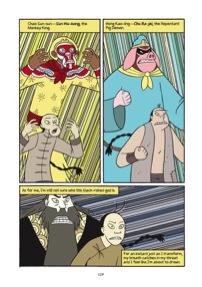
Gene Yang. Boxers. First Second Books
In both volumes of Boxers&Saints, there
are dream sequences. Discuss the role dreams play in relating the
protagonists’ stories. Compare and contrast how the dream sequences are
relayed in each book.
Compare and contrast the colors used in Boxers versus the colors used in Saints. Why are they different, and what message is Yang trying to relay through his color choices?
Discuss how the images complement the text, and ask students to add details and inferences of their own. For example, in Boxers, p. 84, the text reads: “Ever since Red Lantern left, food has been difficult to come by”
and we see images of old and young villagers reaching for whatever bark
is left on a lone tree in their village. How does this image support,
complement, and reinforce the text?
Compare and contrast the differences in how the Western god is
portrayed versus how the Chinese gods are portrayed. Why is this
important?
Suggested Prose Novel and Poetry Pairings
For greater discussion of literary style, related fictional histories
and non-fiction texts you may want to read the following suggestions
with Boxers & Saints:
The Good Earth by Pearl S. Buck: About a farmer in a small village in China, post Boxer Rebellion, pre pre-revolutionary China. (Young Adult)
East Wind, West Wind by Pearl S. Buck: About a family facing cultural change in early 20th Century China. (Young Adult)
Imperial Woman by Pearl S. Buck: About Tzu His, China’s last empress, who ruled during the 19th Century. (Young Adult)
Spring Moon by Bette Bao Lord: About five generations of a
Chinese family during the period of war and cultural change that took
place during the late 19 and early 20 Centuries. (Young Adult)
Spring Pearl: The Last Flower by Laurence Yep, Kazuhiko Sano
(illustrator): About 12 year-old Chou Spring Pearl, who is taken to live
in the home of her father’s wealthy benefactor after the death of her
parents. Chou must deal with her own battles as the Opium Wars rage
around her. (Ages 9-12)


 Honorable Mention - Fiction