Showing posts with label First Second Books. Show all posts

Monday, March 2, 2015

Honors: Caldecott + Printz = This One Summer

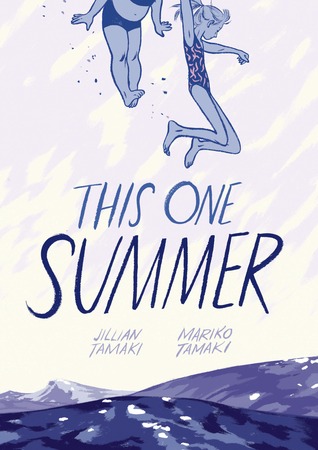
This One SummerThis past February, This One Summer (First Second, 2014) by Jillian Tamaki and Mariko Tamaki rocked the publishing, library, and literary world by being the first graphic novel to receive the Caldecott Honor for “Most Distinguished American Picture Book for Children” and the Printz Honor for “Excellence in Literature for Young Adults.” It has also been the subject of book challenges since receiving these honors. In this post, we examine This One Summer’s merits, issues of concern, and teaching elements to empower educators, parents, and librarians to make their own decisions (for ages 12+).


Here's a bit about the book:

OVERVIEW
page1
This One Summer by Mariko and Jillian Tamaki
Told in warm prose and exquisite monochromatic blue images, This One Summer delicately balances the nostalgic power of summer traditions with the often harsh and intruding lessons of life. It embraces readers of all ages as two tween girls, local townie teens, and one set of parents all tangle in the delicate balances of friendships and relationships, grapple with the pains of growing up, deal with the torments of depression and of wanted and unwanted pregnancies, and cope with the heartbreaks and hopes of life. This One Summer has received outstanding praise and unprecedented honors for its stunning art and thoughtful, sensitive content.

In This One Summer, the art is as powerful as the prose and they work brilliantly together, delicately weaving the troubles and traumas of Rose’s summer at Awago Beach. The beach’s bright summer days are mixed with endless wet heavy rain, both helping to sustain the luscious trees, vines, bushes, grass, milkweed, and verdant undergrowth of the surrounding woods. Then, there are illuminating summer night skies full of stars and striking moonlight. The details of the beach, the lake, the woods, and even Brewster’s convenience store are breathtaking and contrasted by the less-detailed characters. The story and art are richly relayed and juxtaposed, giving extraordinary depth and presence to the story and its true-to-life characters.
page7
This One Summer by Mariko and Jillian Tamaki

For example, Rose and Windy are often seen swimming, diving, splashing in the water, and readers wonder if they are literally and figuratively out of their depth. Alice, Rose’s mom, and Dunc, the store clerk Rose develops a crush on, are both drawn with strong angles reflecting their short straight hair (that they run their fingers through in exhausted exasperation) and lanky, wiry physiques. They also both wrestle with unwanted aspects of pregnancies. While Dunc refuses to acknowledge Jenny and his role/responsibility for her pregnancy, Alice wrestles with facing her infertility and miscarriage.

Themes embraced and delicately tackled in This One Summer include:
  • The tugs of friendship as Rose and Windy (a year and a half younger than Rose), face adolescence at different paces and stages;
  • The pains and torments of depression felt by individuals and their families;
  • The importance and frailties of communication;
  • The challenges of dealing with unwanted pregnancies and failing at wanted ones;
  • The stresses and responsibilities of teen sexuality and group pressure.
page2
This One Summer byMariko and Jillian Tamaki

In This One Summer, Mariko Tamaki’s prose and Jillian Tamaki’s lush art invite us to watch and learn about real life issues in a sensitive and hopeful manner. We meet tweens fantasizing about what their developing breasts will look like. We learn how one family deals with the mother’s growing depression. We watch along with Rose and Windy as we observe, overhear, and deal with older teens. We see how long, comfortable summer friendship is stressed and strained by a one-and-a-half-year age gap between the girls as they enter adolescence. And finally, we observe (along with Rose and Windy) how older teens and adults deal with their own relationships and sexuality.

Jillian Tamaki’s monochromatic blue images and the wide range of textures and details in the artwork add incredible depth, passion, and complexity to Mariko Tamaki’s prose. This One Summer is truly a feast for mind and eyes. The beauty, power, and serenity of the beach, the expansive night skies, the milkweed plants and pollen, and the woods of Awago Beach balance the secrets, sorrows, and unfolding drama of the characters. What makes this book so outstanding is the sensitive manner in which important real life issues and challenges are faced honestly and imperfectly by the very real characters of Awago Beach. The out-of-depth feelings the characters experience are beautifully offset by the power of the water and the beach. As their secrets unfold, all but the tweens are reluctant to talk about them. As a result, this book can be a powerful resource and jumping point for healthy, open, non-threatening discussion about powerfully challenging life issues.
page3
This One Summer by Mariko and Jillian Tamaki


Elements of Concern
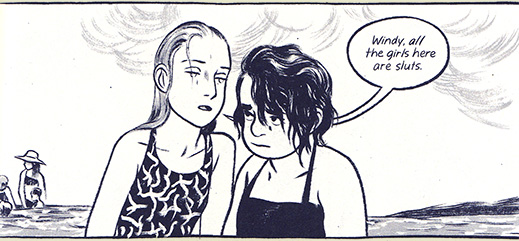
This One Summer earned a Caldecott Honor, which covers children’s book for readers up to age 14, putting the book at the high end of the age spectrum for the honor. First Second recommends this book for ages 12 and up because it contains mature content. Despite having rightfully received this honor, there may be some confusion by consumers unfamiliar with this book and who believe the Caldecott honor is given exclusively to books for younger readers. To clarify, please note that there is some profanity, especially dealing with the older teen characters (the girls are labeled “sluts”). There is also a teen pregnancy and the burgeoning questions of sex and sexuality that the tweens experience in parallel subplots.
page5
This One Summer by Mariko and Jillian Tamaki
That said, these issues are sensitively and realistically developed through a warmly complex and penetrating story that delicately deals with questions young teens have. Furthermore, the characters are true to life, flaws and all. While mature content may cause some concern, this book is wonderfully appropriate for mature tweens and young teens as they explore adolescence, sexuality, and the increasingly complex relationships they find themselves facing.


For classroom lessons or book club lesson suggestions, please see my post "Using Graphic Novels in Education: This One Summer"  - a featured column I write for The Comic Book Legal Defense Fund

***

In the meantime, below is an excerpt from an interview I did with Mariko Tamaki and Jillian Tamaki right after hearing they received the Caldecott and Printz Honors. [For the full interview, please visit my post "CBLDF Talks with Caldecott and Printz Honor Winners Jillian Tamaki and Mariko Tamaki"

page6
This One Summer by Mariko and Jillian Tamaki
This One Summer has taken the children’s books and graphic novel communities by storm, being the first graphic novel to win the Caldecott Honor for “Most Distinguished American Picture Book for Children” and Printz Honor for “Excellence in Literature for Young Adults.” It is a coming-of-age story that embraces readers of all ages as two tween girls, some local townie teens, and one set of parents all look at growing up, pregnancy, and babies from very different perspectives. What makes this book so special is how it sensitively and somewhat magically deals with these very difficult and mature issues through the growing awareness of two girls one summer. CBLDF is thrilled for the recognition graphic novels are beginning to get outside the comic book communities (hoping this will be just the beginning), we are thrilled for the recognition this gem of a book has received for its breathtaking prose and art, and we are thrilled to have had the opportunity to talk with Jillian Tamaki and Mariko Tamaki just after receiving these honors.

CBLDF: First, we’d like to thank you for taking the time to talk with us.  We know you’ve been getting tons of interview requests and appreciate the time and consideration you’ve given us.
page9
This One Summer by Mariko and Jillian Tamaki
Jillian and Mariko, what were your first thoughts/reactions when you heard you won the Caldecott Honor AND the Printz Honor?

Jillian Tamaki: What more is there to say except for it’s really, really cool? I never expected to win the Caldecott, given it is not a picture book.
Mariko Tamaki: It was an honor to be honored.

CBLDF: What were your later thoughts about winning these prestigious honors?
Mariko Tamaki: Wow, I must be prestigious now.  Better get back to work.
Jillian Tamaki: It’s only been a few days!

CBLDF: Mariko, you’ve written both graphic novels and prose. What made you decide this story was a graphic novel? (Jillian, feel free to jump in here too).
Mariko Tamaki: I think in this case the setting felt really ripe for a comic.  Also so much of this was about atmosphere.  Not just the visual details but the little noises in the silence that Jillian captured so well.

CBLDF: You’re cousins, and some swear it’s best to keep work and family separate. How does your familial relationship affect the ways in which you work together?
 Jillian Tamaki: Ehh, that’s usually good advice, probably. Oh well. I think we share a similar Tamaki humour. Very dry.
Mariko Tamaki: I think it makes it all the more important to make sure we don’t wear the same thing when we appear in public.

 CBLDF: I loved This One Summer for so many reasons. What struck me while reading this was how many subtle layers there were in the prose, art and story lines and yet how exquisitely seamlessly it unfolds. It’s a thoughtful, sensitive journey exploring love, relationships, life and growing up, but feels as light and warming as the magical milkweed pods that float up and around the beach on pages 32-33. The dialogue, the characters, and situations in this book ring so true and personal. Were they taken from your own lives, were you channeling you or your friends at Rose and Windy’s age, or is this story purely fictional?
Jillian Tamaki: I don’t think anything is purely fictional or purely autobiographical. You’re constantly weaving in elements of your life and personal philosophy in ways that are conscious and subconscious.
Mariko Tamaki: Exactly.
page13
This One Summer by Mariko and Jillian Tamaki

CBLDF: There are so many stories going on here between tweens Rose and Windy, the mystery around Rose’s parents’ marital issues, and even around the local teen scene. In short, this coming of age story for tweens has mature topics and some mature language, especially with Dunc the Corner Store Guy and his friends. Was there an editing process around the book, story and its rating?
Jillian Tamaki: Sure. There was some discussion about the sex terms. But, to be honest, that’s not something Mariko and I consider too much. We’ve been lucky in that we’ve been able to make the books we want to make and reflect what we believe to be a true experience.
Mariko Tamaki: I think half the fun of this is remembering the ways we talked about stuff when we were little.  Which were probably FAR TAMER than the way kids talk about things today.

CBLDF: As a follow-up, have you received any challenges for this book from tween or younger reader communities?
Mariko Tamaki: I believe the book was removed from one shelf in New Jersey, but the decision, thanks to an amazing librarian’s fighting the good fight, was reversed.  Beyond that I tell people that the book addresses the existence of sex, when they ask if there’s anything inappropriate in it.  I follow that up by saying that I, myself, do not think that is inappropriate.

page8
This One Summer by Mariko and Jillian Tamaki
CBLDF: As mentioned earlier, you won the Randolph Caldecott Honor for most distinguished American picture book for children AND the Michael L. Printz Honor for excellence in literature for young adults. Two awards for one book covering two different age groups.  What does this tell you about your book, your story and the graphic novel format?
Jillian Tamaki: I feel like a lot of those distinctions are marketing decisions. I try to make books that appeal to myself and maybe a few ideal readers. I love that people of different ages can take various things away from the story, though.

CBLDF: Thank you so much for your time and awesome responses. We are thrilled for you and we’re thrilled for the industry.  We’ll definitely be looking out for your next projects.
page10
This One Summer by Mariko and Jillian Tamaki

For extended reading here are some Paired Reading Suggestions:
  • I Kill Giants by Joe Kelly and JM Ken Niimura: About an 11-year-old girl who struggles to face and understand an untimely loss, first through escapism and then gradually through acceptance.
  • Chiggers by Hope Larson: About growing up, friendships, funs and foils of summer camp.
  • Are You There God? It’s Me, Margaret by Judy Blume: About the trials and tribulations of growing up, particularly for adolescent girls.
  • Chinese Born American by Gene Luen Yang: Another Caldecott Honor winner about a teenager’s need to fit in.
  • Before You Go by James Preller: About Jude, who takes a summer job flipping burgers at Jones Beach while dealing with his mother who is kept in a darkened room ever since his little sister drowned several years before.
  • The Color of Earth Trilogy by Kim Dong Hwa: Like This One Summer, the Color of Earth Trilogy is a beautifully balanced blend of prose, poetry, and art that tactfully and sensitively deals with a girl’s growth from adolescence to adulthood.


page12
This One Summer by Mariko and Jillian Tamaki
For further discussion, here are some additional Links and Resources:


page11
This One Summer by Mariko and Jillian Tamaki

Sunday, July 7, 2013

Zahra - from Paradise to President: How Graphic Novels Inspire

Zahra's Paradise is a webcomic and graphic novel by Amir with illustrations by Khalil (both have chosen to remain anonymous for political reasons), published in 2011 and published by First Second Books (here's a link to see -at least part of book - online).

Its story takes place in Iran, June 2009 after one of the great street protests following the elections. A young man, believed to have attended the protest vanishes and the story, narrated by his brother a blogger, tells of his and his mother's (who is named, Zahra) undying quest to find him through the vast labyrinth of the Iranian judicial system. They tenaciously go from hospitals, morgues, neighbors, friends, and bureaucrats, to hacking a prison's computers to find him. And, while it is a story about human rights and the turmoil of a troubling time, it also about the love of a people who help this mother through her heartbreaking ordeal.
http://media.npr.org/blogs/monkeysee/2010/03/17/zparadise_sq-aac77cd1da80b1612dd703692c10d228830a7f82-s6-c30.jpg
Courtesy of Zahra's Paradise by Amir & Khalil, First Second Books
Zahra's Paradise is also the English name of Behesht-e Zahra, a large cemetery in Tehran where Iranians from ayatollahs to war veterans to student dissidents are buried.  It is this cemetery that the title refers to. It's the place where society affirms its solidarity and connections. And, while the novel's characters are fictional, nothing in the book invented. Its characters echo real-life figure and the story is no-less poignant.

To learn more, and for additional resources and articles please visit:

"Zahra's Paradise:" An Interview with Amir and Khalil

Here is a YouTube interview with Amir who discusses the book, the Iranian judicial system and the crimes  committed in the name of the prophet:

Recently, in addition to being a powerful webcomic/graphic novel, Zhara's Paradise, also became a virtual campaign for the recent Iranian elections.


The Zahra for President Campaign was launched as a collaboration between United for Iran and Zahra's Paradise. Its purpose was to "create a collaborative space for the voice, vote and vision of the Iranian people." Through Twitter and Facebook many people have expressed their support. As noted in an article Zahra for Iranian President (June 17, 2013 via SyndiGate.info):
"In 2009, Zahra and her family, along with millions of Iranians took to the streets to demand fair and free elections. Despite a brutal crackdown, the promise of an Iranian spring - democracy, dignity, and justice - is far from extinguished. Today, Zahra is running for President, the promise of a new day. Join her. Let's win back our Iran."

The campaign spread from Iran to Germany, France and Sweden and around the globe, with supporters  posting their pictures on the site with Voter4Zahra posters.


Here are a few more links you may want to check out:

Zahra's Paradise in the Classrooom:This book is powerful and informative.  I recommend it for high school students and older (meeting Common Core State Standards for language, reading, writing, and for history ) along with the many links provided in this post as students read, write and discuss:


In closing, here are two outstanding examples of the visual and verbal power of this work.

Courtesy of Zahra's Paradise by Amir & Khalil, First Second Books
http://www.comicsbulletin.com/main/sites/default/files/reviews/images/1110/zp2.jpg
Courtesy of Zahra's Paradise by Amir & Khalil, First Second Books

Please leave your reactions in the comments below and thank you, as always, for your visit.

Sunday, May 19, 2013

Astronaut Academy

Dave Roman's Astronaut Academy
Inspired by Commander Chris Hadfield's tweets and posts (including his rendition of David Bowie's Space Oddity), here is a treat for kids of all ages by Dave Roman and First Second Books. While it takes place in space,  isn't about space or science but it is a lot of fun and worth the read.

Dave Roman's Astronaut Academy began as a webcomic before First Second Books expanded and transformed it into two books. The first, introduces the characters' backgrounds, friendships, arch rivals, and passions. It also vaguely introduces a student "threat" hiding within the school that somehow feeds off of human emotion. In Book 2, the pace picks up as we meet the monster who disguises itself as different people to steal hearts. [In Dave Roman's world, people have multiple hearts to survive physical and emotional threats, and at the same time empowers them to express their love to others by giving them one of their many hearts. Parents give hearts to kids, friends give each other hearts, etc. Just one example of his use of language and metaphor.]

Both books are filled with wisdom, humor, word-play and puns, dinosaur car races and the exciting sport of Fireball.

BOOK ONE - ASTRONAUT ACADEMY: ZERO GRAVITY  (First Second Books, 2011) introduces the school through their "Official Promotional Guide" and once at the Academy, we learn about the various students - their passions, friendships,  secrets and motivations, and in many cases, their rivalries. So for example, Hakata Soy just wants to forget his past and fit in. Marcos Stamatis has a broken heart and wants to impress a girl from his Rocket Science class. Hakata Soy's roommate,Tak Offsky, eats, lives and breathes Fireball.  Maribele Mellonbelly the richest kid ever (whom everyone wants to befriend), is still lonely and finding ways to unseat her "arch rival" Miyumi San, who wants to learn everything she can.

Below are two pages to show you the feel and genius of this book.

In the first image, we see a page from the school's  "Official Promotional Guide." On this page, we're introduced to three of their very talented staff.

The second image illustrates how Roman introduces just one of his many characters.
      From Astronaut Elementary by Dave  Roman, Courtesy First Second Books (2011


      Cybert is a robot that was built for destruction but prefers to play card games.
      Sample page from  Astronaut Elementary by Dave Roman Courtesy of First Second Books (2011)


    There are a lot of characters in this story, and the genius of Dave Roman and Astronaut Academy  is that he introduces their stories and voices in an organized manner.  Mini-chapters are introduced with the name of the character 'talking,' along with a brief snippet about the character, and each has his or her own unique look and manner. So for example in the page above we see that this chapter will be told from Cybert the cyborg's perspective, and that Cybert is somewhat 'confused' and has "no idea what I'm doing at Astronaut Academy."  

    When discussing how he set up the characters, Roman commented (in an interview with ComicBookResources.com):
    I try to think about archetypes I might be playing to or against. For example, Hakata Soy is introduced as a  mysterious hero with a troubled past, so he wears a high collared jacket and has wild hair, sort of like a sci-fi James Dean...
    Aside from the brilliant way we meet the characters, here are some of my favorite examples of Roman's word-play, humor, and 'words of wisdom':
    • The "fabric of time" is a worn-torn garment;
    • One of the characters notes, "A few years ago on the far planet of Hoppiton I lived hoppily with my family..."
    • Another character talks about how he got a "crush" on a girl - after literally being crushed by her;
    • The Guidance Chancellor B or Bee advises a renegade cyborg whose only goal (at that time) is  destroying Hakata Soy that, "You could spend your WHOLE LIFE searching for an exclusive chase card...and no matter how many booster packs you buy, never find the one you seek. Diversify your interests. Don't let one card game consume your ambitions."
    • Mr. Taketo Sky is one of the Astronaut Academy teachers and Tak Offsky is a student;
    • Students are told by Mr. Taketo Sky to "...start ADDING two and two together by solving these QUESTIONABLE EQUATIONS." 
    For more 'goodies' please see:

    Teaching suggestions for Astronaut Academy: Zero Gravity:
    •  Addressing Common Core State Standards (CCSS) this book is full of advanced vocabulary, and tells the story verbally and visually, addressing multi-modal teaching.
    • This book is full of wordplay, acronyms, puns and metaphors.  Have your students go on a scavenger hunt through the book looking for examples. (CCSS: Vocabulary Acquisition and Use, Conventions of Standard English, Range of Reading and Level of Text Complexity)
    • The book opens with a new student arriving late in the semester.  This is a great way to start a new term, reading this aloud to help students feel more comfortable in their new class.
    • This book is about stereotyping, rivalry and friendship - important learning points for all kids.
    • Since students are continuously meeting new students as the characters are introduced, you can have them work in groups constructing character maps of each one (CCSS: Vocabulary Acquisition and Use, Craft and Structure, Key Ideas and Details, Comprehension and Collaboration, Presentation of Knowledge and Ideas.)  Then meet as a whole, comparing and contrasting character traits.

    BOOK TWO - ASTRONAUT ACADEMY: RE-ENTRY (First Second, 2013) begins as the students return to school after semester break and find security is "beared-up" because the monster feeding on their emotions is now a serious threat. With their kids' safety at jeopardy (many have 'heart attacks' as they are tricked to give one of their hearts to the heart-eating monster), the school goes into lockdown mode searching for robots and later banning love. The action centers on an epic Fireball championship and the mysterious heart-stealing monster. After ineffective teacher/parent interventions, students learn that they must rely on themselves. There are space ninjas, dinosaur cars, security 'bears' and the story is told through inspiring images, and page design, with puns and wordplay galore to relieve the stress and tension.
    • Here is a "Re-Entry Book Trailer""
    • Here are some sample pages, courtesy of First Second Books 
    • And, for readers who grew up with Where's Waldo and love searches and scavenger hunts, Dave Roman in the same interview, mentioned above tells us that:
    "Here's a (possibly incomplete) list if anyone wants to go on a pop culture scavenger hunt through "Astronaut Academy: Re-Entry!" Some of the other things possibly referenced include "My Neighbor Totoro," "THX 1138," My Chemical Romance, Harry and the Potters, All Girl Summer Fun Band, The Knitting Factory, "Bill and Ted's Excellent Adventure," "Doctor Who," "A Wrinkle in Time," "Back to the Future," "The Girl Who Leapt Through Time," "The Halloween Tree," "Sweeney Todd," "Star Wars," "Mystery Science Theater 3000," "The Aquabats," "Digimon," "The Ewok Movie," "Santa Claus is Coming to Town," "The Black Hole," "The Great Pumpkin Charlie Brown," Sega Saturn games, "Dark Side of the Moon," "Pinocchio," "Sailor Moon," Kiss, "Avatar: The Last Airbender," "Gatchaman," Cobra Commander, Tales of Ribaldry, Pom Poko, "Transformers," "Say Anything," "Voltron," "The Fly," MC Hammer, Depeche Mode, "Sonic The Hedgehog," Bum Equipment, Ub Iwerks, Bumper Boy, Monticello, "The Secret of Nimh," ShamWow, Team Rocket, "Super Mario World" and "Flight of the Navigator."
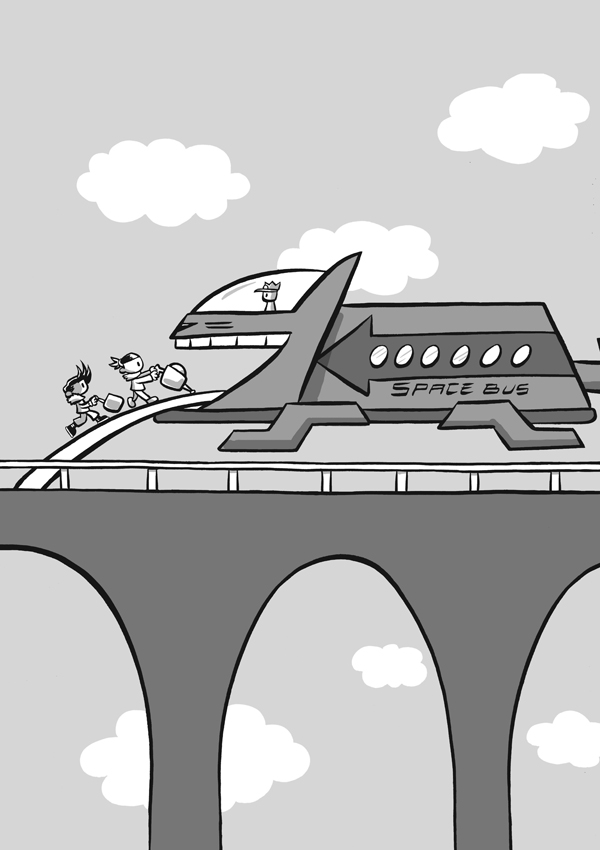
    Students traveling to school after semester break. Courtesy of Dave Roman and First Second Books, 2013
    In addition to these goodies, Roman continues to include wordplay, wisdom and fun. Here are some examples:
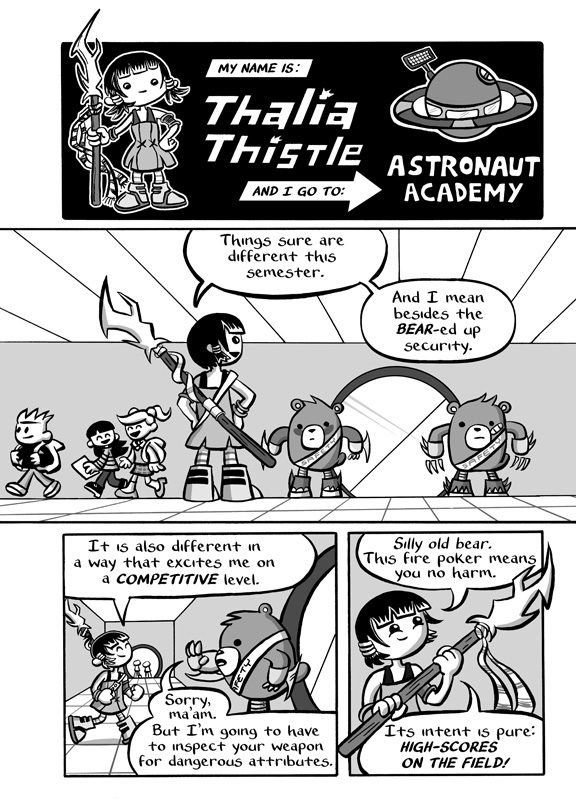
    • Thalia Thistle, ace Fireball player has an aversion to acronyms and in one instance, two 'security bears' try to figure out what "BFF" means;
    • A wounded student is taken to Dr. Nursen;
    • One of the 'security bears' announces that he "hates to be the bear of bad news... "
    • A student notes that after a science-project gone awry by his scientist parents, they became less-visible, ""My parents' visits were increasingly short and trans-parent"
    • Another character who finds he cannot compete on the Fireball team becomes interested and words and spelling bees saying, "...something about the way they were constructed always intrigued me. I liked the way they looked and sounded."
    • Words of wisdom: "I know Dad is worried about my safety...but life involves scrapes and bruises, especially if I want to play the game..."
    Here is a page from Astronaut Academy: Re-Entry:
    http://yaytime.com/academy/aa2_preview/pages/aa2_025_thalia1.jpg
    Courtesy: Dave Roman and First Second Books http://yaytime.com/academy/aa2_preview/pages/aa2_025_thalia1.jpg

    Teaching suggestions for Astronaut Academy: Re-Entry:
    • Have students go on a scavenger hunt for acronyms, puns and word-play.  Have them create their own that might easily fit into the book and story as well. (CCSS: Vocabulary Acquisition and Use, Conventions of Standard English, Range of Reading and Level of Text Complexity)
    • Discuss the themes of this book: teamwork, forgiveness, rivalry. Map their development.  (CCSS: Key Ideas and Details, Integration of knowledge and Ideas, Comprehension and Collaboration)
    • Compare the different style of story-telling in the two books (CCSS: Conventions of Standard English, Craft and Structure, Key Ideas and Details, Integration of Knowledge and Ideas, Range of Reading and Level of Text Complexity, Text Types and Purposes, Presentation of Knwoledge and Ideas.)
    • Meeting CCSS, have students practice different forms of writing, creating "Rules of Play" for Fireball.  You may want them to brainstorm on ways the game can be played in school/ recess.  They can also write/review the game as it is being played. (CCSS: Vocabulary Acquisition and Use, Conventions of Standard English, Craft and Structure, Key Ideas and Details, Text Types and Purposes, Presentation of Knowledge and Ideas.)

    These books are wonderful entertainment for kids of ALL ages.  I hope you take a closer look yourselves. For more from Dave Roman, check his website:http://yaytime.com/ 
    For more teaching ideas please go to: http://yaytime.com/resources/teachers-guides/

    In the meantime, thank you for your visit, and please leave your reactions, reviews, and creative ideas in the comments.

    Tuesday, October 30, 2012

    Passionate Pursuits Along the Hudson: Feeding Them, Researching Them and Hopefully Finding them at Work and in Your Classrooms

    How many times do you hear the terms "passionate pursuits" and "in the classroom" together?  My bet is rarely, and so much the pity. While the post below did not take place in a classroom I hope to inspire writers and educators alike to put passion and projects into everyday practice and learning.

    This past week, I went to an author talk / exhibit opening at the New York City Public Library. Walking into the main building alone is inspiring but even the majestic space paled to the passion, practice and hard work that went into the making of Mark Siegel's "Sailor Twain or the Mermaid in the Hudson."

    Sailor Twain or the Mermaid in the Hudson. This is a graphic novel for young-adult teens and adults about a steamboat captain who finds a harpooned mermaid.  (I say teens because there is some nudity.)

    Sailor Twain or the Mermaid in the Hudson is about love, mermaids, metaphors, and intrigue.  But this post in not about the book as much as the project. In a few weeks, I'll blog a review of the book.


    Can't wait for the review?  Here is my first link:  Table of Contents - Overview and Part I of the book with blog notes. This link has the first part of the book online along with the writer's blog about work and research that went into those pages. The blog itself is chock full of gems and well worth the time and read.

    This book began as doodles during Siegel's daily commute. Over the course of nine years Siegel conducted research (at the New York Public Library and visiting townships, villages and industries along the Hudson River), built models (of steamships and steamship compartments used later for his drawing), developed his story and the resulting art panels for this book. He became such a fixture at the library and endeared so many there that the exhibit (in room 117) has incorporated his book into displays of maps and photos of the Hudson River and the library (then called the Astor Library) from the late 1880's. If you are in the New York City area, a visit to room 117 in the New York City Public Library (the Main Library on Fifth Avenue and 42nd Street) is worth your time.  It's a small exhibit in a comfortable room where old New York comes to life.

    For Sailor Twain, first there were the doodles: During his communites from his home in Tarrytown to work (midtown Manhattan) Siegel would simply sketch figures and ideas as he gazed through the train window at the Hudson River.  At the time he was in his mid-thirties and was facing challenging life decisions, and he realized that not only were his doodle related to the river and to his life, but they were actually beginning to tell a story. This story is not biographical, but Siegel noted that there were overlapping themes (in particular, one of his parents was French the other American and you see this mix in his main character selections).

    Once he had the initial story grain, he began his research and model building.

    In terms of research, Siegel read about:
    • mermaid myth - especially the allure of mermaid song and how sailors were 'lured' to their death as they became obsessed with the song.  [NOTE: Siegel uses this later in his book as a metaphor for addictions and obsessive pursuits.]
    • Hudson River steamships along the Hudson and the roles they played
    • fashion in lower Manhattan
    • trade in lower Manhattan and reactions to suffrage and racism
    • food served on the steamships [NOTE: the Hudson River was teaming with sturgeon and the steamships religiously served sturgeon caviar].
    • industry along the Hudson River [NOTE: aside from the emerging industrial revolution along the Hudson, there was a winery (the Millbrook Winery), which still produces wine and they have bottled two wines in honor of this book.  At the book/exhibit launch we had a sample...they're good!]
    • communities and townships along the River
    • publications from the late 1880's most were published in serial publications [which Siegel mirrored with the weekly blogs and presentation of his book]  
    Once the research was done, Siegel built models of steamships and their interiors to help with the  art.


    The art itself was done in charcoal to give it an industrial feel and while he decided to draw a few of the characters more 'cartoon-like', others were drawn in intricate detail.  The art is breathtaking and well worth (to his readers) the horrible mess charcoal presented for him. Here is the opening page of Chapter 1 - you can feel the soot and industrial pollution.

    SailorTwain 013
    Finally, some more links taken from sailortwain.com  Here are some highlights (go visit sailortwain.com for more):

    New York & Hudson River :
    The treasure trove! The New York Historical Society
    Ephemeral New York—full of goodies
    The Bowery Boys—essential!
    A beauty on the river, a marvelous way to experience the Hudson, with a crew of some of its greatest champions, Pete Seeger’s beloved Clearwater
    Millbrook Winery is a flagship Hudson Valley winery. Their Tocai Friulano is served up and down the river towns for good reason.
    Whitecliffe Winery: another Hudson Valley award-winning vineyard

    *
    The Vanishing Art of Letter Writing?
    Victorian Rituals an introduction
    Letters, Letter-writing and Other Intimate Discourse, by Wendy Russ—lots of links to more
    On Victorian letter-writing manuals, from Victorianweb.org
    *
    For map lovers
    Matt Knutzen’s blog of the priceless New York Public Library Maps Division
    Strange Maps! (thanks, Warren!)
    Historical Charts: the National Oceanic and Atmospheric Administration (NOAA) keeps a list of historical navigation charts, and here is clickable, zoomable example of what the pilot Utterson and Twain would have been using aboard the Lorelei (this one from 1865) (Thanks, Anne!)
    The David Rumsey maps database: tons of searchable maps! (Thanks, David!)
    *
    VICTORIANA
    From the University of Texas, a magnificently illustrated Glossary of Victorian Sartorial Terms!
    Superb photo exhibits at Clio Visualizing History.
    Dating in the Victorian Age: “The Unsuitable Suitor of 1879″—from Victoriana.com

     Remember... In a few weeks I'll have a review of the book along with some teaching/enrichment suggestions for mature young-adult/adult students. 
     
    Aside from just reading this book to see how his story and work unfolds, here are some ways to integrate passion in your home and classrooms:
    •  Research other passion projects - talk about common threads and elements that allowed these people to realize their dreams.
    • Ask your kids what they might want to do if they had a 'passion project'- brainstorm, ruminate about what might be done.
    • Help them realize the more 'doable' passions. Have them work alone or in a group to create their own passion projects.
    • Pursue your own passion project and ask your kids (if interested)  to help you realize the project. Model and discuss what needs to be done.
    In the meantime, thank you for your visit, please leave your notes, reactions and questions in the comments.