Showing posts with label ebooks versus print books. Show all posts

Sunday, November 16, 2014

The Science, and Surveys on Benefits of Reading (Ebooks and Hard Copy Books)

From: detroit.cbslocal.com
Most of us already know the importance of reading for our kids, and that reading is the best indicator of success in school. But here are some more studies supporting why reading is so important for everyone whether they're in or out of school.

Reading reduces stress

A 2009 study (University of Sussex, published in The Telegraph, March 2009) found that reading (for pleasure - not work) for just six minutes can reduce stress levels by 68%.

[Note that listening to music reduced the levels by 61%, a cup of tea or coffee lowered them by 54%, taking a walk lowered stress levels by 42% and playing video games reduced stress levels by 21%.] 

According to the article, psychologists believe reading helps reduce stress because while reading, we concentrate on the reading and this distraction eases the tensions in the muscles and heart. Dr. Lewis, Cognitive Neuropsychologist further notes that,
"...It really doesn’t matter what book you read, by losing yourself in a thoroughly engrossing book you can escape from the worries and stresses of the everyday world and spend a while exploring the domain of the author’s imagination.”

Reading helps maintain the brain's grey matter

In another study which appeared in the Proceedings of the National Academy of Sciences and was reported by ABCNews, elderly people who regularly read are 2.5 times less likely to develop Alzheimer's disease than those who don't. According to the study's main author, Dr. Robert Freidland, people who don't exercise their brains lose brain power.

 The Wall Street Journal notes another study of 300 elderly people (published by the journal Neurology) which showed that regular engagement in mentally challenging activities, including reading slowed memory loss in its participants' later years. The article, "Read Slowly to Benefit Your Brain and Cut Stress" by Jeanne Whalen (updated 9/16/2014) also notes a study published in Science where reading literary fiction was shown to help people understand others' mental states and beliefs.

Source: http://online.wsj.com/articles/read-slowly-to-benefit-your-brain-and-cut-stress-1410823086?mod=e2tw--&cb=logged0.05918099640127339


Reading print books may help comprehension better than reading ebooks

A 2014 study led by Anne Mangen at the University of Stavanger in Norway, and Jean-Luc Velay at Aix-Marseille University in France found that 25 subjects who read a short mystery story in print, retained and comprehended more than another 25 who read the story on a Kindle. While there was no significant difference between the groups along emotional measures or to questions about the the plot or setting, Kindle readers scored significantly lower on questions about when events in the story occurred. They also performed almost twice as poorly when asked to arrange 14 plot points in the correct sequence.
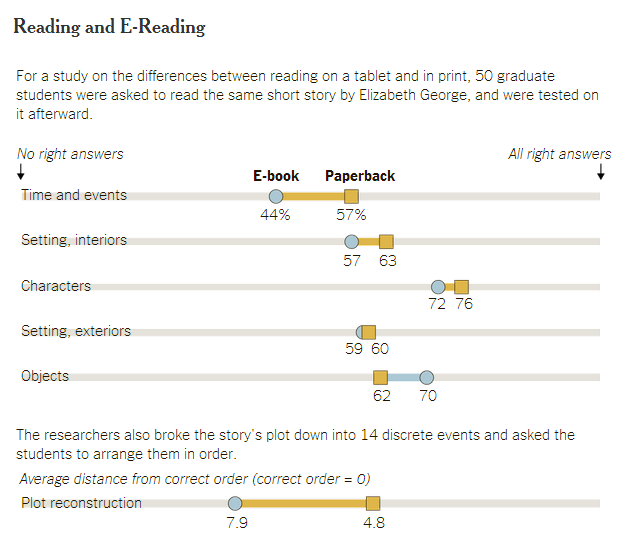
Source: Reading Center, University of Stavanger; CNRS/Aix-Marseille Université (via The New York Times)

From: paidcontent.org
Analyzing their data, they believe that the brain finds it easier to make a mental map of text when it is presented via physical, tactile interaction with the book. They note that,
"Previous research has demonstrated that a mental map is particularly important if the text is long. Lengthy texts call for quicker navigation. You need to be able to leaf back and forth through different parts of the text to see, review, and comprehend relationships and contexts."
Mangen further notes that,
"... laboratory experiments, polls and consumer reports indicate that modern screens and e-readers fail to adequately recreate certain tactile experiences of reading on paper that many people miss and, more importantly, prevent people from navigating long texts in an intuitive and satisfying way. In turn, such navigational difficulties may subtly inhibit reading comprehension. Compared with paper, screens may also drain more of our mental resources while we are reading and make it a little harder to remember what we read when we are done...."
According to an article in The Guardian, Mangen also published a study in 2013, in which she gave 72 Norwegian 10th-graders texts to read in print or in PDF on a computer screen. Comprehension tests following the reading found that, "students who read texts in print scored significantly better on the reading comprehension test than students who read the texts digitally."
 

 In "The reading Brain in the Digital Age" posted on April 11 2013, Scientific American, Ferris Jabr reports on various studies of digital versus printed text reading. Jabr, for example notes that Before 1992, most studies concluded that people read slower, less accurately and less comprehensively on screens than on paper. More recent studies, however "have produced more inconsistent results."
From: blogs.msdn.com

Surveys about the use of e-readers suggest that our inability to flip pates affects our sense of control and limit our sensory experience, thus reducing long term memory of the text. Studies also find that reading long sentences without links is a skill we all need, but can lose if we don't practice.

As noted in "Science has Great News for People Who Read Actual Books" Rachel Grate notes that,
"Before the Internet, the brain read in a linear fashion, taking advantage of sensory details to remember where key information was in the book by layout.
As we increasingly read on screens,  our reading habits have adapted to skim text rather than really absorb the meaning."
Grate further notes that Tufts University neuroscientist Maryanne Wolf worries that, "the superficial way we read during the day is affecting us when we have to read with more in-depth processing." Wolf and others advocate a "slow reading" movement, as a way to counteract their difficulty many face making it through a book.

Slow Reading

Slow reading advocates recommend 30-45 minutes of daily reading away from the computer, ebooks, smart phones and other distractions of modern technology. These advocates site many of of the studies above noting the benefits of 'slow' low-tech reading such as stress reduction, empathy, and the ability to concentrate.

What do you think?
 
As always, thank you for your visit.
Please leave your reactions and insights in the comments below

 And, for more on reading, please visit:


Thursday, January 17, 2013

Books: eBooks vs. Print Books- A Study on Reading

This week, Scholastic posted results from their recent national survey of parents and their kids - ages 6-17  (conducted in conjunction with the Harrison Group) "Kids and Family Reading Report - 4th edition*" asking them about their reading habits and preferences, and the results are interesting.

Here are some of their results on the increase and motivational aspects of ebooks:
From: paidcontent.org
  • The percent of children who have read an ebook has almost doubled since 2010 (25% in 2010 vs. 46% in 2012);
  • Half the children ages 9-17 would read more books for fun if they had greater access to ebooks (an increase of 50% from 2010);
  • One in four boys who has read an ebook says he is now reading more books for fun (there was no marked increase for girls);
  • 57% of moderately frequent readers (defined as kids who read one to four days a week) who have not read an ebook agree they would read more if they had greater access to ebooks;
  • Kids say that ebooks are better than print books when they do not want their friends to know what they are reading and when they are traveling;
  • 31% of parents who have read an ebook say they personally read more books now than they read before starting to read ebooks;
  • ebooks are read primarily at home (75%) then at school (27%), at a friend's house (15%); at the library (13%) or someplace else (9%);
  • Children and parents identify convenience and interactive properties (such as dictionaries, note taking, and read-aloud options) as the top benefit of ebooks over print books for children;
Here are some results on the the motivational aspects of print books:
  • 80% of kids who read ebooks still read books for fun primarily in print;
  • 58% of kids ages 9-17 say they will always want to read books printed on paper even though there are ebooks available (a slight decline from 66% in 2010);
  • Print books are seen by kids as better sharing with friends and reading at bedtime;
  • 49% of parents prefer their child read print books, 47% do not have a preference, and 4% prefer their child read ebooks. However, 68% of parents with younger kids (ages 6-8) prefer they read print books;
  • Children and parents say the top benefits of print books for kids are not having to charge a battery and being able to see how much they read;
  • 54% of parents say a benefit of print books over ebooks is to give their child time away from technology;
Regarding girl/boy gender preferences, the report notes that the gender gap in reading frequency and attitudes towards reading is narrowing; however, the narrowing of the gap is driven more by decreases among girls than it is by increases in boys.
  • Among girls since 2010, there has been a decline in frequent readers (42% vs. 36%), reading enjoyment (39% vs. 32% say they love reading), and the importance of reading books for fun (62% vs. 56% say it is extremely or very important).
  • Among girls ages 12-17 there was an increase in the amount of time they spend visiting social networking sites and using their smartphones for going online.
  • Among boys since 2010, there has been an increase in reading enjoyment (20% vs. 26% say they love reading), and importance of reading books for fun (39% vs. 47%). Reading frequency among boys has stayed steady, with 32% being frequent readers.
  • The percentage of boys who read 5-7 days a week drops at every age, whereas girls level off in their teens;
What factors most influence kids' reading:
From: blogs.msdn.com
"The study also looked at the influences that impact kids’ reading frequency, and parents ranked extremely high. The report found that having a reading role-model parent or a large book collection at home has a greater impact on kids’ reading frequency than does household income. Plus, building reading into kids’ daily schedules and regularly bringing home books for children positively impacts kids’ reading frequency."
Additional findings related to reading preferences and patterns:
  • 49% of the parents feel their children do not spend enough time reading books for fun (an increase from 2010 when only 36% of parents were dissatisfied with time their child spent reading);
  • Nine out of ten kids say they are more likely to finish a book they choose themselves (same as in 2010);
  • 32% of parents say they are reading new kinds of books they never thought they would read, including children's books and teen fiction;
  • Compared to 2010, fewer boys age 12-14 are playing video games while more boys age 15-17 are going online via computer, visiting social networking sites, and playing video games 5-7 days a week;
  • Young children age 6-11 are more likely to read books (for fun and for school 5-7 days a week) than older children age 12-17;
  • 83% of the children noted positive outcomes of reading a book required for school (42% said they would not have read it otherwise, 40% noted they were surprised by how much they liked it, 39% found a character they really liked, 27% found a series they really liked, 21% said they wanted to lear more about a topic they read about in school, 20% noted they found an author they really liked);
  • 83% of parents have acquired books for their children in the past six months (13 books on average). This is higher for younger children compared to older children;
  • 65% of parents of 6-8 year olds read to their children at least weekly. This drops to 37% of parents with 9-11 year olds.
For the visually literate, here are some of their findings in charts and graphs:


WHAT DOES THIS MEAN FOR PARENTS AND TEACHERS:
  • Model reading.  Let your kids see you read for pleasure and for work; have books around the house, take them out when at the table to share interesting stories/facts/images/maps.  Make them part of your life.
  • Read aloud at bedtime, while traveling, while waiting at the doctor's office.  Make reading fun and show them the incredible worlds books open up for them.
  • Schedule reading times at home and/or at school - time your kids know are devoted to reading for fun.
  • Read aloud to your OLDER kids at bedtime for as long as they'll let you!  This is particularly important as reading has been found to drop off for older kids.  Reading aloud will keep the world of books alive for them.
  • Graphic novels are great reading choices for good, slow, reluctant and enthusiastic readers, and older readers who move away from print books, and while they may not be readily available to browse in the book store, libraries are great places to check them out, as are many of my blog posts: great non-fiction /historical fiction graphic novels, great kids' graphic novels encouraging critical thinking, my favorite kids' graphic, more great suggestions).
  • Visit libraries and books stores
  • Talk about favorite books or books you are currently reading at family meals, when driving the kids places.  Make books an important part of your life.

Thank you as always for your visit.  Please leave your reading preferences and ways of encouraging your kids to read in the comments.


NOTE: *As noted by Scholastic:
 The study was conducted by Scholastic and managed by Harrison Group, a YouGov Company. Survey data were collected by GfK, and the source of the survey sample of 1,074 pairs of children age 6-17 and their parents was GfK’s nationally representative KnowledgePanel®. 
To download the Kids & Family Reading Report and access audio sound bites, visit www.scholastic.com/readingreport
To learn more about Scholastic, visit our media room at http://mediaroom.scholastic.com. To learn about our global literacy campaign, visit www.scholastic.com/readeveryday.