I find myself torn this week between two reaction posts and so have decided to combine them under one heading...WAY WRONG. One has to do with a comment left in an earlier post about "wasted potential" and the other a response to a front page New York Times article, Sunday June 10, 2012 "Risky Rise of the Good-Grade Pill" Please let me know what you think in the comments.
1. WASTED POTENTIAL
In a recent blog post discussing underachievers, I received a comment that:
As one who teaches intellectually gifted kids, these are the students who make me the craziest! So much wasted potential.
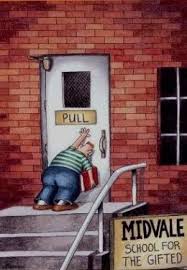
While I understand this teacher's frustration, the view that these students are 'wasted' hit a chord with me. I understand the intent, but would like to argue that instead of looking at these students as 'wasted potential', it is healthier for everyone to regard any underachiever as having "untapped" or "undisciplined" potential. As with most of us, we all have strengths and weaknesses. As a parent and a teacher of intellectually gifted kids, I have found three major sources of gifted underachievers.
These students often have weaknesses that are not always or easily found because the gifted can better mask and overcompensate. It is our job to find their Achilles heels and help them reach their potentials. We can do this by observing them in and out of class, noticing their successes and better accepting and understanding their failures. I truly believe students always initially try; they breakdown with continued failures (both seen and unseen).
Another source of underachieving is ATTENTION. The material is often too slowly presented or the content too shallow and they go off on mind-trips to further stimulate their intellect. It is our responsibility to help them better discipline and refine their attention by helping them better recognize when they take mind trips; helping them regroup when mind trips have been taken; and empowering them with strategies to prevent the mind trips.
A third source is undisciplined work habits. So often content is too easy they never learn how to STUDY or PREPARE content because they have been able to 'wing' it. This inevitably comes back to bite them. They have to be challenged and taught how to break work down and how to best prepare. They, like everyone else must learn how to STUDY, RESEARCH, and RELATE.
And, we as parents and teachers must advocate for their needs. The truth is I see gifted as wasted potential from a totally different perspective. There are so many GIFTED and TALENTED among us, many of whom are not even noticed. We are so busy trying to get everyone to meet certain standards, the 'bar' for the talented is lowered or ignored. It is these kids who go unnoticed and unchallenged who are WASTED POTENTIAL - and a wasted resource.
He steered into the high school parking lot...Crinkled chip bags...Soda cups... on the passenger seat, a rumpled SAT practice book...Before opening the car door ... he twisted open a capsule of orange powder and arranged it in a neat line on the armrest... leaned over, closed one nostril and snorted it...
Throughout the parking lot...eight of his friends did the same thing...The drug was not cocaine or heroin, but Adderall, an amphetamine prescribed for attention deficit hyperactivity disorder that the boy said he and his friends routinely shared to study...focus during tests and ultimately get the grades...The drug did more than just jolt them awake...it gave them a tunnel focus tailor-made for the marathon of tests long known to make or break college applications.
Observed Gary Boggs, a special agent for the Drug Enforcement Administration, "We're seeing it all across the United States."
The D.E.A. lists prescription stimulants like Adderall...Vyvanse...Ritalin...Focalin as Class 2 controlled substances - the same as cocaine and morphine - because they rank among the most addictive...they carry high legal risks too...the same as selling it and can be prosecuted as a felony...abuse...can lead to depression and mood swings (from sleep deprivation), heart irregularities and acute exhaustion or psychosis during withdrawal.
Paul L. Hokemeyer, a family therapist...said, "Children have prefrontal cortexes that are not fully developed, and we're changing the chemistry of the brain. That's what these drugs do. It's one thing if you have a real deficiency - the medicine is really important to those people - but not if your deficiency is not getting into Brown."
"isn't it just like a vitamin?" asked one high school junior from Eastchester, a suburb of New York.
The mother of one high school freshman... said she would open the kitchen cabinet every morning and watch her son take his prescribed dose of Ritalin. She noticed one day that the capsule was strangely airy and held it up to the light. It was empty...A number of teenagers interviewed laughed at the ease with which they got some doctors to write prescriptions...Many youngsters with prescriptions said their doctors merely listened to their stories and took out their prescription pads.
We allowed athletes to do this for so long, we are now allowing kids to do this unattested. Awareness and commitment to our kids has to grow. The problem is so overwhelming. Too much emphasis on SAT's and tests in general, too much labeling, too much leniency in drug prescriptions, and not enough effective means of monitoring. Then of course there is the source of their incredible stress that must also be addressed!
I admire the mom who checks and watches her son take his meds, but parents can't always do this. We can't easily or effecitively 'drug test' before exams, schools have little way of monitoring either. We may need to more closely monitor the labeling and prescription giving. Maybe, drugs for minors need to be 'administered' by parents and school personnel only - although I doubt this is practical or even possible. Part of the solution, however, also lies in relieving the source of their stress. We somehow have to address this incredible competition for colleges and the roles the 'gatekeepers' play. Maybe we as parents have to realize and relay to our kids that getting into that Ivy League college is not the only solution for success. There are other excellent institutions and other equally successful options and paths your young adults can follow on their journey to inner growth, intellectual growth, and success.
For anyone interested in links for drug abuse/addition here are some links:
I was recently at Macmillain Publisher's children's Fall 2012 preview event and their books are AWESOME!!!! (A sneak peak will follow in a future post.) What struck me, however, was the buzz all the editors used... Visual Literacy.
From: geekologie.com
Visual literacy is the ability to interpret, negotiate, and make meaning from information presented in the form of an image. Visual literacy is based on the idea that pictures can be “read” and that meaning can be communicated through a process of reading. (From:wikipedia.org)
We need visual literacy to:
- read maps;
- read charts and graphs;
- decipher icons on computer, cellphones, tablets;
- encourage reluctant readers to read;
- read music;
- comprehend nuances in bold, italic, and varied fonts in words they see every day;
- decipher letters when learning to read - visual letter recognition relies on visual literacy;
- read faces/body language when interacting with others (or watching movies, videos, TV).
This is the third in a series of posts on visual literacy. Each post can be read independently or in conjunction with the other. Here's a quick synopsis:
Part 1: "Visual vs. Verbal Literacy" relates how BOTH visual and verbal literacies are vital for learning and cognition; suggested readings for kids of all ages are included.
In this post - Part 3, I focus on visual literacy as an aid to critical thinking (understanding and recognizing relationships, developing creativity, and reasoning) and attention.
I. HOW VISUALLY LITERATE ARE YOU?
Look at the picture below. [It was taken from Tribes: The Dog Yearswritten by Michael Geszel and Peter Spinetta, illustrated by Inaki Miranda with colors by Eva de la Cruz, produced by Soulcraft Comics (the book is on sale online and is geared for young adults and over - an AWESOME read). NOTE: This is the first book about the world which is organized into tribes, each of which is led by its elders - all below the age of 21.]
Answer the following questions:
PART I
Where does this take place?
When does this take place?
How does this tribe survive and care for its members? What is it's main form of sustenance?
How might you describe this tribe's culture?
Would you want to live in this tribe? Why / why not?
PART 2: And, a few more questions:
Did you notice the rubber ducky? What purpose might it play in this tribe's culture?
Did you notice the "One Way" sign? What purpose might it play?
Does my pointing it out the rubber ducky and one-way sign change or influence any of your other responses?
How would you answer Eisner's six questions (which are discussed below):
How does the image affect the viewer?
How is the image composed?
How do the symbols that appear in the image affect the meaning?
How does the subject matter affect the viewer's responses?
How do the materials used affect the meaning of the image (photo, drawing, computer generated images, animation...)?
How does the cultural context affect the production and understanding of the image?
Note: I will post the answers on Thursday, June 14th. If you want, feel free to leave your answers in the comments section.
II. SOME EXPLANATION: Visual literacy aids critical thinking because when reading a face or a picture, one must construct their understanding. There are no words to tell 'readers' what to think, there is an image relaying 'bits' and hints of information - as evidenced above. It is this CONSTRUCTION that we use when reasoning, comparing, contrasting and creating.
Visual literacy aids boosts attention and attention skillsbecause by definition, one must stop, look, attend to the art, and then proceed to make sense out of all its components.
Elliot W. Eisner, professor emeritus Art and Education at the Stanford University School of Education and known for his work in arts education, curriculum studies, and educational evaluation noted:
"Our language development does not define the limits of our cognition." Conversely, "our cognition is not defined by the limits of our language development."
He then offers a series of questions to facilitate students' cognitive development using images:
How does the image affect the viewer?
How is the image composed?
How do the symbols that appear in the image affect the meaning?
How does the subject matter affect the viewer's responses?
How do the materials used affect the meaning of the image (photo, drawing, computer generated images, animation...)?
How does the cultural context affect the production and understanding of the image?
Each of these questions should be incorporated into discussions in your classrooms and homes to better understand the full message images relay in books, advertisements, etc.
My point here is that
the colors used
the design of the page
the letter fonts, sizes and even letter/word placements
the details of faces, places,and objects added in the picture. ..
...THEY ALL were used by us to construct some level of understanding - they are the basics of visual literacy.
Aside from the importance of images to help aid in critical thinking and attention, we live in an age where visual icons and illustrations are an integral part of our daily lives - from deciphering icons on our phones and computers, to building furniture bought for our homes, or using/viewing clips from pinterest or YouTube...(you get the message). Images and communication via images are EVERYWHERE!
III. SUMMER SUGGESTIONS to help build your family's visual literacy:
Have an origami day - construct origami figures by following graphic instructions.
Talk about messages that colors, fonts and images relay - play around with them and make non-verbal messages for each other. Try leaving daily messages for family members using icons instead of words. How well does that work?
Make maps - treasure maps for dessert, or for a gift, or map out vacation plans.
Have a crafts day, where everyone 'writes' up craft directions for a project to be completed by another family member BUT... the directions are all given through charts, icons and/or illustrations. How did the crafts projects come out?
Keep a visual diary of vacations, of camp, of a fun family activity - using photos and illustrations. Compare this to written entries. How does it compare?
Read graphic novels aloud - talk about the information the pictures relay and how the images ADD to the story line.
Watch Disney's Carl and Ellie's story in Up (I've attached it below) or the first half of WALLE with a critical eye. Talk about how these movies told their stories visually - with limited or no words. How were the emotions and thoughts of those characters relayed?
Thanks for the visit. Please leave your reactions and/or quiz answers in the comments and please make sure you check back on Thursday, June 14th for the answers. In the meantime, have a great week.
FOR YOUR WEEKEND ENTERTAINMENT...HERE ARE THE ANSWERS TO THE QUESTIONS ABOVE:
Part I
1. This takes place on earth in what looks like the plains area of the United States.
2. This takes place in the future. You can tell this by signs of technology: the signs at the entrance of the 'village', the sunglasses worn by one of the characters in the bottom right corner, and the one-way sign on the center character's shirt. (The reader also know this as it is stated at the beginning of the book.)
3. The tribe survives by hunting and gathering - you can see the laden sleds entering the village - this is seen relatively clearly in the inserted box at the top right corner.
4. This is a social tribe - you see that by its configuration - semicircular, inclusive; we see this by the way the background characters are interacting in the bottom panel. They appear strong, concerned, not hostile.
5. That's a very personal question...
Part 2:
The rubber ducky is in the bottom right corner, hanging from the (Shaman's) stick.
The one-way sign is on the center character's shirt.
1. Personal... I find it the image engaging and inviting - what about you?
2. I love the horizontal panels with the inserted boxes. I find the boxes really bring in and engage the reader. What about you?
3. I think these symbols give A LOT of information. They tell you these are 'modern' or even post-modern times and that these tribes have 'collected' and used abandoned resources.
4-6 Personal opinions
Thanks for playing - I hope you enjoyed the challenge!
As a parent, a teacher, and a school psychologist, I know first-hand how frustrating underachievement is. In this post, I discuss possible sources of underachievement and provide potential interventions.
Undiscovered weaknesses or uneven learning skills
Most of us are strong is some areas and weak in others. Often these weaknesses go undiscovered and the child appears to be an underachiever. Here are some often overlooked areas of weakness:
Weak visual learners. Some students are excellent verbal learners but cannot process information presented visually in graphs, charts, or process details in illustrations or visual clips. If undiscovered, "talented" students appear to perform "below their expected performance level". Possible paths of action:
"read" pictures together - comics and graphic novels are GREAT materials for this. Talk about how the information is relayed using letter fonts and sizes, different colors, facial expressions and visual icons. Here are some links with suggested kids' graphic novels and another that discusses visual literacy;
have students practice visual learning at home (outside of school so there is no embarrassment) encourage students to practice reading graphs and charts at home. Here, for example, is a link for mapping skills which will help kids learn to relay information with target words and visual organizers;
here's a link on reading graphic images - discuss how concepts and objects can be labeled with words or with icons - take out your phone or computer and play with the icons, when walking or driving, talk about the visual signs and billboards and the messages the pictures relay;
discuss this with your child's teacher. Ask for a 'heads-up' before an up-coming unit, exam or even a lesson with a lot of visual icons, graphs, charts, etc. where you (or some other responsible adult) can preview the unit with your child BEFORE the class or exam - to boost and bolster their skills and confidence. If your child walks in cold, he or she can easily just 'shut down' and you want to try to avoid this pattern of behavior.
Weak verbal learners cannot process lectures, or dense dry passages (having receptive language weaknesses) and/or they cannot efficiently express - in writing or in speech what it is they want to say (expressive language weaknesses). Here too, if undiscovered, "talented" students appear to perform "below their expected performance level". Possible paths of action:
have your child practice expression at home with an adult (outside of school so there is no embarrassment). You can leave notes for each other on pillows, refrigerators, in lunch/snack bags;
Graphomotor weaknesses can hinder test performance and students 'underachieve' because they cannot efficiently relay the information they know and have learned. It may take your child too long to write what he or she needs to write; OR your child may be so daunted with having to write an essay, he or she may just relay 'the basics' and chose not to write in detail because it is too difficult to physically write, or they may not be enough room on the page or in the allotted space for his/her large, uneven handwriting; OR in math the 4's become 9's, the 3's become 8's. the 7's become 1's. In such cases, they may have accurately solved the problem while the answer itself is wrong because somewhere along the way they inadvertently changed the digits in the problem. Possible paths of action:
practice penmanship AT HOME (outside of school so there is no embarrassment);
have your child write out all math problems with large spaced graph paper, where they put each digit in one of the 'boxes';
for tests, talk to your child's teacher and ask him or her to make sure there is enough space right under the question for your child to respond. In math, for example, if students have to turn the page over to write their answer, I guarantee they will miss-copy the question.
ATTENTION weaknesses can be another contributor to underachievement. One word may trigger associations and these kids are off on fascinating "mind trips" or tangents, often missing important details (see youtube clip below). OR, students may fail to see the 'relevancy' of the lesson and simple turn off because it 'is boring'. Bart Simpson and Billy Madison are two such characters who have 'tuned out' because they saw no relevancy to their school lessons. Possible paths of action:
help students find relevancy to what they're learning. Talk about what they learned at home (dinner, maybe) or when driving to after-school activities. You may want to relate what they are learning about to current events or to books you've recently read, or movies you've recently seen;
make sure the lessons move at a comfortable pace - provide additional resources for the weak and (different more challenging ones ) for the advanced learners to keep their attention;
regardless of what the lesson is, make sure the kids understand 'what's in it for them';
here is a link on attention you may want to check out;
as a parent, if you think your child is bored in a class, find ways of enriching what he/she is learning in class - go to the library and find related books, go online and search for related links to help make the material more challenging and more meaningful.
SOCIAL FACTORS often come into play with underachievers. For some, 'smart' is not cool so they dumb-down to fit in with the group of friends and avoid bullying. Possible paths of action:
here is a link on nerds and bullying which play into these social factors;
there may be other social and emotional factors that feed into underachieving which are beyond the scope of this post. TALK with your child and know that while they'll often say 'the homework is stupid' or 'the class is boring' there is always more to it. Ask about their friends, ask what your child does at recess and who he/she plays with, talk to the teacher and try to get additional insights into social aspects that impinge on school performance.
Regardless of the possible sources of underachieving there are a few generic interventions you can take:
reinforce good work and good grades;
set up structured goals and celebrate their achievement;
help your child organize his/her schedule and required assignments;
make your child accountable for homework assignments and projects;
establish routines making sure your child gets enough sleep, has ample time to do homework and 'play'.
In closing here is a video clip of an unlikely pair of underachievers -where one word links associations taking them on mind trips, missing material and resulting in ...well enjoy!
I hope you found this discussion relevant and helpful. Please share your experiences, suggestions, and opinions in the comments. Have a great week and thank you for your visit!
There is a good deal of truth to Tevya's line from Fiddler on the Roof that "...because of our traditions, we've kept our balance for many, many years..."
Tradition (noun - whose origin is traced to Middle English 1350-1400) means:
"the handing down of statements, beliefs, legends, customs, information, etc., from generation to generation, especially by word of mouth or practice....
Tradition has been shown to provide a comfort and stability to family life and is essential for our kids' development. Their particular rites create a sense of identity, unity, warmth and security. While we often think of traditions as religious practices and rites of passage, traditions are found in all aspects of our religious and/or secular lives.
Social scientist, Ernest W. Burgess, Professor of Sociology at The University of Chicago has studied family traditions and noted that:
"Whatever its biological inheritance from its parents and other ancestors, the child receives also from the a heritage of attitudes, sentiments, and ideals with what may be termed the family tradition, or family culture."
So let's talk traditions - traditions worth pursuing/continuing, and others worth tweaking:
Family Dinners-
provide opportunities and vehicles for families to learn to communicate effectively - sharing personal events and issues faced that day, sharing relevant current events, bouncing and brainstorming ideas off of each other;
discussing each family member's day together at the table relays your interest in each one's lives - providing kids with healthier self-concepts and opportunities to comfortably share ideas and opinions, and take risks;
provide opportunities to validate, clarify, and explain emotional events and behavior
provides opportunities to learn and model manners and practice consideration;
research shows that the more often families eat together, the less likely kids are to smoke, drink or do drugs, and the more likely they are to do well in school, delay in having sex, and exhibit healthier eating/food habits;
passing down family recipes is a way of passing down identity and heritage.
National holiday celebrations -
sharing a Thanksgiving meal with friends and neighbors; or reenacting the Plymouth Rock dinner;
Fourth of July picnics - (in our family we also have an annual screening of 1776 where we watch and sing along - corny, I know, but true and loads of fun);
watching or participating in holiday parades.
Family Holiday and Birthday celebrations
Religious celebrations
Annual family vacations - and/or family game nights planning, traveling and playing together on an annual or regular basis - not at home teaches and models brainstorming, calculated 'risk' taking, and allows the family to collect very special memories of unity, belonging and just plain fun
Religious holidays - aside from unifying the family by attending church or temple and praying together, religious holiday celebration also helps extend your kids' sense of community
Rites of passage family rituals -
to help wean my kids off bottles and diapers, we had 'bye-bye baby bottle and diaper' parties. When I felt my kids were ready to wean, we would talk about having a party. It helped make that transition easier and much less anxiety producing. We also had a lot of fun planning and brain-storming. And best of all, it became their decision.
First School rituals - making a ritual of visiting the new school, having a party the night before the first day, buying notebooks or pencils and pens and other school supplies;
Communion/ Bar and Bat Mitzvas
Sweet Fifteens and Sweet Sixteens
Weddings
Graduations
On the other hand, there are some traditions, that do not and maybe should not necessarily be passed down:
All jokes aside, each of our family (and cultural) traditions help add a sense of family, community, trust, stability and unity. What are some of your family/community traditions? Please share them in your comments.
Shakespeare is believed to be the most read author in the Western Hemisphere other than the Bible. Whether this is true or not, his work is integral to our cultural past, present, and future.
Why is his work so popular and integral to our culture?
Shakespeare's work uncannily captures the good and bad in human nature in such a way that even today we can easily relate to the issues and emotions faced by his characters;
He took (familiar) older stories/poems/myths and reworked plot and /or language in such a way that audiences easily related and understood the passions, challenges, loves, hates,and motives of all his characters - and yet there is nice depth to them;
Shakespeare was the master of the art of language. He fabricated meaningful and nonsensical words making sure audiences were involved in the performance (and not just those down by the stage), he toyed with puns, curses and saucy slams, and he spoke of the people and to the people with wit, passion, humor, insight and sensitivity.
And yet, given all this, his work is often hard for younger audiences and today's students to understand.
Why Shakespeare may be challenging and helpful hints and tools to tackle his great works:
Inconsistent writing format: Shakespeare's plays are part verse, part prose. While verse follows a regular, rhythmic pattern (usually iambic pentameter), prose has no rhyme or metric scheme as it is the language of everyday common conversation. This can often make reading Shakespeare more challenging for beginners.
Helpful hint #1: In modern published editions of his work, each line in a multi-line verse passage begins with a capital letter; while each line in a multi-line prose passage is in lower-case letters, except for the first line or beginning of that passage.
Helpful hint #2: Shakespeare typically used verse to express deep emotion, share deep insights, inject irony, or simply share a lyrical poem. He typically used prose to relate commonplace discussions, make quick one-line replies, poke fun at characters who lack wit or to suggest madness (in King Lear, Lear speaks almost exclusively in verse for the for half of the play but wavers between verse and prose as the story and his madness progress).
Artistic liberty: In Shakespeare's time, there were no official English dictionaries. As a result, Shakespeare 'penned' words as he chose to spell and use them, often taking words from Italy, France and other countries. Furthermore, when words did not exist, or could not fitinto the meter of his works, he would make them up (see the next bullet). These 'creative' spellings and word usages make reading his works fun for some, challenging for others.
New words: William Shakespeare used approximately 17,000 words in his plays, and almost 2,000 of those, were words he 'tweaked' or made up. He did this by changing nouns into verbs, verbs into adjectives, adding prefixes and suffixes, and coining a few all on his own. Consider the following list of fifty plus words that, as far as can be told, were first found in Shakespeare's writing:
New compound words: Aside from coining or 're-minting' individual words, Shakespeare combined and connected words never before used together, creating new compound words such as:
Weird sentence structure: Shakespeare frequently shifted his sentences away from "normal" English arrangements in order to:
create the rhythm or rhyme he sought;
use a line's poetic rhythm to emphasize a particular word; or
give a character his or her own speech pattern and /or to identify his or her social status (i.e. in Romeo and Juliet, the servants and nurse have very different speech patterns from Romeo, Juliet, and their social peers).
How did he do this?
Look for the placement of subject and verb. Shakespeare often puts the verb BEFORE the subject. For example, in Act 1, Scene 1 in Romeo and Juliet, line 140, Montague says, "Away from light steals home my heavy son." (Instead of "...my son steals home.")
Sometimes Shakespeare placed the object or adjective before the subject and verb. For example in Act 1 Scene 2 line 4 of Romeo and Juliet, Paris says "Of honorable reckoning are you both."
Imagery and figurative speech. Shakespeare frequently used literary devices such as:
Hyperbole (exaggerations);
Simile (comparing one thing to another using "like" or "as");
Metaphor ( comparing one thing to another without "like" or "as");
Oxymorons (combining words opposite in meaning, such as 'freezing fire', usually to startle the audience and make them think);
Archaic speech. some words used in Shakespeare's plays have fallen into disuse or their meanings have changed. Here are a few:
anon = straightway
buckles = small shields
marry = indeed
heavy = sorrowful
o'er = over again
morrow = morning
Given all these challenges, reading, studying and acting out Shakespeare's plays is just loads of fun.
Shakespeare Starter Suggestions:
Start them with the stories, with the magic in the stories, great characters. Some of the easier plays are the ones with a lot of dialogue (and not necessarily the famous soliloquies) such as Much Ado About Nothing, Twelfth Night, and The Tempest. Macbeth can be fun for the more morbid kids, kids into witches and high drama.
Watch classic video clips. Here are a few of my favorites:
Great slams: Beatrice and Benedick arguing in "Much Ado About Nothing"
The games people play in (and accepting) love: David Tenant and Catherine Tate in Much Ado About Nothing
Great motivating speech: Henry V St. Crispin's Day Speech to the troops from Henry V
On bigotry, antisemitism and revenge; Shylock's monologue from The Merchant of Venice
On life, living, the seven ages of man, and the 'stage' - from As You Like It
I hope you find these resources helpful. Please share some of your favorite teaching/viewing/reading Shakespeare moments of your own in the comics. Thanks for you visit and have a great week.
Thinking of risk, J.P. Morgan Chase's blunder which surfaced this past week takes center stage. Interestingly, there were two articles in this past Saturday/Sunday Wall Street Journal(May 12-13, 2012) address risk-taking. My intention is to present excerpts from these articles on risk taking and relate how we as parents and educators can address our kids' school-related risks.
From openinno.wordpress.com
The Intelligent Investor column by Jason Zweig (Sat/Sun May) "Polishing the Dimon Principle" discusses James Dimon's (J.P. Morgan Chase's chief executive) failed reasoning, comparing it to what he calls "The Feynman Principle." (Richard Feynman was a Nobel Prize-winning Physicist who worked on the Manhattan Project, quantum physics, discovered the source of the Space Shuttle disaster, and in his spare time was an artist and musician.) According to Zweig:
The Feynman principle, however, is simple: "You must not fool yourself—and you are the easiest person to fool," as the Nobel Prize-winning physicist Richard Feynman put it.
The article continues:
The moguls of J.P. Morgan, in letting a complex risk run wild and denying any potential for error until it was too late, are a reminder that one of the biggest dangers in finance is self-deception.
...You can also fool yourself by placing too much faith in the findings of supposed experts. Mr. Feynman recounted the story of an influential formula for measuring the charge of an electron ...devised by...pioneering physicist Robert Millikan. The result was slightly wrong, but it took many researchers years to prove it wrong - since Millikan's successors assumed that he had to be right."
In section C (page C1) of the WSJ, there is a second article by Dylan Evans, "How to Beat the Odds at Judging Risk: Fast, clear feedback is crucial to gauging probabilities; for lessons, consult weathermen and gamblers."
Whether as a trader betting on ... a stock, a lawyer gauging a witness's reliability or a doctor pondering the accuracy of a diagnosis, we spend much of our time—consciously or not—guessing about the future based on incomplete information. Unfortunately, decades of research indicate that humans are not very good at this. Most of us, for example, tend to vastly overestimate our chances of winning the lottery, while similarly underestimating the chances that we will get divorced.
The article continues noting, however, that
"...certain groups of people—such as meteorologists and professional gamblers—have managed to overcome these biases and are thus able to estimate probabilities much more accurately than the rest of us.
The article continues noting that Sarah Lichtenstein, an expert in the field of decision science, points to several characteristics of groups that exhibit high intelligence with respect to risk.
They tend to be comfortable assigning numerical probabilities to possible outcomes (in 1965, for instance, U.S. National Weather Service forecasters have been required to predict weather patterns such as chance of snow or rain in percentage terms);
They tend to make predictions on only a narrow range of topics (probability of rain - a narrow prediction vs. the probability of a drug's effectiveness, which involves many more factors and is therefore a much more complicated prediction);
They tend to get prompt and well-defined feedback, which increases the chance that they will incorporate new information into their understanding.
This, in part, may explain Dimon and J.P. Morgan's recent trading failures: placing too much value on possibly faulty 'formulas' set by other 'giants', fooling oneself into believing what we want to believe, and making faulty predictions on a complicated 'bets'.
Translating Risk Research for Home and School:
Risks are important to take. As parents, we make and take risks all the time - in choosing schools and summer programs, and evaluating and acting upon professionals' recommendations, to name a few. Students must also take risks: in choosing school-project topics, books to read, deciding what comments to share and how best to share them. Students take risks when taking tests - knowing what answers to answer and how to select the 'best' response. Kids take risks in sports, socially, even dressing. We need to empower our kids to take risks, while teaching them how best to do this.
I am not an investor or an economist, but Feynman's Principle and the research by Sarah Lichtenstein and Dylan Evans rings true for me as a parent / educator:
Avoid fooling yourself: While this is intrinsically difficult to do, here are some things to help you better understand your kids, their teachers, their health, their skills:
look at and listen to various sources to better understand our kids' strengths and weaknesses.
look at their actual successes and failures in and out of school - review their homework assignments and tests once graded; meet with teachers;
listen and weigh teacher/physician/professional evaluations; while
talking and listening to our kids to get their perspectives as well.
This is important to constantly monitor as parents while modeling and teaching these skills to our kids as well. Play prediction games with your kids - assigning specific numbers or values to what it is you are predicting. This will help them understand 'number' concepts, better understand variables effecting the outcomes they are predicting, and better understand their own skills. Here are some examples of what they might predict:
Have them predict on how well they will do on a test or paper. Make sure they assign themselves a number or letter grade. Then check for immediate (or relatively immediate feedback). Chart these predictions to see if they improve in accuracy while reviewing and incorporating teachers' comments.
Predict how long it will take them to complete homework assignments. Here too, chart their predictions and monitor their accuracy. Not only will this give them a better sense of their skills in that subject, it will help them develop a keener sense of time, all while helping them analyze their skills and (homework) risks.
Play games of chance and risk. Discuss options and probabilities. Assign numbers or 'grades' to your 'chances'.
These are just a few suggestions. I'd love to hear your suggestions and reactions. Please share them in the comments. Thank you for your visit and have a wonderful week.
Quests typically relate a character's need to undergo some form of travel, trial, and/or tribulation, searching for an endeared object, potion, chalice, answer, loved one, treasure, etc. It involves peril, persistence, and the overcoming of formidable obstacles.
Joesph Campbell in The Hero With a Thousand Faces explains quest in great detail, and may well be worth your look. According to Campbell, in myth and stories themonomyth or hero's journey follows a basic pattern. Campbell describes 17 stages or steps that can be broken down into three main sections:
The "Departure" which deals with the hero's adventure before the quest (and often involves some form of initial denial and the meeting of a mentor or guide);
The "Initiation" dealing with the hero's adventures and journeys while following the quest; and
The "Return" where the hero has faced his or her quest and returns with knowledge, wealth, and/or power gained on the journey.
In 1997, Muse Magazine (The Smithsonian Institute's young adult magazine) published an article, "Star Wars: It's Just Another Myth" by Mary Henderson (now a book Star Wars: The Magic of Myth). In the article, Henderson condensed and delineated Campbell's steps while illustrating how Star Wars, the King Arthur story, the story of Perseus, and Tolkien's Bilbo Baggins from The Hobbit all follow Campbell's steps. The article provides a wonderful template for young readers and writers to follow when evaluating and creating their own quests and adventures.
Here is Henderson's template of heroes' quests as found in the article:
The quest is to...
The hero (discovers) he/she's the son/daughter of...
But he/she was raised by....
The call to adventure comes when...
The wise and helpful guide is...
The magic talisman is...
The hero undergoes ordeals and difficulties when he/she...
The hero performs daring deeds when she/he...
The hero returns home to...
In the end she/he...
The Power of Quests:
Aside from being engrossing and fun to read, watch, or play, quests serve very important roles in children's education.
Literature - is full of quests. Knowing the templates or 'essentials' of quests make them easier to recognize, understand and follow. Understanding a quest's basic 'ingredients' also makes it easier for kids to create and write their own.
History - leaders and nations must face quests and obstacles in their growth to maturity and power. Familiarity with quests and heroes makes studying history more familiar and more interesting, which in turn, adds depth and additional memory associations.
Life's Lessons - fortunately or unfortunately kids face numerous obstacles in their daily lives. They are often "called to action", often seek mentors or guides, and face challenges and daunting tasks (be they intellectual, social, or physical). As they develop and grow from the world of childhood to that of adulthood - the rules often change and are often not what was expected. Having heroes(and templates) to learn from and about, can only help them find comfort while meeting and mastering their own personal quests.
Educational applications:
Discuss the obstacles and quandaries heroes must face - be they Moses, Jesus, Luke Skywalker, Perseus, Harry Potter, Matilda, Bilbo Baggins, etc.
Create your own myths from this template - write, act, relate stories of heroes.
Brainstorm other possible solutions and paths for famous quests. Discuss the 'paths not taken'.
Compare the fate and journeys of religious figures to those of modern, historical figures and of literary figures. Evaluate the similarities and differences in their quests. Discuss the lessons learned and values exhibited.
Some of my favorite (less well-known) stories of quests: Dealing with Dragons(ages 6+) by Patricia Wrede - about Cimorene a princess who is tired of learning etiquette and wants to learn about math and the world. Johnny Tremain (ages 9+) by Esther Forbes - a story of Johnny a silversmith apprentice who suffers a terrible injury and must find his true path. Along the way the finds himself involved with the Sons of Liberty, Paul Revere, the Adams cousins (Sam and John), John Hancock, and others. I Kill Giants (ages 10+) by Joe Kelly - a story about a girl who must kill the giants in her life. The reader, intitially, is unsure whether there are real giants or metaphors. I won't ruin it for you as this is a MUST READ book for kids grade 5+. The Book of Three (ages 8+) by Lloyd Alexander (the first of The Chronicles of Prydain series) about a boy, taran, ward of a prophetic pig who reluctantly must guard the pig and fight the evil following the pig in order to save all he holds dear. The Giver (ages 10+) by Lois Lowry - about Jonas who lives in a dystopian society and must (reluctantly) learn to be the next Giver. Ender's Game (ages 10+) by Orson Scott Card about eight-year-old gifted Ender who is reluctantly recruited by his government for s special space/defense school. A Wrinkle in Time(ages 9+) by Madeleine L'Engle about Meg Murry who (reluctantly) is transported through a tesseract (a fifth dimensional wrinkle in time) with her younger brother Charles Wallace and friend Calvin O'Keefe to rescue her (scientist) father from evil forces holding him captive on another planet. Inkheart (ages 8+) by Cornelia Funke - about Meggie and her father who must (reluctantly) read characters out of books Pink and Say(ages 5+) by Patricia Polacco about two boys fighting for the Union - one black one white - who must find a way to stay alive and save their families during the Civil War.
In closing, for those seeking quests for 'older' and more 'mature' audiences, one of my favorite quests was Monty Python's Monty Python and the Holy Grail. Here is a brilliant excerpt I hope you enjoy (the quality of the YouTube clip isn't great, but it is good enough and well worth the view):
These are just a few suggestions. Thank you for your time and visit - I hope to see you here next week. In the meantime... Please leave your own favorite quests in the comments.
 I find myself torn this week between two reaction posts and so have decided to combine them under one heading...WAY WRONG. One has to do with a comment left in an earlier post about "wasted potential" and the other a response to a front page New York Times article, Sunday June 10, 2012 "Risky Rise of the Good-Grade Pill" Please let me know what you think in the comments.


![[RISK]](http://si.wsj.net/public/resources/images/RV-AG849_RISK_DV_20120511015044.jpg)





- These students often have weaknesses that are not always or easily found because the gifted can better mask and overcompensate. It is our job to find their Achilles heels and help them reach their potentials. We can do this by observing them in and out of class, noticing their successes and better accepting and understanding their failures. I truly believe students always initially try; they breakdown with continued failures (both seen and unseen).
- Another source of underachieving is ATTENTION. The material is often too slowly presented or the content too shallow and they go off on mind-trips to further stimulate their intellect. It is our responsibility to help them better discipline and refine their attention by helping them better recognize when they take mind trips; helping them regroup when mind trips have been taken; and empowering them with strategies to prevent the mind trips.
- A third source is undisciplined work habits. So often content is too easy they never learn how to STUDY or PREPARE content because they have been able to 'wing' it. This inevitably comes back to bite them. They have to be challenged and taught how to break work down and how to best prepare. They, like everyone else must learn how to STUDY, RESEARCH, and RELATE.
And, we as parents and teachers must advocate for their needs. The truth is I see gifted as wasted potential from a totally different perspective. There are so many GIFTED and TALENTED among us, many of whom are not even noticed. We are so busy trying to get everyone to meet certain standards, the 'bar' for the talented is lowered or ignored. It is these kids who go unnoticed and unchallenged who are WASTED POTENTIAL - and a wasted resource.2. Risky Rise of the Good-Grade Pill - A response
Sunday, June 10, 2012 New York Times front page article: "Risky Rise of the Good-Grade Pill: Taking stimulants Not for a High, but for a Higher SAT Score by Alan Schwartz
First, a brief synopsis of the article:
I admire the mom who checks and watches her son take his meds, but parents can't always do this. We can't easily or effecitively 'drug test' before exams, schools have little way of monitoring either. We may need to more closely monitor the labeling and prescription giving. Maybe, drugs for minors need to be 'administered' by parents and school personnel only - although I doubt this is practical or even possible. Part of the solution, however, also lies in relieving the source of their stress. We somehow have to address this incredible competition for colleges and the roles the 'gatekeepers' play. Maybe we as parents have to realize and relay to our kids that getting into that Ivy League college is not the only solution for success. There are other excellent institutions and other equally successful options and paths your young adults can follow on their journey to inner growth, intellectual growth, and success.
For anyone interested in links for drug abuse/addition here are some links:
The bottom line is we are hurting our kids' and our nation's future. Where do we begin?