I find myself torn this week between two reaction posts and so have decided to combine them under one heading...WAY WRONG. One has to do with a comment left in an earlier post about "wasted potential" and the other a response to a front page New York Times article, Sunday June 10, 2012 "Risky Rise of the Good-Grade Pill" Please let me know what you think in the comments.
1. WASTED POTENTIAL
In a recent blog post discussing underachievers, I received a comment that:
As one who teaches intellectually gifted kids, these are the students who make me the craziest! So much wasted potential.
While I understand this teacher's frustration, the view that these students are 'wasted' hit a chord with me. I understand the intent, but would like to argue that instead of looking at these students as 'wasted potential', it is healthier for everyone to regard any underachiever as having "untapped" or "undisciplined" potential. As with most of us, we all have strengths and weaknesses. As a parent and a teacher of intellectually gifted kids, I have found three major sources of gifted underachievers.
These students often have weaknesses that are not always or easily found because the gifted can better mask and overcompensate. It is our job to find their Achilles heels and help them reach their potentials. We can do this by observing them in and out of class, noticing their successes and better accepting and understanding their failures. I truly believe students always initially try; they breakdown with continued failures (both seen and unseen).
Another source of underachieving is ATTENTION. The material is often too slowly presented or the content too shallow and they go off on mind-trips to further stimulate their intellect. It is our responsibility to help them better discipline and refine their attention by helping them better recognize when they take mind trips; helping them regroup when mind trips have been taken; and empowering them with strategies to prevent the mind trips.
A third source is undisciplined work habits. So often content is too easy they never learn how to STUDY or PREPARE content because they have been able to 'wing' it. This inevitably comes back to bite them. They have to be challenged and taught how to break work down and how to best prepare. They, like everyone else must learn how to STUDY, RESEARCH, and RELATE.
And, we as parents and teachers must advocate for their needs. The truth is I see gifted as wasted potential from a totally different perspective. There are so many GIFTED and TALENTED among us, many of whom are not even noticed. We are so busy trying to get everyone to meet certain standards, the 'bar' for the talented is lowered or ignored. It is these kids who go unnoticed and unchallenged who are WASTED POTENTIAL - and a wasted resource.
He steered into the high school parking lot...Crinkled chip bags...Soda cups... on the passenger seat, a rumpled SAT practice book...Before opening the car door ... he twisted open a capsule of orange powder and arranged it in a neat line on the armrest... leaned over, closed one nostril and snorted it...
Throughout the parking lot...eight of his friends did the same thing...The drug was not cocaine or heroin, but Adderall, an amphetamine prescribed for attention deficit hyperactivity disorder that the boy said he and his friends routinely shared to study...focus during tests and ultimately get the grades...The drug did more than just jolt them awake...it gave them a tunnel focus tailor-made for the marathon of tests long known to make or break college applications.
Observed Gary Boggs, a special agent for the Drug Enforcement Administration, "We're seeing it all across the United States."
The D.E.A. lists prescription stimulants like Adderall...Vyvanse...Ritalin...Focalin as Class 2 controlled substances - the same as cocaine and morphine - because they rank among the most addictive...they carry high legal risks too...the same as selling it and can be prosecuted as a felony...abuse...can lead to depression and mood swings (from sleep deprivation), heart irregularities and acute exhaustion or psychosis during withdrawal.
Paul L. Hokemeyer, a family therapist...said, "Children have prefrontal cortexes that are not fully developed, and we're changing the chemistry of the brain. That's what these drugs do. It's one thing if you have a real deficiency - the medicine is really important to those people - but not if your deficiency is not getting into Brown."
"isn't it just like a vitamin?" asked one high school junior from Eastchester, a suburb of New York.
The mother of one high school freshman... said she would open the kitchen cabinet every morning and watch her son take his prescribed dose of Ritalin. She noticed one day that the capsule was strangely airy and held it up to the light. It was empty...A number of teenagers interviewed laughed at the ease with which they got some doctors to write prescriptions...Many youngsters with prescriptions said their doctors merely listened to their stories and took out their prescription pads.
We allowed athletes to do this for so long, we are now allowing kids to do this unattested. Awareness and commitment to our kids has to grow. The problem is so overwhelming. Too much emphasis on SAT's and tests in general, too much labeling, too much leniency in drug prescriptions, and not enough effective means of monitoring. Then of course there is the source of their incredible stress that must also be addressed!
I admire the mom who checks and watches her son take his meds, but parents can't always do this. We can't easily or effecitively 'drug test' before exams, schools have little way of monitoring either. We may need to more closely monitor the labeling and prescription giving. Maybe, drugs for minors need to be 'administered' by parents and school personnel only - although I doubt this is practical or even possible. Part of the solution, however, also lies in relieving the source of their stress. We somehow have to address this incredible competition for colleges and the roles the 'gatekeepers' play. Maybe we as parents have to realize and relay to our kids that getting into that Ivy League college is not the only solution for success. There are other excellent institutions and other equally successful options and paths your young adults can follow on their journey to inner growth, intellectual growth, and success.
For anyone interested in links for drug abuse/addition here are some links:
Mister Rogers Defending PBS to the US Senate in 1969
I admit that in my house we occasionally made fun of Mister Roger's sappy low-budgeted show, and laughed as Eddie Murphy spoofed 'Mr. Robinson's Neighborhood' on SNL, but there was something warm and comforting about watching Mister Roger's Neighborhood. More importantly, there were kids from disadvantaged and troubled homes who needed his soothing, reassuring love and constant commitment.
This clip shows Fred Rogers passionately championing public television and the need to promote "Expressions of Care" while demonstrating that angry feelings can be "reasonable and manageable." My daughter (in her 20's) who grew up watching Sesame Street, Reading Rainbow, and the occasional Mister Rogers, wrote the following reaction: "As a child watching his programming, I didn't quite realize how profound that man was, but man did we loose a leading light when he died."
Just look, listen and feel his passion! It is breathtaking. Where are our champions today?
Let's talk about bullying. It's time to model and teach our bullies more appropriate expressions of conflict while empowering their victims to speak up and not feel embarrassed. Gifted kids should not need to hide their gifts for fear of ridicule. New kids, kids of different ethnicities, sizes, and colors. Rich kids, poor kids, just plain different kids should not feel they have to hide who they are. My kids, for example, should not have had to attend Johns Hopkins University's CTY (Center for Talented Youth) to feel like they belonged. Their schools and clubs should have been able to. Schools, athletic teams, social clubs need to focus on social as well as academic or athletic goals. We need to teach our kids to how to effectively communicate needs and desires and to feel compassion for those who may not be like them. There are two blogs I came across that do just this, you may want to take a look at them:
Now let's talk about graphic novels, and violence: Fredrick Wertham published Seduction of the Innocent (1954) which protested the harmful effects violent imagery in mass media and comic books had on children. [Ironically, the early superhero comics were about standing up to bullies and fighting for the voices of the 'little guys'.] Wertham called television "a school for violence" and his book helped spark a U.S. Congressional inquiry into the comic book industry that led to the "Comics Code." Comic book publishers were to submit their works to the CAA (Comics Code Authority) and those "acceptable" publications would receive a seal of approval. This almost killed the comics industry until recently. Now authors, publishers and readers are finding that comics are not just for adults and there are some truly wonderful, nonviolent fiction and nonfiction publications for kids of all ages.
Yes, there are still violent graphic novels published. There are also very violent novels, movies, plays, music and music videos published and produced as well. It is up to us to promote the positive messages and argue the negative ones.
The Answer as I see it: We need to validate angry feelings while modeling and nurturing appropriate acceptable means of expression. And while Rodgers' puppetry, educational /video clips, even his clothing are now way outdated, his message should not be. We need to promote "expressions of care" in the way we behave, in how we communicate, in the shows we watch, the books we read and the songs we sing.
What we can do as parents and teachers:
It is really important to validate feelings.
If your child or student is angry, insulted, upset, embarrassed, overanxious, etc. acknowledge those feelings - even if you feel they are unwarranted.
IF unwarranted, first, calm him or her down. Once calm, talk in a soothing voice pointing out concrete examples of why he or she may be overreacting. Listen carefully to what they are saying. Continue to acknowledge their feelings while discussing other possibilities.
For a young child, help him or her express feelings. You may want to role play responses (with puppets, dolls, legos, train characters - whatever they will best relate to, find 'fun,' and least threatening).
Brainstorm possible solutions and ways to respond. For a young child who is reluctant to talk about this, you may want to role play with puppets or dolls. When role playing help show your child how to use their words.
When brainstorming, or as a followup, you may want to discuss favorite book, movie, television characters who have dealt with similar issues. Discuss how they resolved the problem. Did it really help? Why? Can the strategy work for your child?
These discussions should be held privately with your child or student. They can then be discussed later, more generically in the classroom as a whole - possibly using story characters (so students involved are not embarrassed or further upset).
If the problem continues, you may want to seek further help from school or medical professionals.
If you see bullying, name calling, shoving, break it up. Don't let it go. Talk to the parties involved.
In your classroom do a lot of group work, mixing up students - helping them learn to work (and hopefully) respect each other a bit more. Supervise group work carefully, monitoring dialogue between frequently targeted kids whenever possible.
If you find your child has been bullied, talk to him or her about it. Talk to the teacher or responsible adults (coaches, playground/cafeteria supervisors - where appropriate).
These are only a few suggestions. I'd love to hear what you do. Let me know how you are promoting expressions of care with your kids. Let me know how you are dealing with violence and bullying. Let's learn from each other while supporting each other - while shaping future Fred Rogers'!
 I find myself torn this week between two reaction posts and so have decided to combine them under one heading...WAY WRONG. One has to do with a comment left in an earlier post about "wasted potential" and the other a response to a front page New York Times article, Sunday June 10, 2012 "Risky Rise of the Good-Grade Pill" Please let me know what you think in the comments.


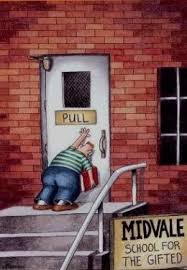
- These students often have weaknesses that are not always or easily found because the gifted can better mask and overcompensate. It is our job to find their Achilles heels and help them reach their potentials. We can do this by observing them in and out of class, noticing their successes and better accepting and understanding their failures. I truly believe students always initially try; they breakdown with continued failures (both seen and unseen).
- Another source of underachieving is ATTENTION. The material is often too slowly presented or the content too shallow and they go off on mind-trips to further stimulate their intellect. It is our responsibility to help them better discipline and refine their attention by helping them better recognize when they take mind trips; helping them regroup when mind trips have been taken; and empowering them with strategies to prevent the mind trips.
- A third source is undisciplined work habits. So often content is too easy they never learn how to STUDY or PREPARE content because they have been able to 'wing' it. This inevitably comes back to bite them. They have to be challenged and taught how to break work down and how to best prepare. They, like everyone else must learn how to STUDY, RESEARCH, and RELATE.
And, we as parents and teachers must advocate for their needs. The truth is I see gifted as wasted potential from a totally different perspective. There are so many GIFTED and TALENTED among us, many of whom are not even noticed. We are so busy trying to get everyone to meet certain standards, the 'bar' for the talented is lowered or ignored. It is these kids who go unnoticed and unchallenged who are WASTED POTENTIAL - and a wasted resource.2. Risky Rise of the Good-Grade Pill - A response
Sunday, June 10, 2012 New York Times front page article: "Risky Rise of the Good-Grade Pill: Taking stimulants Not for a High, but for a Higher SAT Score by Alan Schwartz
First, a brief synopsis of the article:
I admire the mom who checks and watches her son take his meds, but parents can't always do this. We can't easily or effecitively 'drug test' before exams, schools have little way of monitoring either. We may need to more closely monitor the labeling and prescription giving. Maybe, drugs for minors need to be 'administered' by parents and school personnel only - although I doubt this is practical or even possible. Part of the solution, however, also lies in relieving the source of their stress. We somehow have to address this incredible competition for colleges and the roles the 'gatekeepers' play. Maybe we as parents have to realize and relay to our kids that getting into that Ivy League college is not the only solution for success. There are other excellent institutions and other equally successful options and paths your young adults can follow on their journey to inner growth, intellectual growth, and success.
For anyone interested in links for drug abuse/addition here are some links:
The bottom line is we are hurting our kids' and our nation's future. Where do we begin?