Showing posts with label graphic novel. Show all posts

Sunday, December 8, 2013

Using Graphic Novels in Education...SMILE


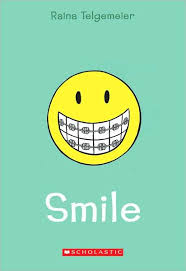
smilecover“Weird…Something happens when you smile at people. They smile back!” – Raina Telgemeier, Smile

Smile is a New York Times bestseller; winner of the 2011 Eisner Award for Best Publication for Teens; winner of the Dorothy Canfield Fisher Award, 2012; winner of the Maine Student Book Award, 2012; finalist for the Children’s Choice Book Award, 2011; ALA Notable Children’s Book, 2011; Honor Book for the Boston Globe-Horn Book Awards, 2010; Kirkus Best Book of 2010; and the New York Times Editors’ Choice, 2010.

In this autobiographical coming-of-age graphic novel memoir, Raina Telgemeier ruminates with humor and honesty on the tumultuous challenges and perils of her teen years: from the trauma of falling one night on her way home from a Girl Scout meeting severely injuring her front teeth, to dealing with boys, earthquakes and the true meaning of friendship.

OVERVIEW
Smile is an empowering, heart-warming story about a typical teenager who feels out of place with her changing body, skin, and teeth, and whose only wish is to be a “normal” teen. What readers realize is that as Raina deals with accident traumas and earthquakes, navigates friendships with her childhood girl friends, and learns how to deal with boys in middle and high school, most of us have some kind of issue we must deal with in adolescence. As such, the book speaks honestly and humorously to us all. From beginning to end, Smile shows us how to gracefully embrace life’s twists and be more sensitive to others who are doing the same.

SUMMARY
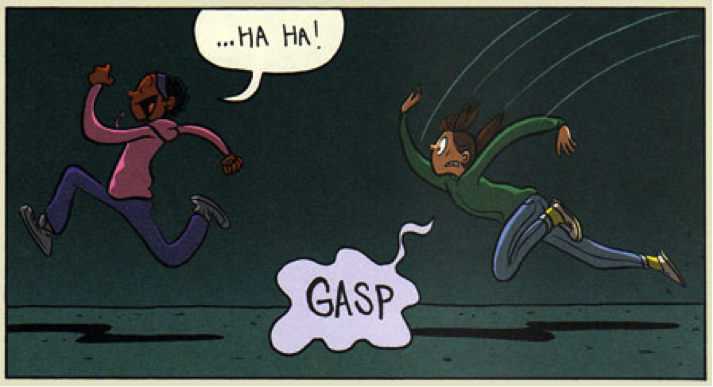
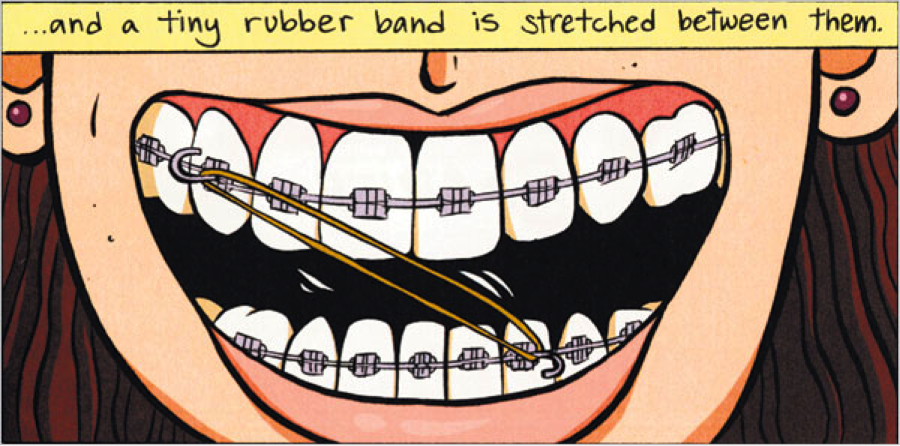
smile01Smile opens with Raina coming home from a Girl Scout meeting and racing with her friends to her front door. As fate would have it, Raina trips over her adolescent feet and realizes that while her bones seem whole and intact, her two front teeth are not. Her parents rush her to the dentist, who inserts the tooth she found and lowers the second tooth that was lodged up in her gums. However, after the tooth cast is removed, they find the gum and bone damage was so extensive that the two front teeth were fused too high in her mouth (looking like an inverted vampire). Raina undergoes a root canal and surgery to reinsert the teeth more securely. The operations fail, and her doctors decide to remove the teeth and with braces and move her other teeth to the front – a process that will take years, patience and considerable discomfort. Raina handles the news and pain with as much aplomb as a teenager might muster, along with some serious couch gaming (and painkillers) after surgery.
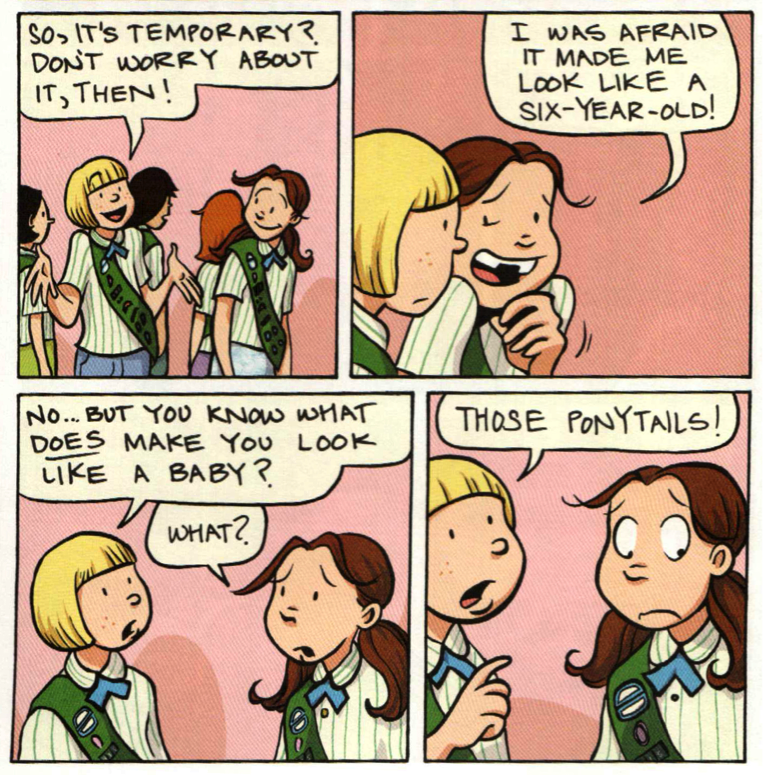
While Raina’s tooth trauma frames the story, Smile is more about the traumas of teen hood. Through the years of braces and orthodontics, we follow Raina as she deals with a scary earthquake, crushes, parties with awkward spin-the–bottle games (which she decides not to join because she wants her first kiss to mean something), fickle friends who tease her (about her looks, her hair, her teeth, and her crushes); and teachers who, while trying to be supportive, instead focus more than necessary on the oral ordeals she’s dealing with.

Raina eventually realizes that lots of other kids have braces and that friendship means supporting each other, not making things harder, and if your friends can’t do that, then they’re not really your friends.
In short, this is an honest story about dealing gallantly with trauma while learning how to feel comfortable within one’s skin and to embrace one’s strengths, weaknesses, and quirks. Finally, it is a book about growing up and realizing that sometimes we need to rethink friendships. Teens in particular are so concerned about being liked and being part of a group that they often give up their individuality and respect. This is a book all about self-concept and respecting oneself.
Throughout Smile, Telgemeier discusses:
    smle02
  • Development of self-concept and individual versus group identity;
  • Development of self-esteem;
  • How to cope with trauma, accidents, and natural disasters;
  • Distinguishing true friends from “comfortable” friends and non-friends;
  • Coming of age issues (belonging and dating);
TEACHING/DISCUSSION SUGGESTIONS:
Plot, Themes, and Values Related
  • Discuss and chart the different themes Telgemeier presents in this work.
  • Compare and contrast how Telgemeier relates these themes in her graphic novel to the way other writers, such as Judy Blume, have done so in traditional prose texts.
  • Discuss what it is like to feel and to look different from others and the importance of fitting in. Brainstorm and evaluate the different ways in which teens can feel and look different.
  • Discuss different types of friendships one might have with others. Detail what it means to be a good friend. Discuss the challenges we have in determining and maintaining friendships, and why this is so important.
  • Chart how Raina grows and matures over the course of the book.
  • Discuss how Raina and her family and community deal with the earthquake, and compare this with natural disasters students have faced in your part of the country. Have students and their parents come up with family plans to help them prepare for and deal with life’s emergencies and natural disasters.
  • Research and discuss root canals. Define and discuss different types of dentists and their specialties.
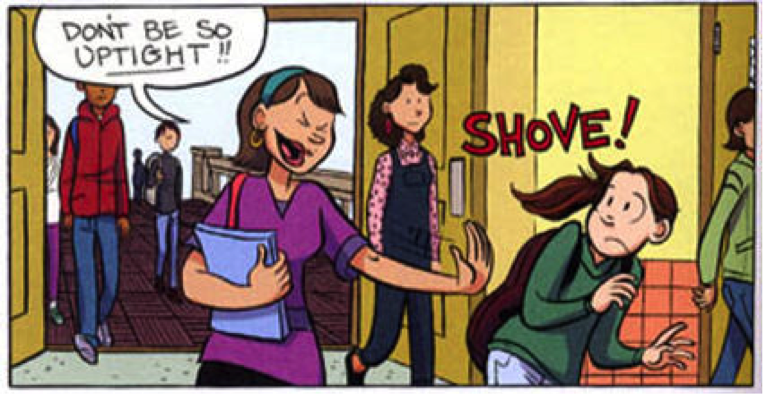
smile03
Critical Reading and Making Inferences
  • Search and discuss the many wise words of wisdom and inference Raina relays in Smile. For example:
    • On page 49, Raina says to her mother, “I’m starting to feel like a real teenager!” Discuss, draw, enact, and relate what being a real teenager means to your students.
    • On page 56, Raina’s mother tries to make Raina feel better and notes, “Lots of kids wear funny stuff to help fix their bodies… You probably just don’t realize it because no one talks about it.” And Raina responds passionately, “Well maybe someone should start talking about it!” Brainstorm and discuss various issues most teens deal with but no one really talks about. Discuss how teens might help raise awareness for those issues.
    • On page 141, Raina ruminates, “What if it is true? What if Sean really would notice me if I dressed differently? Would I be willing to change for him?” Discuss and debate how far, if at all, one should change their looks, interests, personalities, and/or beliefs for someone else.
    • On pages 206-207 Raina reflects, “My life didn’t’ magically turn perfect… Instead I threw my passion into things I enjoyed rather then feel sorry for myself. I realized that I had been letting the way I looked on the outside affect how I felt on the inside. But the more I focused on my interests, the more it brought out things I liked about myself. And that affected the way other people saw me!” Discuss this reflection with your students. Ask them to create a collage of words and / or images that relate the things they do and their interests that help them define themselves.
    • Discuss why Raina was so upset after her first day of high school. You may want students to relay their feelings and impressions of their first day in their current school.
    • Discuss how Telgemeier combines text and images to express and explain Raina’s noting that “I imaging being perfect….won’t happen any time soon” on pages 162-163. Have students explain how Raina knows she won’t be “perfect” for a long time. Discuss what you think her definition of perfect is. What is your students’ definition of perfect? How do these definitions compare/differ? Discuss whether or not it is healthy to have a perfect goal or image.
    • Discuss why Raina dreams during one oral surgery that she is losing a tooth.
Language, Literature, and Language Usage
  • Discuss how Telgemeier uses images and text to foreshadow events.
  • Have students go on a scavenger hunt for idioms, slang, colloquialisms, metaphors, and similes throughout Smile.
  • Plot and compare the author’s use of vocabulary, slang, idioms, and images as she relates how her friends treated her. Chart and compare the derogatory words used by her initial friends versus the supportive words used by her later high school friends.
  • Create a working definition of “hero.” Discuss and analyze whether Raina fits the definition.
  • Have students share their own stories of feeling different and / or their stories of trying to fit in. Compare how the stories are told, and chart the words used to relate their challenges and their feelings.
smile04
Modes of Storytelling and Visual Literacy
In graphic novels, images are used to relay messages with and without accompanying text, adding additional dimension to the story. In Smile, Telgemeier deftly weaves story and background with image, text, and design. Reading Smile with your students allows you to analyze, discuss, and learn how Telgemeier uses page and panels, text, and images to relay complex messages. For example:
  • Compare and contrast Raina’s technique of distinguishing between her dreams (pp. 96-101) and real-life events.
  • Compare when Telgemeier uses a full-page single-panel splash versus pages with multiple panels. Chart when she uses single-panel splashes to emphasize key events or separate chapters and slow the reader down to emphasize particular points of the story, and discuss how effective this method is when story-telling with images. For example:
    • Page 11, right after tripping and getting a bleeding and shocked Raina into the house, there is a single-page panel of a very concerned mom looking in her address book and calling the dentist. Discuss why Telgemeier decides to emphasize this image to help readers fully understand and take in the seriousness of this accident.
    • Compare the page full-page panel (right after the accident) on page 11 with other full-page-panels that signal time or scene changes (pages 64, 74, 81, 94, 104, 110, 120, 142, 151, 163, 169, 196, 205, 207, 214). Chart and discuss where full-page panels occur in the story, what is being conveyed , and how these panels pace the story.
    • Discuss Telgemeier’s use of panel shapes to distinguish between events. For example, on page 66-67, Telgemeier uses jagged panel edges and gutters to emphasize the shifting tectonic plates of the earthquake and the fears and dangers of living through them.
    • Chart Raina’s emotional ranges as shown throughout the book. Chart the different expressions and body language / postures and what each image relays. Discuss why being able to distinguish facial expressions is so important (learning, recognizing, and internalizing facial and social cues). You may even want students to do their own research with a camera, trying to capture’different expressions and postures of their family members or friends in action.
    • Discuss, explain, and evaluate the message the author relates on page 205, on which her braces are removed. We see a close-up of her dresser — an image of an oval mirror with a ticket stub and early photo of Raina in her girl scout uniform, smiling with her original teeth, with a statuette of The Little Mermaid, a poster of Bart Simpson, her night brace placed around to candles right under the mirror. Why are these items included in the image, and what ideas are being conveyed?
Suggested Prose Novel and Poetry Pairings
For greater discussion on literary style and content, here are some prose novels about growing up, being a pre-teen/teen, and the challenges of middle school and high school that you may want to read and pair with Smile:
  • Drama by Raina Telgemeier — a fictional story about high school, friendships, and finding one’s voice.
  • The Baby-sitters Club series by A.M. Martin, illustrated by Telgemeier –- a popular young adult series about teenagers that has been adapted into graphic novel format.
  • Freckle Juice; Tales of a Fourth Grade Nothing; Are You There God? It’s Me, Margaret; and Otherwise Known as Sheila the Great –- just a few of the books Judy Blume wrote about the honest and humorous trials of growing up.
  • Diary of a Wimpy Kid by Jeff Kinney — a series about a boy and his struggles in middle school.
  • Maniac Magee by Jerry Spinelli –- about an orphaned boy looking for a home in a fictional Pennsylvania town.
  • The Book of Three by Lloyd Alexander — about how a teen and farmhand who is hired to take care of a prophetic pig must deal with life challenges of, well, taking care of a prophetic pig.
  • The Wonderful Wizard of Oz series by Lyman Frank Baum
Here are some nonfiction, historical fiction, and memoirs you may want to pair with Smile:
  • The Diary of Anne Frank by Anne Frank — relating what it was like as a Jewish girl hiding from the Nazis.
  • Johnny Tremain by Esther Forbes — about life for a teen in Boston at the start of the American Revolution.
  • Farewell to Manzanar by James and Jeanne Houston — about what life was like for Japanese-American teens and families as they were forced to live in internment camps during World War II.
  • The Witch of Blackbird Pond by Elizabeth George Speare — a story about life for 16-year old Katherine Tyler, who must go live with her aunt and uncle in Puritan New England (Wethersfield, Connecticut) in the late 17th century.
  • Be Confident in Who You Are by Annie Fox — a graphic novel that offers advice on common middle school concerns and practical advice for being healthy and for staying in control of your feelings and actions.
To see how these suggestions fit with Common Core State Standards, please visit my post at http://cbldf.org/2013/12/using-graphic-novels-in-education-smile/


ADDITIONAL RESOURCES:
smile06

Monday, September 30, 2013

LOVING and Learning from MONSTER ON THE HILL

After reading Monster on the Hill  (Top Shelf Productions, 2013) by cartoonist Rob Harrell (Adam @ Home, Big Top), I am itching to share it with you. It was a blast to read - a book for kids of all ages, from children through adults, and will make a welcome addition to any library or classroom.  Monster on the Hill  is simply - fun. The characters are awesome, the illustrations are complement the tone, plot and characters, and dialogue is fun and the twists and turns are pure, unadulterated fun! 

I gave a copy of this book to a (very) reluctant reader and watched him sit a VERY long time, reading through this, smiling and reacting.  It was a joy to watch. 

Here's why:

A Brief Overview:
Monster on the Hill  opens with a family vacationing in Billingwood, England, 1867 when a large, green, large sharp tooth-baring monster breaks into the sweet shop they're patronizing. Fear on their faces and running for cover they miraculously survive at which time, the mom, exhausted declares "That's the most frightened I've ever been! EVER!" and the dad two panels later notes, "Why he's...he's BRILLIANT!...[The monster, Tentaculor] makes OUR town monster seem bloody pathetic doesn't it?" They then go back to the shop to purchase Tentaculor souvenirs! On the way home, Dad notes "I'm glad you had a good scare, children" as we see the children in the back of a surrey, noting how discouraging it is that  their town monster, Rayburn, is so lame.

Three days later we are back in the famiily's town and learn that in fact their home town, Stoker-on-Avon is at their wits end. The Town Fathers have called the eccentric Dr. Charles Wilkie, the disgraced town doctor to "fix" the town monster.  If he succeeds, he'll be reinstated and get his laboratory back.  Reluctantly the 'doc' agrees and when at the Monster's Hill, discovers that the scrappy street urchin and town crier, Timmy, has stowed away in his trunk and has decided to join him on this adventure.
MonsterOnHill2 Review of the Day: Monster on the Hill by Rob Harrell
From: Monster on the Hill, by Rob Harrell (Top Shelf, 2013)

Why this is such a great addition and how it might be used in classrooms:
  • Aside from a few cuss words ("suck" and "hell")  Mr. Harrell's text serves as a wonderful jumping board to discuss language use, word choice, and the art of creating character voices.
  • When discussing Harrell's use of language you might discuss:
    • his choice of dragon names;
    • his use of British versus American English (example: "E's a bit of a soddy monster...";
    • his use of 'old fashioned' toys, vehicles, names, etc. 
      For example:
    https://blogger.googleusercontent.com/img/b/R29vZ2xl/AVvXsEgIRcxen0Kd9qy2qXm0Fq8eHbaICRsLBg_jbY8QY0sy7rxWEaK6hZNIPL3YyI9NJg7XOWcc77eOaSfnXo-82mXJpT4pYvNNiqW0YzSmerbzZuhhFdE5EnG7-a9QbD2mRBrHRAToJThbeenO/s1600/MOTH40color.tif
    From: Monster on the Hill, by Rob Harrell (Top Shelf, 2013)
  • The book is a wonderful way to help address themes of:
    • setting, meeting and not meeting expectations;
    • addressing fears; 
    • learning to use the skills and gifts one is given, while accommodating for those one might lack; 
    • the power of friendship;
    • the powers and pitfalls of pride;
    • facing and meeting responsibilities; and
    • finding one's 'inner voice'
  • I would also recommend a conversation about visual literacy - and more specifically about Harrell's use of color choice, artistic style and design:
    •  there is a wonderful congruence of color, image and context, so much so that the viewer feels transported to England, 1867
    • many of the jokes and humor in this book are done visually - through image.  Take this panel, for example:
    MonsterOnHill3 300x195 Review of the Day: Monster on the Hill by Rob Harrell
    From: Monster on the Hill, by Rob Harrell (Top Shelf, 2013)
These are just a few classroom/book club/ read-aloud suggestions and whether read in or out of classrooms, this book will be wonderful addition to any library or reading list.

For more fun please visit:

 As always, I thank you for your visit.  Please leave your reactions and suggestions in the comments below.

Tuesday, April 30, 2013

Poseidon: Earth Shaker


Poseidon, brother of Zeus, son of Kronos and Rhea, ruler of the seas and creator of storms, tempests, and tsunamis that shake the earth, is back in live action and color thanks to George O'Connor and First Second Books. This book has breath-taking art, great story-telling, a detailed Greek god family tree to help us mere mortals follow their royal lineage, Greek Geek notes, discussion points, and links for extra reading. Aside from O'Connor's continuing to bring the Greek Gods to life rivaling  D'Aulaire's Book of Greek Myth's mantle, this book belongs in home and school libraries.  Let's take a closer look why:

This fifth volume of the Olympian series is absolutely AWESOME as George O'Connor tells his story through a powerful combination of image and text story-telling.  In telling Poseidon's story, O'Connor focuses on a few themes, all of which serve as vehicles for further discussion and learning, and all of which can be used in integrating Common Core State Standards:
  • Throughout the book Poseidon questions his "choice" to rule the seas and whether it was a choice at all.  Was Zeus' idea to draw lots the best way to divide the cosmos? This, in turn, can lead to discussions for readers of all ages about decisions and decision making, and whether our decisions are as 'free' as we think they are. For example, on pages 4-7 O'Connor relays how Zeus and his brothers divided the spoils of the battle of the Titans.  He notes that, "Zeus was awarded the sky. He alone of us grew up knowing it...there could be no other way...I of course, drew the sea. As with my brothers, this was the only way it could be... Or was it?"
Poseidon: Earth Shaker by George O'Connor Image courtesy of First Second
  • O'Connor also relays Poseidon's role in  Odysseus' story from Poseidon's perspective.  As a result this book can be used for classroom or independent reading on Greek mythology as well as a preview for Homer's Iliad and Odyssey, and James Joyce's Ulysses. This is also a way to introduce 1st-person versus 3rd-person narratives and the value of perspective (complying and integrating Common Core State Standards).
Poseidon Earth Shaker by George O'Connor  image courtesy of First Second Books

  • To introduce Poseidon's son Theseus, O'Connor relays Poseidon's regret that "my children have always tended to be monstrous (Polyphemos the cyclops, Triton, Otus and Ephialtes, to name a few), and his reflection (on page 26) that "The desire to produce a suitable heir drives so much of what we do." This theme is found throughout history and literature and can be used, for example, when discussing the lengths Henry VIII took to have a son or  Shakespeare's King Lear's quest to find the right child to inherit his kingdom(to name a few).  This clearly fits the new Common Core State Standards integrating literature, non-fiction and history with multi-modal story telling. This can also be used as a writing theme (creative or analytic) on parenting roles and perspectives.

Poseidon: Earth Shaker by George O'Connor image courtesy of First Second Books
  • Visual literacy -relates to our ability to use and understand images to tell emotional, meaningful and memorable stories. This is especially evident in the vivid images and story O'Connor presents as Poseidon wrestles with his 'choice' of being god of the seas.  As Poseidon gently falls to the bottom of his realm, for example, he begins to wrestle with this 'choice.' While he feels the seas aptly reflects his temper and moods, his tempestuous nature builds as "the waves slide from my dark hair...from the roaring deep my voice thunders...I am Poseidon, earth shaker, ruler of the boundless sea, creator of storms, swallower of ships." This building of emotion is done brilliantly through the use of image and page/panel design and begs deeper analysis. O'Connor's portrayal of Thesues' role in mastering the labyringh and slaying the minotaur is also a classic example of how image can tell a story.  Here are some discussion points to consider when critically reading and evaluating any portion of this book:
    • Point out the use of color, lines and shading to build the story around the text
    • Discuss how emotions are relayed in the images (especially in pages 5-12)
    • Discuss the use of panel arrangement to help tell the story.  On pages 37-42 O'Connor tells the story of Theseus and the Labyrinth.  Here in particular O'Connor playfully uses panels to help tell the story.
      Poseidon: Earth Shaker by George O'Connor image courtesy of First Second Books


Thank  you for your visit.  
Please leave your reactions and other teaching point in the comments.

And, please check out the links below for more on Poseidon.


More links for Poseidon and for Poseiden Earth Shaker by Geroge O'Connor, First Second Books:


Saturday, December 22, 2012

XOC, Ancient Mayan Word and Awesome Non-fiction Graphic Novel


From: www.onipress.com
Did you know that XOC is the ancient Mayan word for shark? This is one of the facts I learned in XOC: The Journey of a Great White (Matt Dembicki, ONI Press, 2012) an awesome graphic novel written by Matt Dembicki and should be seriously considered for home, school or classroom use for kids of all ages.

More specifically:
"XOC (pronounced "shock") is an ancient Mayan word for demon fish (though there are other translations) and likely the origin of the English word shark. The story behind how it entered the English language is rather interesting. Capt. John Hawkins was said to have brought a carcass of a beast that killed some of his crew while they were pirating off the coast of Mexico. He heard some of the local people call it "xoc" and he apparently brought that term back to the Old World with him. The specimen was exhibited in London in 1569...according to Languagehat.com, a broadsheet post about the fish read:

"There is no proper name for it that I knowe but that sertayne men of Captayne Haukinses doth call it a sharke. And it is to bee seene in London, at the Red Lyon, in Fletestreete."

This alone hooked me in terms of the book's value.  This one page peeked my interest in pirates (and their indirect influence on our modern culture), Captain John Hawkins, Old English, and the origin of "shark." But, read on my friends, because this gem of a graphic novel goes even further.

Xoc Page 3Xoc is about nature, conservation,  and the story of a female great white shark's voyage to give birth to her pup as told through a combination of 3rd-person narrative and dialogue between seals (about to be hunted), a sea turtle, and Xoc. But this book is more than that:
  • It is an outstanding resource of vocabulary (with words such as ferocious, piques, impending, denizens, turbulent, bravado, venture, euphoria, lieage, deftly, satiated, intrigued, exuberance, and silhouettes- for example).
  • Dembicki uses alliteration ("this pack of predators...the broadtooth behemoth...the pennipeds (seals)  panic...a cold current hints at impeding change... ), personification ("the blue titan basks in the warm sun...")  and other literary devices to capture our minds and imaginations.
  • It is a tremendous resource when learning about :
    • Xoc Page 4
    •  sharks and their prey
    • shark migration and the spawning female
    • the underwater perils sharks face (orcas, starvation, exhaustion, storms disorienting sea creatures, parasites, pollution and debris of the Great Pacific Garbage Patch)
    • how the sun and Earth's magnetic field help the shark navigate and keep her course
    • life at the bottom, light-less depths of the ocean off the continental shelf
    • how dolphins and hammerhead shark feed and their relation to the great white
Xoc Page 1In terms of the story, it begins off "the Farallon Islands--some 30 miles off the coast of San Francisco--[which] tend to serve a generous breakfast menu. it is a favorite haunt of this pack of predators [who] arrive with ferocious appetites." As  readers continue we see the sharks' hunting tactics in action. Once (temporarily sated) Xoc's journey continues to Maui where she spawns her pup. Along the way we read about the natural and man-made challenges she must face and maneuver around. We see how pollution, boats, orcas, and storms all  effect her travels and how all under-sea creatures must learn to survive. The art, graphics, panel placements and language are all used to create real tension throughout the tale.

While there is an ending to Xoc's story (which I don't want to spoil), Dembicki provides the reader with other additional resources:
  • Author's note - providing additional information about the "Great pacific Garbage Patch" and pollution's effect on the ocean and its inhabitants;
  •  "Did You Know?" with fascinating facts to whet anyone's appetite for more;
  • More information on sharks and conservation links; and a
  • Bibliography worth further exploration
As the teaching suggestions are fairly obvious (and teaching points were noted above when discussing the resources this book offers), I have decided to spend the rest of this post with additional links worth exploring further:


For more information about the book and to read a short story about Xoc's pup, readers should visit http://xocing.blogspot.com/

For more information about XOC and great white sharks visit:
For more information (and extraordinary links) about the "Great Pacific Garbage Patch" readers should visit:
Maybe another new year's resolution might be to make our kids more award of ecological and environmental issues and/or deciding as families and communities to make greater efforts towards minimizing our carbon footprints and polluting agents.


I thank you for your visit and wish all of you a wonderful 2013 - may it bring you and your families joy, peace, good health and success.  I look forward to you comments now and future visits.

Sunday, November 11, 2012

Raising Consciousness and Respect: Pre-Holiday Cheer Suggestions

From: akosfintor.net
This week, three news items were brought to my attention (outside of the election and 'current events') - ironically, all were related.

The first was a release written by Karly Kehres, an intern at at Maupin House Publishers. She wrote the following:
Spencer Toyama and Jon Lewis transcend even classroom-education graphic novels with their recent interactive iBook release of Home of the Brave, a graphic novel aiming to increase the public’s awareness about human trafficking. The story is told from the viewpoint of a 13-year-old girl who is sold into slavery in America.
According to a KHON 2 blog post, nonprofit work preventing the human trafficking epidemic, bullying, and slavery inspired Toyama and Lewis’ creation.
Toyama and Lewis launched the 135-page graphic novel’s Kickstarter page Oct. 4, which has garnered 300 backers and raised $13,203, surpassing its $12,000 fundraising goal with four days remaining. As important as money is to the cause, the authors are equally striving to increase awareness of poverty and human trafficking in America and are also seeking support through social media like Twitter and Facebook.
Whether you donate your money, time, or tweets, Home of the Brave is a unique, crafty way to spread the word about a cause worthy of your money, time, or tweet donations.
Then, I noticed two articles on human trafficking one in  The New York Times  and the other from South Jersey Times.

While not an uplifting subject, maybe its time we talked more about these issues: First raising consciousness about human trafficking and the second - discussing one of its underlining feeders - a LACK of RESPECT for human life.

From: raisingconsciousnessnow.com
Raising consciousness (Wikiedia)- is a form of political activism that was popularized by feminists the late 1960's.
It often takes the form of a group of people attempting to focus the attention of a wider group of people on some cause or condition.
Raising consciousness about human trafficking:

According to Alex Smith ("Spreading Awareness Crucial to Human Trafficking Fight in South Jersey" South Jersey Times 11/11/2012) and Tanya Mohn, ("The Travel Industry Takes on Human Trafficking" The New York Times 11/8/2012) people don't realize how prevalent human trafficking is, and national organizations, local law enforcement agencies, community groups, and now even the travel industry are attempting to raise public consciousness by showing how this wide-reaching abhorrent practice is hitting closer and closer to home. The Polaris Project a human trafficking advocacy group estimates that 21-27 million people globally are held as virtual slaves.

The New York Times article relates an anecdote from Petra Hensley, a survivor of trafficking and founder of the Sojka Foundation:
...an older man traveling with a young girl who does not appear to be his daughter and the two carry passports from different countries. Ask the girl where she is going...If she is reluctant to answer, something is not right. It's about questions.  It's about body language.
According to UNOCD (United Nations Office on Drugs and Crime)
Human Trafficking is a crime against humanity...and involves the act of recruiting, transporting, transferring, harboring or receiving a person through use of force, coercion or other means, for the purpose of exploiting them...for prostitution...forced labor or services, slavery or practices similar to slavery, servitude or the removal of organs.
From: acebook.com
Here are a few ways advocacy groups are raising public awareness:
  • Polaris Project - named after the North Star that guided slaves to freedom along the Underground Railroad Polaris Project has been raising consciousness and pushing or stronger federal and state laws in the U.S.
  • The Department of Homeland Security, Department of Transportation and Amtrak are currently training over 55,000 employees (and soon another 20,000) to identify and counter the problem.
  • Sabre Holdings is sponsoring a "Passport to Freedom" initiative to train 10.000 employees in 60 countries on how to identify and report potential trafficking incidents. 
  • Carlson industries (whose brands include Radisson, Country Ins and Suites and T.G.I. Fridays) says its more than 80,000 hotel employees in 81 countries receive required training ot deter trafficking of children. They are encouraged to look for visual clues like: 
    • signs of abuse or fear among potential victims, 
    • young people made to look older, 
    • clients who pay with cash, 
    • clients who are reluctant to provide identification, or 
    • clients who have no luggage.
  • Sojka Foundation is a nonprofit organization that provides help to survivors of human trafficking and words to raise awareness of and prevent Trafficking in Persons (TIP)
The National Human Trafficking Resource Center (NHTRC) is a national toll-free hotline and a program of Polaris Project. They are not a government entity, law enforcement or an immigration authority.  They provide a contact number (1-800-3737-888) as well as information to  report a tip or to connect with anti-trafficking services in your area.


BUT THE ISSUE HERE  is not just human trafficking per-se but what leads to human trafficking... the lack of RESPECT FOR PEOPLE and for HUMAN LIFE.
    From: consciousnessnow.tv
  • We need to model more respect for people and the human condition. 
  • We must raise our consciousness about others' needs.  
So maybe, we start with Frankenstorm Sandy and have our kids collect clothing to send to relief areas, or ask kids to collect one canned food item from home or from neighbors to send - or maybe its raising money for the homeless and needy (be they storm victims or victims of local crimes or tragedies).

With the Holiday Season upon us, maybe this is the lesson and 'feel' we want for the holidays - that of spreading awareness, assistance, and cheer to those less fortunate than ourselves.

What are your favorite charities?  Please feel free to leave them in your comments.

Below are a few child-centered charities (for more see childhood wishes):
Make A Wish Foundation
Kids Wish Network
St. Jude Children's Research Hospital
Operation Smile
Children's Charities of America
Boys and Girls Clubs of America
Big Brothers Big Sisters of America
Project Night Night - providing sweeter dreams for homeless kids
KaBOOM! Buidling playgrounds, parks, athletic fields in low-income areas
Locks of Love
Save the Children Fund
Ronald McDonald House Charities
New Eyes for the Needy
Sports 4 All Foundation
Toys For Tots
An index of local charities that accept clothing donations
 And here are some of the more known charities you might contact for Hurricane Sandy Relief:
American Red Cross
Americares
Best Friends Animal  Society
Kids in Distressed Situations
Save the Children
World Vision
This is just a starting point.  In addition to helping through donations, raise your child's awareness of the value of life and of those less fortunate.  Read and talk about slavery and child abuse. Read and discuss child labor issues.  Volunteer at a shelter or soup kitchen - raise money for Thanksgiving dinners at a church or community center.  Get involved.

Thank you for your visit.  I realize this is a sad, depressing post, but one that I think is important.  Please feel free to share this with friends, with your kids, or community organizations. 

Also, please feel free to leave you own links and suggestions for raising consciousness and respect for human - and all - life in the comments section.

From: lifeoncue.com

Monday, December 5, 2011

Understanding The United States Constitution

"We the people...."

So often we take these words opening the U.S. Constitution Preamble for granted.  NEVER before had the right of rulers been questioned or the individual rights of the masses been so considered. Never before had people constructed and set up their own form of government.

How much do you know about the US Constitution?  Take this quiz now or after reading this post.  They're a lot of fun:

Ten question quiz

Take the advanced 50 question quiz

Which of the Founding Fathers Are You?

Real or Fake?

Whether you need refreshing or not (I did), there is an awesome book - and graphic novel to boot - that not only details our Constitution - it explains it and puts the rationale behind many of its measures into an enlightening perspective.

The United States Constitution - Jonathan Hennessey; Art by Aaron McConnellThe United States Constitution:  A Graphic Adaptation (written by Jonathan Hennessey, art byAaron McConnell) is one of THE BEST books detailing our Constituion - by far - for kids and adults.  IF you haven't read it - get a copy it is truly outstanding.  This graphic novel describes the precipitating factors and events that led to our Nation's birth and clearly and succinctly details the Preamble and the Twenty-seven Amendments of our Constitution.  It is a vivid, accurate adaptation that totally blew me away.  This comic adaptation portrays the story of our history with incredible power, depth, and insight.

Hennessey and McConnel use metapthor, art, and prose as they explain why the Constitution was - and still is - so special and how it set up the three branches of government trying to check and balance our inherent greed for power.  Here are some of their most striking points:
  • For the first time in history, a resistance movement, "dared to break the colonies away from the richest and most powerful nation on earth.. A nation where most Americans' ancestors had been born... Few even questioned that the right of rulers to rule came from on high (pp. 8-9)."
  • Many, many factors led to the American Revolution. This book, rife with metaphor, details how Britain and the Colonies "wrestled"  bitterly with the growing rebellion and the question of the rights of man as John Locke argued that "all men are created equal with the natural born rights to life, liberty and property..."
  • Hennessey and McConnell argue that the U.S. Constitution was"the greatest compromise of all time. " They explain the thinking and compromises made in order for the very different colonies to form a union and our current form of government. They also explain the elastic and basket clauses the framers put in to help this work adapt to changing times and needs.
  • This book visually and verbally explains the Preamble and each Article of the Constitution detailing not just the laws but the rationale behind them, and the checks and balances put into place to help keep one branch of the government from overpowering the others.
It really is amazing to read this and realize how much thought went into setting up our system of government.

As we face so many internal and external threats today, I find myself in awe of our founding leaders and the compromises they were willing to make NOT for their parties, but for the PEOPLE and the NATION.  It feels today that because our two-party system is so entrenched, the party cogs -our senators and congressional representatives- vote more to maintain their party, their status, and the system.  What must we do to return to that state of understanding compromise?   Just look at the compromises that were made then:
    • Slavery was a huge issue that nearly broke the union. The founding framers could not immediately resolve this issue. So the right to bring in slaves was granted only until the year 1808; the South could not count their slaves as residents (thus limiting the slaves states' power in government); wording about slavery was very carefully controlled in the writing of our Constitution.
    • Possibly the greatest compromises, however, were over power - balancing the power of the people, the states, and the federal government ( a struggle which we grapple with even today).
    • Representation was a compromise - in the Senate each state has the same number of representatives (giving each state the same voting power and thus granting smaller states the same voice as larger states) and in the House of Representatives the number of congresspersons is based on its population (giving larger states more voting power because they represent more people).
    • Who counts as a resident?  Free women (who wouldn't be allowed to vote for another 131 years) were included but native Americans were not.  AND then there was that ever prickling issue of slaves.  The South wanted slaves to be counted as the increased number would give them more voting power, but the North argued that would have given too much power to the South. Thus arose the three-fifths compromise: referring to the slaves as 'other persons' each slave would be counted as 3/5 a person when determining the number of residents per state the the number of representatives for the given states.
    • The electoral college was also developed to help balance the power of large and small states.
    • [One area of no compromise:  the right to vote or hold office.  That was given ONLY to free men and in many cases exclusively to those who owned land. None of the men had any argument with this.]  


I usually post about learning, parenting, and education, not politics but I just couldn't help myself. And, I think there is so much we can learn from this - both politically and personalll. As Spock said to Kirk, "Sometimes the needs of the many outweigh the needs of the few or the one." 


Let's hope in this next election we find those representatives who can turn from their parties and the needs of the 'one' (or few) and compromise effectively to meet the needs of the many!


Please let me know what you thought of the quizes and materials presented here.