Showing posts with label Common Core Standards. Show all posts

Sunday, August 18, 2013

Facts and Fears about Common Core State Standards

With the 2013-14 academic year beginning - or about to begin - depending on where you live, and in conjunction with "F Week" at ABCWednesday, I thought I'd present some facts and fictions about the Common Core State Standards, which again, depending on where you live may be in effect for this upcoming academic year.
http://www.pewstates.org/uploadedImages/PCS_Assets/Stateline_photos/2013/08/08_07_commoncoremap.png
From:http://www.pewstates.org/uploadedImages/PCS_Assets/Stateline_photos/2013/08/08_07_commoncoremap.png
FACTS: The Common Core State Standards initiative are state-led efforts coordinated by the National Governors Association Center for Best Practices (NGA Cener) and the Council of Chief State School Officers (CCSSO).

These Standards were set up to raise the educational bar and expectations for our students and educators, to not only help students meet college's academic demands, but to help make our students and our schools more competitive nationally and internationally. Furthermore, they were written by a panel of experts convened by governors and state superintendents, and focus on critical thinking and analysis rather than memorization and formulas.

Common Core Highlights:
  • The Standards set guidelines emphasizing critical reading and thinking. 
  • The Standards encourage integrating fiction and non-fiction texts across subject and content area. These guidelines outline what is expected at each level and encourage varied types texts and text formats without specifically naming texts, books or how teachers should plan their lessons.  That is up to the state, city, district, schools and/or teachers.
  • The Standards promote critical and analytic reading, writing, and analytic skills in language arts, math, science and social studies.
  • The Standards promote more connectivity between school subjects - reinforcing content across areas and making it more meaningful. They also attempt to unify educational goals across the country.
    http://www.tustin.k12.ca.us/cms/lib02/CA01001904/Centricity/Domain/1831/ccss.jpg
    From: http://www.tustin.k12.ca.us/cms/lib02/CA01001904/Centricity/Domain/1831/ccss.jpg


FEARS and Oppositions:
  • While the Standards were initially embraced by most teachers and unions, opposition began when the Obama administration ramped up its efforts to promote them. Unions then began expressing concerns that there has not been enough time to effectively train and prepare teachers in their implementation. 
  • Unions also expressed concern over how educators would be evaluated, especially as on a parallel front there's been a huge debate on teacher effectiveness, accountability and pay.
  • As the Obama administration got involved, many Republicans identified this push as another example of federal overreach - along with Obamacare and took issue with federal money being tied to the Standards.
  • There as also fear that the Standards, and in particular tests aligned with them have been set too high. These voices and concerns were underscored last week when New York State and Kentucky, both  early adopter of the Standards, released reading and math exam results where student proficiency fell sharply.

Here is a fascinating infographic from http://visual.ly/getting-ready-common-core
http://thumbnails.visually.netdna-cdn.com/getting-ready-for-the-common-core_512d0d2644531.jpg

And one more infographic on getting kids ready for math (from: http://community.practutor.com/discussion-boards/567-infographic-how-to-help-students-meet-the-common-core-standards-for-math):
 

Most agree that these Standards are GOOD standards.  We've lowered the bar too far over the years. The less we expect of our students and teachers, the less we will receive and we deserve a lot more.

We also agree that students have to be much more comfortable and skilled reading, writing, and analyzing all kinds of texts and text formats. We somehow need to remove the politicians, the testing, and the threats of job/funding loss and give the Standards a chance of success.


For more please see: Common Core Standards and Changes: What are they and what's the fuss. This post not only explains the Standards in more detail, it provides reading suggestions as well.


Please your your thoughts, facts and fears of the Common Core State Standards in the comments.
In the meantime, I thank you for your visit.


Sunday, May 19, 2013

Astronaut Academy

Dave Roman's Astronaut Academy
Inspired by Commander Chris Hadfield's tweets and posts (including his rendition of David Bowie's Space Oddity), here is a treat for kids of all ages by Dave Roman and First Second Books. While it takes place in space,  isn't about space or science but it is a lot of fun and worth the read.

Dave Roman's Astronaut Academy began as a webcomic before First Second Books expanded and transformed it into two books. The first, introduces the characters' backgrounds, friendships, arch rivals, and passions. It also vaguely introduces a student "threat" hiding within the school that somehow feeds off of human emotion. In Book 2, the pace picks up as we meet the monster who disguises itself as different people to steal hearts. [In Dave Roman's world, people have multiple hearts to survive physical and emotional threats, and at the same time empowers them to express their love to others by giving them one of their many hearts. Parents give hearts to kids, friends give each other hearts, etc. Just one example of his use of language and metaphor.]

Both books are filled with wisdom, humor, word-play and puns, dinosaur car races and the exciting sport of Fireball.

BOOK ONE - ASTRONAUT ACADEMY: ZERO GRAVITY  (First Second Books, 2011) introduces the school through their "Official Promotional Guide" and once at the Academy, we learn about the various students - their passions, friendships,  secrets and motivations, and in many cases, their rivalries. So for example, Hakata Soy just wants to forget his past and fit in. Marcos Stamatis has a broken heart and wants to impress a girl from his Rocket Science class. Hakata Soy's roommate,Tak Offsky, eats, lives and breathes Fireball.  Maribele Mellonbelly the richest kid ever (whom everyone wants to befriend), is still lonely and finding ways to unseat her "arch rival" Miyumi San, who wants to learn everything she can.

Below are two pages to show you the feel and genius of this book.

In the first image, we see a page from the school's  "Official Promotional Guide." On this page, we're introduced to three of their very talented staff.

The second image illustrates how Roman introduces just one of his many characters.
      From Astronaut Elementary by Dave  Roman, Courtesy First Second Books (2011


      Cybert is a robot that was built for destruction but prefers to play card games.
      Sample page from  Astronaut Elementary by Dave Roman Courtesy of First Second Books (2011)


    There are a lot of characters in this story, and the genius of Dave Roman and Astronaut Academy  is that he introduces their stories and voices in an organized manner.  Mini-chapters are introduced with the name of the character 'talking,' along with a brief snippet about the character, and each has his or her own unique look and manner. So for example in the page above we see that this chapter will be told from Cybert the cyborg's perspective, and that Cybert is somewhat 'confused' and has "no idea what I'm doing at Astronaut Academy."  

    When discussing how he set up the characters, Roman commented (in an interview with ComicBookResources.com):
    I try to think about archetypes I might be playing to or against. For example, Hakata Soy is introduced as a  mysterious hero with a troubled past, so he wears a high collared jacket and has wild hair, sort of like a sci-fi James Dean...
    Aside from the brilliant way we meet the characters, here are some of my favorite examples of Roman's word-play, humor, and 'words of wisdom':
    • The "fabric of time" is a worn-torn garment;
    • One of the characters notes, "A few years ago on the far planet of Hoppiton I lived hoppily with my family..."
    • Another character talks about how he got a "crush" on a girl - after literally being crushed by her;
    • The Guidance Chancellor B or Bee advises a renegade cyborg whose only goal (at that time) is  destroying Hakata Soy that, "You could spend your WHOLE LIFE searching for an exclusive chase card...and no matter how many booster packs you buy, never find the one you seek. Diversify your interests. Don't let one card game consume your ambitions."
    • Mr. Taketo Sky is one of the Astronaut Academy teachers and Tak Offsky is a student;
    • Students are told by Mr. Taketo Sky to "...start ADDING two and two together by solving these QUESTIONABLE EQUATIONS.
    For more 'goodies' please see:

    Teaching suggestions for Astronaut Academy: Zero Gravity:
    •  Addressing Common Core State Standards (CCSS) this book is full of advanced vocabulary, and tells the story verbally and visually, addressing multi-modal teaching.
    • This book is full of wordplay, acronyms, puns and metaphors.  Have your students go on a scavenger hunt through the book looking for examples. (CCSS: Vocabulary Acquisition and Use, Conventions of Standard English, Range of Reading and Level of Text Complexity)
    • The book opens with a new student arriving late in the semester.  This is a great way to start a new term, reading this aloud to help students feel more comfortable in their new class.
    • This book is about stereotyping, rivalry and friendship - important learning points for all kids.
    • Since students are continuously meeting new students as the characters are introduced, you can have them work in groups constructing character maps of each one (CCSS: Vocabulary Acquisition and Use, Craft and Structure, Key Ideas and Details, Comprehension and Collaboration, Presentation of Knowledge and Ideas.)  Then meet as a whole, comparing and contrasting character traits.

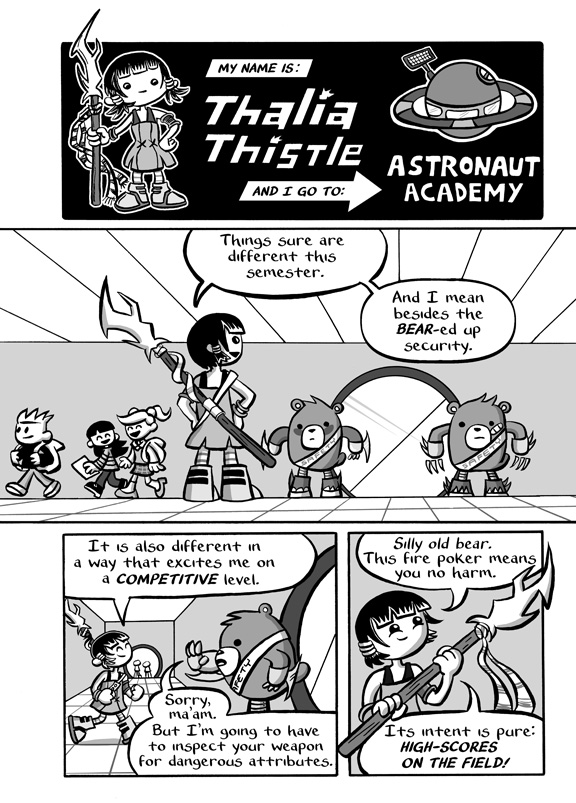
    BOOK TWO - ASTRONAUT ACADEMY: RE-ENTRY (First Second, 2013) begins as the students return to school after semester break and find security is "beared-up" because the monster feeding on their emotions is now a serious threat. With their kids' safety at jeopardy (many have 'heart attacks' as they are tricked to give one of their hearts to the heart-eating monster), the school goes into lockdown mode searching for robots and later banning love. The action centers on an epic Fireball championship and the mysterious heart-stealing monster. After ineffective teacher/parent interventions, students learn that they must rely on themselves. There are space ninjas, dinosaur cars, security 'bears' and the story is told through inspiring images, and page design, with puns and wordplay galore to relieve the stress and tension.
    • Here is a "Re-Entry Book Trailer""
    • Here are some sample pages, courtesy of First Second Books 
    • And, for readers who grew up with Where's Waldo and love searches and scavenger hunts, Dave Roman in the same interview, mentioned above tells us that:
    "Here's a (possibly incomplete) list if anyone wants to go on a pop culture scavenger hunt through "Astronaut Academy: Re-Entry!" Some of the other things possibly referenced include "My Neighbor Totoro," "THX 1138," My Chemical Romance, Harry and the Potters, All Girl Summer Fun Band, The Knitting Factory, "Bill and Ted's Excellent Adventure," "Doctor Who," "A Wrinkle in Time," "Back to the Future," "The Girl Who Leapt Through Time," "The Halloween Tree," "Sweeney Todd," "Star Wars," "Mystery Science Theater 3000," "The Aquabats," "Digimon," "The Ewok Movie," "Santa Claus is Coming to Town," "The Black Hole," "The Great Pumpkin Charlie Brown," Sega Saturn games, "Dark Side of the Moon," "Pinocchio," "Sailor Moon," Kiss, "Avatar: The Last Airbender," "Gatchaman," Cobra Commander, Tales of Ribaldry, Pom Poko, "Transformers," "Say Anything," "Voltron," "The Fly," MC Hammer, Depeche Mode, "Sonic The Hedgehog," Bum Equipment, Ub Iwerks, Bumper Boy, Monticello, "The Secret of Nimh," ShamWow, Team Rocket, "Super Mario World" and "Flight of the Navigator."
    Students traveling to school after semester break. Courtesy of Dave Roman and First Second Books, 2013
    In addition to these goodies, Roman continues to include wordplay, wisdom and fun. Here are some examples:
    • Thalia Thistle, ace Fireball player has an aversion to acronyms and in one instance, two 'security bears' try to figure out what "BFF" means;
    • A wounded student is taken to Dr. Nursen;
    • One of the 'security bears' announces that he "hates to be the bear of bad news... "
    • A student notes that after a science-project gone awry by his scientist parents, they became less-visible, ""My parents' visits were increasingly short and trans-parent"
    • Another character who finds he cannot compete on the Fireball team becomes interested and words and spelling bees saying, "...something about the way they were constructed always intrigued me. I liked the way they looked and sounded."
    • Words of wisdom: "I know Dad is worried about my safety...but life involves scrapes and bruises, especially if I want to play the game..."
    Here is a page from Astronaut Academy: Re-Entry:
    http://yaytime.com/academy/aa2_preview/pages/aa2_025_thalia1.jpg
    Courtesy: Dave Roman and First Second Books http://yaytime.com/academy/aa2_preview/pages/aa2_025_thalia1.jpg

    Teaching suggestions for Astronaut Academy: Re-Entry:
    • Have students go on a scavenger hunt for acronyms, puns and word-play.  Have them create their own that might easily fit into the book and story as well. (CCSS: Vocabulary Acquisition and Use, Conventions of Standard English, Range of Reading and Level of Text Complexity)
    • Discuss the themes of this book: teamwork, forgiveness, rivalry. Map their development.  (CCSS: Key Ideas and Details, Integration of knowledge and Ideas, Comprehension and Collaboration)
    • Compare the different style of story-telling in the two books (CCSS: Conventions of Standard English, Craft and Structure, Key Ideas and Details, Integration of Knowledge and Ideas, Range of Reading and Level of Text Complexity, Text Types and Purposes, Presentation of Knwoledge and Ideas.)
    • Meeting CCSS, have students practice different forms of writing, creating "Rules of Play" for Fireball.  You may want them to brainstorm on ways the game can be played in school/ recess.  They can also write/review the game as it is being played. (CCSS: Vocabulary Acquisition and Use, Conventions of Standard English, Craft and Structure, Key Ideas and Details, Text Types and Purposes, Presentation of Knowledge and Ideas.)

    These books are wonderful entertainment for kids of ALL ages.  I hope you take a closer look yourselves. For more from Dave Roman, check his website:http://yaytime.com/ 
    For more teaching ideas please go to: http://yaytime.com/resources/teachers-guides/

    In the meantime, thank you for your visit, and please leave your reactions, reviews, and creative ideas in the comments.

    Sunday, December 2, 2012

    The ULTIMATE, UNABASHEDLY UNIQUE Book Review

    It is "U" week at  ABC Wednesday and with my book now out for two + weeks, I thought it time for a review. And, who to give it a better review than...me!  So with tongue in cheek and a touch of holiday humor, here is the ultimate, unabashedly unique  view of my book, "Using Content Area Graphic Texts for Learning."

    The ULTIMATE overview: This book is for educators and parents hoping to integrate graphic novels into their classrooms and libraries.  In this book we detail:
    • how quality graphic novels can be integrated into the language arts, math, social studies AND science curricula - with detailed lesson plans within each middle-school content area;
    • how graphic novels help enhance attention, memory, language, cognition, and sequencing skills;
    • how specific graphic novels and how our suggested lessons fit into the Common Core State Curriculum Standards;
    • and provides lists of recommended graphic novel for students within each of the subject areas (language arts, math, social studies and science).
    USAGE: This book is geared for home and school libraries, middle-school classrooms.

    UNIQUE and UNABASHED REVIEW: CONTINUING the ABC Wednesday theme, and instead of torturing you for 26 weeks of the alphabet (not to mention exposing you to UNENDING boredom), here is an abridged ultimate, unabashedly unique book review that's as simple as ABC: 
    • A: This is an AMAZING book with an awesome cover (although we probably could have used more ASSISTANCE with the title...LOL). 
    • B: The  BEST book ever BECAUSE it BOLDLY relates how to use graphic novels for learning.
    • C: CATCHY CONCEPTS and CHARTS for CONTENT-AREA subjects with lessons that COMPLY with COMMON CORE Standards
    • D: It DEFINITIVELY and DEFTLY integrates graphic novels into middle-school classrooms.
    • E: EXQUISITELY detailed lessons plans.
    • F: The FABULOUS FACTS about how graphic novels.
    • G: GRAPHICALLY details why GRAPHIC novels help with attention, memory, language, sequencing and cognitive skills.
    • H: HOPING you're still with me on this...
    • I: INDISPENSABLE for teachers INTERESTED IN INTEGRATING mutlti-media INCENTIVES while INCREASING INTELLECTUAL pursuits in the classrooms.
    • J: JUSTIFIABLY a JEWEL for teachers hoping to JUMP-START learning.
    • K: KILLING you softly or KNOCKING you over with my KRYPTIC  KAPTIONS? (OK I know these two words start with a "c" but I couldn't help myself.)
    • L: LAUDABLE treatment of the subject matter...LUGUBRIOUS it is not! And, the book offers suggestions LINKING graphic with the more traditional prose texts.
    • M: MARVELOUS book recommendations with no MENTION of MARVEL and an awesome chapter detailing two very different ways to use graphic novels in MIDDLE SCHOOL MATH classes.
    • N: NIFTY
    • O: ORIGINAL
    • P: PRACTICALLY PERFECT in every way - it worked for Mary Poppins,  it works for me, it will work for you!
    • Q: QUALITY educational materials
    • R: REALLY READABLE
    • S: SUPER SUGGESTIONS for enhancing attention, memory, SEQUENCING. and cognitive reasoning skills in math, SCIENCE, SOCIAL STUDIES, and language arts.
    • T: TERRIFIC TREATMENT of subject matter
    • U: UNDENIABLY the best graphic novel classroom suggestions
    • V: VALUABLE for promoting VISUAL LITERACY
    • W: WITH me still?
    • X: 'Xciting anecdotes
    • Y: YEP, we're almost through
    • Z: ZIP over to Amazon.com for a look at the book or link over to a preview of the book to read the Introduction 
    [Note: If you're interested in reviewing this book please let me know, I have a few more copies I can offer for more traditional and objective reviews.]
    For those of you who stuck to this all the way through and for those of you who jumped to the end, thank you for humoring me in my ultimate, unabashedly unique review of my book.

    Please leave your own "review" suggestions in the comments...maybe I'll use them!!!

    In any event, thank you for your visit and have a great week.

    Sunday, October 21, 2012

    OH the FUN Elections can Occupy in Classrooms: Overview of Awesome Ideas and Websites

    From: bendbulletin.com Art by Ben Clanton
    This year's national and local elections are overflowing with rivalry, challenges, infused debates and accusations.  The Presidential and many local races are still too close to call and offer wonderful excitement as well as civic learning opportunities.

    In the final two weeks before the 2012 elections here are some diverse ways to look, learn and bring the national and local issues to your kids. The resources below have games, national projects and challenges, and research tools. 


    PROJECTS AND CHALLENGES:

    Engage in Democracy 2012 Student Journalism Challenge is a non-profit project supported by the Media Arts Institute whose goals are to engage K-12 students in democracy, leadership, and community involvement.  Through the challenge described below Engage 2012 goals are to:
    • encourage curiosity, 
    • develop students' technical and non-fiction storytelling skills in a hands-on learning environment, 
    • assist educators in building curriculum that teachers about journalism and the democratic process, and
    • empower students to make positive changes on a community and societal level
    The Engage 2012 Challenge:
    "To participate, shoot a video under two minutes in length using stories from around your community with a focus on one of six big election topics below. You or a team of three students can submit three entries by January 19, 2012. Research, shoot, write, edit.  Use your smartphone, camcorder or flip camera...we are looking for entries that are fair, accurate and informative. The six big election topic are:
      • voter turnout
      • jobs and the economy
      • education reform
      • health care
      • energy and the environment
      • immigration
    For more details, for helpful resources and sample videos please go to:http://www.engage2012.org/

     
    MTV's Fantasy Election is an interactive game for kids.  Students log in and pick their political dream team for President and for Congress.  Points are accumulated based on how each candidate rates in the real world along numerous dimensions (such as honesty, transparency, public opinion, and engagement), for logging in to the debates. reading information online in published articles and even showing up at local political events. They are offering great prizes and if you're not sure what your dream team is, "Doris" their computer can generate one for you which can be tweaked any time up to the elections.

    Join the Debate is a forum for high school students to chat about the debates.  After each debate, students are invited to log in and discuss the issues (the economy, renewable energy, education, foreign policy civil rights, and immigration, the candidates and their questions in a safe environment of peers from all over the world. High school students can log in and are assigned to a video chat discussion group led by one of their facilitators on Google hangout.


    CLASSROOM IDEAS
    • Conduct your own debates  
      • Mock Presidential debates
      • Mock Congressional debates of local candidates
      • From: powerlineblog.com
      • Debate the issues.  To give everyone a voice you may opt for small groups, and either have each group debate each issue or assign issues to the various groups - allow them to debate - and then reflect their opinions to the class as a whole.
    • Conduct  polls (neighborhood, class and/or school) for local or student and/or staff opinions on the candidates and on selected issues (gun control, immigration, economy, energy, health care, educations, or even voter turnout).
    • For visual literacy activities:  Look at the election cartoons and art.  Discuss use of slogans, colors, animals and content to relay information and attempt to sway opinions.  
    • When researching topics (please see suggested tools/sites below) some websites and newspaper articles are more objective than others.  Discuss the role and challenges of objective reporting.
    • Discuss how you can set up elections booths in the classroom for the school students.  Discuss need for ID's, polling, and how best to create a ballot and vote.

    TOOLS THAT PRESENT ELECTION INFORMATION (note some are more objective than others and this on its own is an excellent discussion or project):

    • http://www.google.com/elections/ed/us  this site allows you to sort information along candidates and issues and follow search trends and follow real time public opinion.
    • FactCheck.org monitors the accuracy of what candidates actually say.  There is an awesome viral spiral page which lists false or misleading information gone viral that they are asked most frequently about.
    • 2012 election for kids cartoons you should screen them first but there are some wonderful cartoons here rife for discussion.
    • Chan Lowe from http://theweek.com/section/cartoon/93/235059/2012-elections
    • TIME Magazine for Kids special election coverage - this site has links on the debates, behind the scenes at the conventions, meet the candidates (Presidential and VicePresidential), chat rooms, and meet the media to name a few. They also have a link where kids can cast their own votes.
    • Scholastic Magazine  also has a neat site that features "breaking news" meet the candidates, lesson plans for teachers and parents, election vocabulary, election timeline, and election maps and games.
    • USA.gov - Government Made Easy  - has information about the elections and voting, the electoral college, election history, legislation and reform, and links for  educational material
    • http://www.infoplease.com/us/government/presidential-election-campaign-2012.html is a wonderful resource.  Under "History and Government" they have a wealth of information on the election, the candidates, and the issues. Sections at this site include:
      • Mitt Romney on the Issues
      • Barak Obama on the Issues
      • Elections & Issues (with information on the closest Presidential races, the electoral college vs. popular vote, PACs, superdeligates, types of ballots)
      • Presidential Factfile with information on past and present Presidents, their families, their pardons, and milestones, to name a few
      • Presidential Fun Stuff - with quizzes, slideshows, films, crossword puzzles, games
      • Inaugural speeches and notable addresses
    Thanks to Talia Hurwich for this blog idea as well as for recommending an awesome resource: Ideas from Infinite Thinking Machine

    Regardless of who you vote for, make sure you vote and please share some of your favorite kid-friendly ideas ore websites.

    Thanks for your visit and comments.

    .

    Sunday, October 7, 2012

    "M" is for Mohawk and Musk Ox (Usually): Integrating a journal, a graphic novel, Thanksgiving, and the Common Core

    In honor of "M" Week at ABCWednesday and in preparation for Thanksgiving I decided to write about
    • the Mohawk Nation
    • a wonderful young adult graphic novel (whose text is taken from the diary of twenty-three year old Harem Meyndertsz van den Bogaert, illustrated by George O'Connor depicting his travels deep into what is now New York State to establish a tribal trading friendship between the Dutch and the Mohawk Nation)
    • Thanksgiving, and
    • The Common Core Curriculum Standards
    • A new ABC book WELL WORTH it ...for ALL AGES ..."A is for MUSK OX"

    The Mohawk Nation

    The Mohawk Nation, then known as Kanien'kehake (people of the flint) was one of the five founding Nations of the Iroquois League.  [The other Nations in the Confederacy were the Cayuga, the Seneca, the Oneida, and the Onondaga.  The sixth Nation to join were the Tuscarora.]

    From: www.native-languages.org/york.htm
    The name Mohawk was given to the tribe by the Algonquin and was later adopted by the Europeans who had difficulty pronouncing Kanien'kehake. "Mohawk" means man-eaters, although many believe this name was just a figure of speech to depict their fierce nature.  

    The Mohawks are the true Native New Yorkers. At the time of the formation of the Iroquois League, the five tribes occupied territory from the East to the West, the Mohawk being the "keepers of the eastern door."  Today, while some still live in New York, most retreated to Canada in the 1700's.


    People of Iroquoian linguistic stock were sedentary tribes who were accustomed to life in the harsher climates of the North-East.  In addition to hunting, the Mohawk practiced agriculture, cultivating corn, squash and beans (the three sisters). They were also excellent trappers; when the European settlers came, the Mohawk exchanged furs for rifles, an arrangement which kept the colonists warm, and the conquering Mohawk strong.


    They were sometimes referred to as the Haudenosaunee, which meant "People of the Longhouse" because of their long, rectangular communal dwellings.
      
    Journey into Mohawk Country: A graphic novel by Messrs. Harmen Meyndertsz Van den Bogaert and George O'Connor (First Second Books, 2006, for ages 9+)

    Early in the winter of 1634, a young dutch trader, Messr. Harmen Meyndertsz Van den Bogaert, set out from the tiny Dutch colony on the southern tip of Manhattan Island to explore Iroquois country.  His team's hope is to
    • establish a new fur trading friendship that would strengthen the faltering Dutch trade
    • determine the French role in the Dutch's faltering fur trade
    Despite the freezing temperatures, a scarcity of trustworthy guides, maps, and scarce food, HM Van den Bogaert and his friends set out on their journey. Throughout this journey, Van den Bogaert kept a journal recording the fears, obstacles, successes and hardships faced on his journey.


    http://guttergeek.com/2006/November2006/mohawk/files/page64_2.jpg


    This graphic novel, almost four centuries later is presented here in Bogaert's own words and accompanied by George O'Connor's illustrations.  Readers will experience what harsh winters were like for traders and explorers and see early detente at its best.They even partake in a true "Thanksgiving" dinner.

    This graphic novel also contains a forward (describing the role of trade and the Dutch West India Company, the topography and names of the region and time), an afterward, and a glossary.

    For more graphic images go to: http://www.nytimes.com/interactive/2009/12/28/nyregion/200912-MOHAWK-ILLOS.html

    Teaching suggestions/discussions:
    • Compare this story (1st-person journal entry) to that of The Last Mohicans.  Discuss the different formats and stories.  Discuss non-fiction vs. fictional depictions of story.
    • Use the resources below to get a more complete picture of life for the Mohawk/Iroquois Indians as well as the role of trade 
    • Discuss this journal and its story to the history of early native Americans, to the role of trade, and to the relationships the Mohawks had with the French, Dutch and Swedes.
    • Discuss the role of symbols (see below as well as throughout the book) across cultures.
    • Discuss the impact of 'thanksgiving' dinners and detente Colonial/Dutch/French/Indian relations.
    • Discuss the different models of governance between the cultures.
    • Discuss the role the Longhouse played in Mohawk culture.

    Additional Resources and Multi-modal lesson suggestions
    • Mohawk Tribe - a link sponsored and produced by the Mohawk tribe
    • Constitution of the Six Nations: Gayanashagowa - The Great Binding Law
    • OnLine Resources endorsed by the Mohawk Tribe 
    • Theyebdabegea a.k.a. Joseph Brant  - was a Mohawk leader who sided with the British during the Revolutionary War, was educated in white schools, was a protoge of Sir William Johnson and learned Latin and Greek.  He translated the new Testament into his native language and is a fascinating figure - well worth a diversion - at least to this site.
    • Symbols of the Mohawks [Haudenosaunee]- Haudenosaunee designs feature recurring symbols and have deep cultural significance to the Mohawk Tribe.  These symbols include  
      • The Tree of Peace a tall white pine representing Gayanahsagowa, the binding law with unified the five Iroquois Nations, 
      • the tree's four white roots representing the four beings who help the Creator and the four winds that blow, 
      • an eagle perched atop the tree of peace, watching over the Nations. [You may want to discuss the similarities and differences in the image of the eagle in American and Mohawk cultures.]
      • a bundle of five arrows each representing one of the five founding Iroquois tribes
      • the Celestial Tree
      • Turtle Island which represents Earth and whose carapace features thirteen plates, each of which represent one of the thirteen moons that make up an entire year. [You may want to discuss the different cultures whose calendars follow the moon vs. the sun. Older students when learning about the Earth resting on a giant turtle may want to read the Discworld books by Terry Pratchett].
      • The Underworld represented by snakes and a horned panther with a long serpentine tail which lives underwater in eth great lakes.
    • Books to read relating to the Mohawk Nation or their culture:
      • The Last of the Mohicans by James Fenimore Cooper (1826) - READER NOTES:
        • The Mohicans were the victims of several attacks and were eventually conquered by the Mohawks (who were their neighbors to the south of the Hudson River Valley). 
        • The Mohican surrendered to the Iroquois Nations, and became the first members of the "Covenant Chain" - a protective trade alliance between the Iroquois, the European settlers (primarily Dutch and Swedes), and the tribes they had conquered.
        • While James Fenimore Cooper led his readers to believe the tribe ceased to exist, there are (as of 2003) over 1,500 descendants of the Mohicans (The Stockbrige Indians) currently living in Wisconsin.
      • Discworld series  - pure, fun fiction for older readers (high school) depicting fictional worlds surviving on the back of a turtle.  It serves as an interesting 'folk-lore' comparison. Discuss any other cultures where the world is depicted as riding on the back of a turtle.  Why a turtle?
    BEFORE CLOSING... FOR YOUNGER READERS... YOU CAN'T MISS:
    "M" IS ALSO USUALLY FOR MUSK OX...

    On October 16th, Roaring Book Press will be introducing a new picture book "a if for musk ox"written by Erin Cabatingan and illustrated byMatthew Myers.

    This is an AWESOME book about a wily musk ox who eats the apple for "a'" and angers a cool zebra because the zebra thinks the musk ox ruined his ABC book.  The musk ox argues that he is actually saving the book because alphabet books are so boring - everyone knows "a" stands for "apple" but few knew - until now that "a" also stands for musk ox because... they're so...AWESOME!  The books goes on, and our wily musk ox highjacks most of the other letters as well as he romps through the alphabet and the zebra learns more than he ever wanted to know about musk ox.


    Here's a YouTube video to introduce the book:


    This books IS AWESOME and my whole family enjoyed it (and we're way past ABC books!).  You will too!!!!


    Thanks once again, for your visit. Please leave your ideas on how you might teach/integrate Native American culture and Thanksgiving this year... OR... your opinions of A IS FOR MUSK OX...OR...any other fun facts you may have of the Mohawk Nation.


    Thursday, September 6, 2012

    CALL FOR PAPERS... EDUCATORS, LIBRARIANS, AUTHORS, HISTORIANS...

    My editor, Emily Raij from Maupin House (publishing my book Using Content Area Graphic Texts for Learning: A Guide for Middle-Level Educators - sorry but I couldn't help plugging my work) has forwarded TWO CALLS FOR PAPERS that I thought I would pass on to you.

    A brief overview:
    1. The first call for papers is from The Conversations Project: Interdisciplinary Conversations About Comics, Literacy, and Scholarship. The editor, James Bucky Carter, is looking for "conversations" between two figures, from different professional or personal perspectives who can create a narrative interview where each voice relates their perspective of comics in libraries, in classrooms (grades k-12), or on the drafting board.  Submissions due January 1, 2013 -see details below.  (If you want to submit but don't have a 'partner to converse with' - contact me, maybe I can help)
    2. The second call for papers is from Comics and the American Southwest and Borderland.  The editors of Comics and the American Southwest and Borderlands and the University Press of Mississippi are seeking pieces addressing  the "creating, and illuminating the intersections of comics scholarship and established academic writing on the Southwestern United States, the U.S-Mexico border, and their literatures, identities, and cultures."  Submissions due January 1, 2013 -see details below.


    CFP: The Conversations Project: Interdisciplinary Conversations About Comics, Literacy, and Scholarship  Dr. James Bucky Carter seeks abstracts/papers for an edited collection currently entitled The Conversations Project.

    Comics scholarship has grown substantially over the last twenty years and has always inhabited an interdisciplinary domain. However, rarely do the myriad voices have an opportunity to intersect and interact like they might. This is especially true between those involved in humanities-based comics scholarship and those who explore comics from pedagogical potentialities – and an even more salient divide exists when one looks at those who are doing work with comics in the humanities and those who study comics’ k-12 applications and potentials.

    The goal of the Conversations Project is to bring together leading and emergent voices in often distinctive and divergent sub-fields of comics scholarship via pairing those who study comics primarily from a humanities scholarship perspective with those who study comics mostly from the social sciences/ education/ literacy perspectives.

    The editor argues that this has had a limiting effect on comics scholarship and offers the Conversations Project as a mode of addressing the issue (while, of course, recognizing that there are figures who work in and across multiple disciplines).

    Each chapter of the project will be a conversation between two figures, one involved mostly in humanities-based comics scholarship and the other mostly involved in literacy/education-based comics scholarship.

    Non-exhaustive examples of possible pairings:

    • A children’s literature scholar might pair with a literacy scholar.
    • Someone studying reader response theory in comics might pair with an education professor or practicing k-12 teacher
    • A librarian of a comics collection at a university might pair with a public. school librarian or a librarian studying literacy issues associated with comics.
    • A visual rhetoric scholar might pair with a social scientist studying how young people read or decode the language/systems of comics.
    • A scholar of a specific cartoonist or comics work might pair with a k-12 teacher who has used that artist’s works or the specific text.
    • A scholar-practitioner of Design might pair with a literacy educator or k-12 teacher.
    • An art historian might pair with an Art educator or k-12 art teacher
    • An academic who runs an after-school program connecting comics and literacy might pair with a practicing k-12 teacher who does the same.
    • Someone who studies media might pair up with a media literacy educator.

    Pairs will be instructed to craft their narrative in the form of a mutual interview, similar to and inspired by the format of the University Press of Mississippi’s Conversations series, where each voice is clearly distinguished and labeled each time it speaks. Editors will provide a brief introduction of both figures to introduce the readership to the authors, their areas of expertise, and the general gist of their arguments presented in the chapter.

    Pairs might consider the following:

    • What are your big questions and concerns regarding how the “other side” seems to view comics.
    • How could your own work be used to advance understandings for the “other side.”
    • Where do you see common ground in your work and theories and big ideas on comics, their value, use, and importance?
    • Where do you and your paired partner agree? Disagree? Mine these spots for communication. Cite scholarship to assert your claims. Can you find middle ground?
    • What major texts and figures inform thoughts?
    • What new perspectives have you gained from working with your partner? What new avenues do you feel you may have opened up for readers who might also be looking to bridge the space between one form of comics scholarship and another?

    The editor will craft a summative chapter that treats the bulk of the collection as qualitative data and will draw conclusions and make recommendations to readers based on emerging ideas, theories, and problem areas across the contributions. In this way, the book is similar to Aldema’s work in Multicultural Comics: From Zap to Blue Beetle and Your Brain on Latina Comics.

    Interested parties should contact general editor Dr. James Bucky Carter at jbcarter777@gmail.com. Those who already have a co-author in mind are welcomed, but Dr. Carter can assist in finding possible partners. Once a pairing is approved, the authors should prepare a 300-500 word abstract and submit it to the editor by January 1, 2013.

    *******


    CFP: Comics and the American Southwest and Borderland

    The editors of Comics and the American Southwest and Borderlands seek submissions for this collection, which has interest from the University Press of Mississippi. We hope the collection does for the Southwest and Border region what Costello and Whitted’s Comics and the U.S. South did for that region and Southern studies via mining, creating, and illuminating the intersections of comics scholarship and established academic writing on the Southwestern United States, the U.S-Mexico border, and their literatures, identities, and cultures.


    Submissions might consider:
    • The impact of comics creators from the Southwest or Border region
    • The work of Jaxon/Jack Jackson, specifically
    • Characters or storylines set in and/or influenced by the Southwest or Border region
    • Depictions of the Southwest or Borderlands in comics
    • Examinations of how non-American artists have represented the American West (Charlier, Moebius, Blain, etc.)
    • U.S-Mexico relations in comics
    • Immigration; citizenship; nationalism in comics from or about the region
    • Race, gender, sex and ethnic studies in comics from or about the region
    • Nationalism; politics; violence in comics from or featuring the region
    • Liminal spaces; contact zones; politics of the region in comics
    • Westerns
    • Adaptations of Southwest, Chicano, Latina, or Mexican literature
    • Chicana/a or Latina/o studies as frames for analysis of comics
    • Class and economic issues in comics from or featuring the region
    • Depictions of Native peoples from the region in comics

    Submissions may explore comic strips, comic books, graphic novels, web comics, and editorial cartoons. Submissions may focus on any genre.

    Please send 300-500 word abstracts to both Dr. James Bucky Carter (jbcarter777@gmail.com) and Dr. Derek Parker Royal (Derek@DerekRoyal.com) by January 31, 2013.


    *******

    Again, if you have any questions or need help find a conversation partner, please use the comment section as a bulletin board.  I would also love your comments and feedback.
    Thanks you, as always, for your visit, I hope to see you again soon!