Showing posts with label social studies. Show all posts

Sunday, December 2, 2012

The ULTIMATE, UNABASHEDLY UNIQUE Book Review

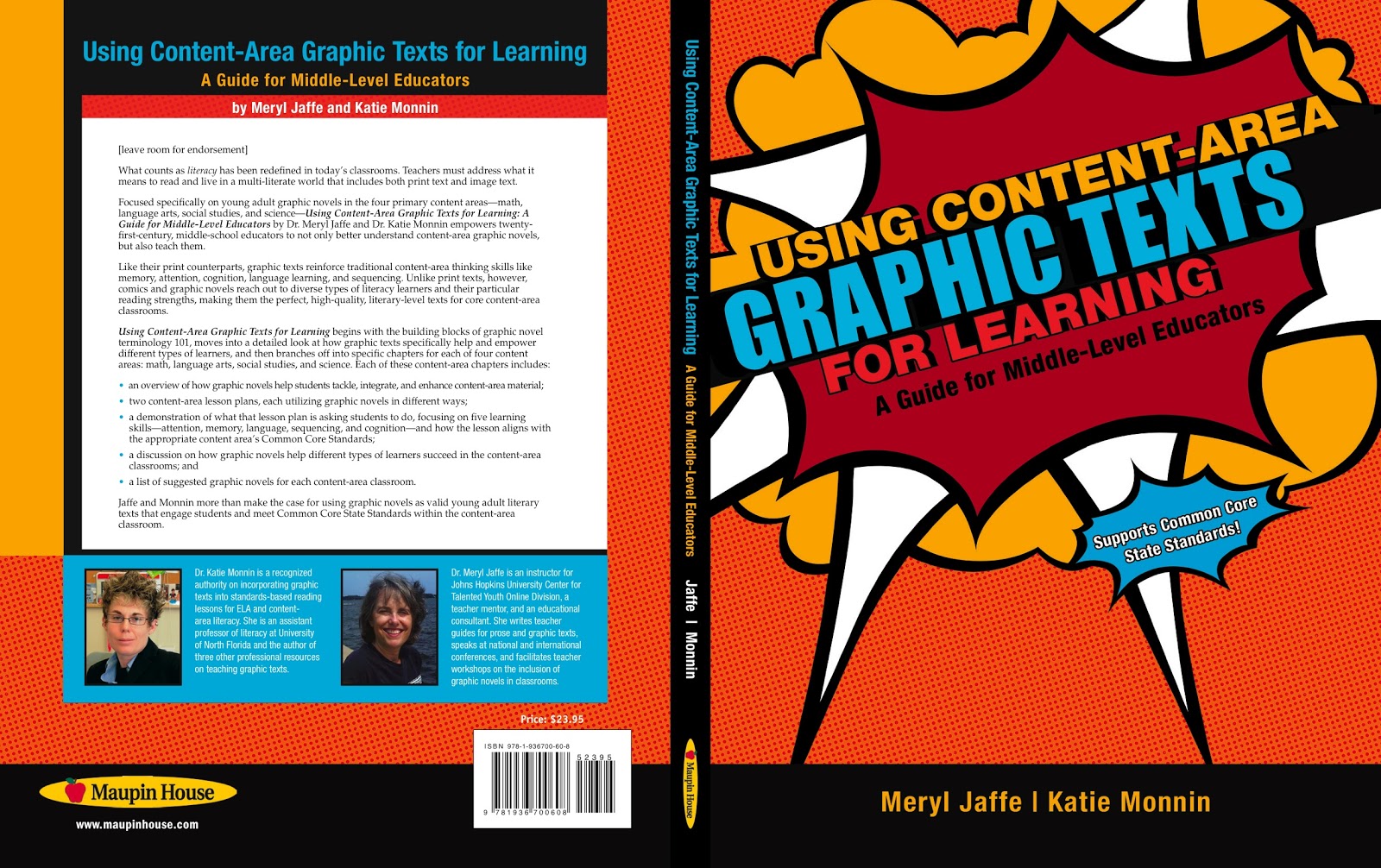
It is "U" week at  ABC Wednesday and with my book now out for two + weeks, I thought it time for a review. And, who to give it a better review than...me!  So with tongue in cheek and a touch of holiday humor, here is the ultimate, unabashedly unique  view of my book, "Using Content Area Graphic Texts for Learning."

The ULTIMATE overview: This book is for educators and parents hoping to integrate graphic novels into their classrooms and libraries.  In this book we detail:
  • how quality graphic novels can be integrated into the language arts, math, social studies AND science curricula - with detailed lesson plans within each middle-school content area;
  • how graphic novels help enhance attention, memory, language, cognition, and sequencing skills;
  • how specific graphic novels and how our suggested lessons fit into the Common Core State Curriculum Standards;
  • and provides lists of recommended graphic novel for students within each of the subject areas (language arts, math, social studies and science).
USAGE: This book is geared for home and school libraries, middle-school classrooms.

UNIQUE and UNABASHED REVIEW: CONTINUING the ABC Wednesday theme, and instead of torturing you for 26 weeks of the alphabet (not to mention exposing you to UNENDING boredom), here is an abridged ultimate, unabashedly unique book review that's as simple as ABC: 
  • A: This is an AMAZING book with an awesome cover (although we probably could have used more ASSISTANCE with the title...LOL). 
  • B: The  BEST book ever BECAUSE it BOLDLY relates how to use graphic novels for learning.
  • C: CATCHY CONCEPTS and CHARTS for CONTENT-AREA subjects with lessons that COMPLY with COMMON CORE Standards
  • D: It DEFINITIVELY and DEFTLY integrates graphic novels into middle-school classrooms.
  • E: EXQUISITELY detailed lessons plans.
  • F: The FABULOUS FACTS about how graphic novels.
  • G: GRAPHICALLY details why GRAPHIC novels help with attention, memory, language, sequencing and cognitive skills.
  • H: HOPING you're still with me on this...
  • I: INDISPENSABLE for teachers INTERESTED IN INTEGRATING mutlti-media INCENTIVES while INCREASING INTELLECTUAL pursuits in the classrooms.
  • J: JUSTIFIABLY a JEWEL for teachers hoping to JUMP-START learning.
  • K: KILLING you softly or KNOCKING you over with my KRYPTIC  KAPTIONS? (OK I know these two words start with a "c" but I couldn't help myself.)
  • L: LAUDABLE treatment of the subject matter...LUGUBRIOUS it is not! And, the book offers suggestions LINKING graphic with the more traditional prose texts.
  • M: MARVELOUS book recommendations with no MENTION of MARVEL and an awesome chapter detailing two very different ways to use graphic novels in MIDDLE SCHOOL MATH classes.
  • N: NIFTY
  • O: ORIGINAL
  • P: PRACTICALLY PERFECT in every way - it worked for Mary Poppins,  it works for me, it will work for you!
  • Q: QUALITY educational materials
  • R: REALLY READABLE
  • S: SUPER SUGGESTIONS for enhancing attention, memory, SEQUENCING. and cognitive reasoning skills in math, SCIENCE, SOCIAL STUDIES, and language arts.
  • T: TERRIFIC TREATMENT of subject matter
  • U: UNDENIABLY the best graphic novel classroom suggestions
  • V: VALUABLE for promoting VISUAL LITERACY
  • W: WITH me still?
  • X: 'Xciting anecdotes
  • Y: YEP, we're almost through
  • Z: ZIP over to Amazon.com for a look at the book or link over to a preview of the book to read the Introduction 
[Note: If you're interested in reviewing this book please let me know, I have a few more copies I can offer for more traditional and objective reviews.]
For those of you who stuck to this all the way through and for those of you who jumped to the end, thank you for humoring me in my ultimate, unabashedly unique review of my book.

Please leave your own "review" suggestions in the comments...maybe I'll use them!!!

In any event, thank you for your visit and have a great week.

Sunday, October 28, 2012

PREVIEW...Using Content Area Graphic Texts for Learning


With a bit over a week until our book hits the stores, I will be previewing selections of the book over the next few weeks.

Here is the introduction which provides an overview of the book.  We will be awarding a few more copies for review.  Please let us know if you're interested in receiving a copy (and why) and please leave your opinions, questions and reactions in the comments below.


Introduction

“We’re here for forty-five minutes. Have fun with the time, but don’t even
THINK about taking out any of those comics or graphic novels!”
-Meryl Jaffe

That is how I used to preface visits to the library or bookstore with my students and children.

In my mind graphic novels were often violent collections about caped crime-fighters, masked madmen, or fictional friends at Riverdale High School.  How did I know this?  That’s what the comic books of my childhood were all about, and I hadn’t seen anything different to change my mind. Admittedly, I hadn’t been looking to change my mind. Johnny Tremain, Of Mice and Men, and The Gammage Cup were just fine for my middle schoolers. These books created worlds of fantasy or historical fiction that made my readers think while incorporating language in inspiring ways. I realize now though that reading lists, like most things in life, can’t remain static. They must be fluid, dynamically bending and adjusting to the time and winds of change.

A few years ago, my children sat me down and passionately argued that in any discussion of literacy, graphic novels had to be included. I reluctantly agreed to read one book of their choice. With the stakes high I advised them to choose wisely, and they did. They selected Joe Kelly’s I Kill Giants, and I was truly blown away. As Kelly’s story opens the reader meets Barbara, a fifth-grade girl who explains that she kills giants. The thing is, it takes most of the book to determine whether this is a metaphor for something bigger, stronger, and scarier in her life or she actually kills giants. He leaves it to you (and your students) to figure out which is the case.

Katie and I come to you from different perspectives. She began her career in the classroom and is now in academia; I began in academia and am now in the classroom. She is a young vibrant rising star, and I am a seasoned parent,  school psychologist, and educator. Although we both came to graphic novels relatively recently in our professional careers, we have become strong advocates for their inclusion in today’s classrooms and libraries.

While Katie and I discuss the movement of graphic novels from comic book shops to the classroom in Part I of this book, there have been three general factors that led us personally, to include them in our classrooms:
1.     There is now a wealth of motivating high-quality graphic novels (be they fiction, science fiction, historical fiction, fantasy, or nonfiction) that lend themselves to content-area classroom use.
2.     With the growth of technology and access to the Internet there is now an increasing need for visual and verbal literacy mastery, emphasized not only in our everyday lives, but also in the Common Core State Standards.
3.     Graphic novels, by their very nature draw the reader into the story because the reader must construct the story by actively integrating visual and verbal components. This is a highly creative and interactive process, which makes learning more meaningful.


Our Goals

While teaching methods and goals are rapidly expanding to meet the demands of our ever shrinking—and yet expanding—worlds we hope to empower you with specific tools to meet those demands. Educators are now mandated to address visual and verbal literacies by incorporating multimodal texts and sources, while fostering greater independent, creative, and analytic thinking. To help address these needs and changes we offer you concrete teaching options in the form of interactive graphic novel suggestions and lesson plans. Graphic novels provide an excellent vehicle to meet curricular standards while incorporating diverse student needs and affinities.

Our goal in this book is to introduce you to today’s graphic novels. We explain how they have matured, how they address learning and curriculum standards, and, finally, how they can be taught in your content-area middle-school classrooms. We also demonstrate how graphic novels and our suggested lessons meet diverse student needs featuring attention, memory, language, sequencing, and cognition skills.


How This Book Is Organized

In the first part of this book, we introduce you to the mechanics of today’s graphic novels and detail how they have changed throughout the years. We also relate why these books are such effective teaching tools for modern classrooms.

The second part of this book takes you to our four content-area classrooms: math, language arts, social studies, and science. Each content-area chapter:
·      Explains how graphic novels can meet your curricular needs;
·      Provides two types of lessons, each using graphic novels in a different way;
·      Demonstrates what each lesson asks students to do—focusing on attention, memory, language, sequencing, and cognition skills;
·      Shows each lesson’s alignment with the Common Core State Standards;
·      Discusses how graphic novels in our lessons help different types of students succeed in the content-area classroom; and
·      Includes a list of other suggested graphic novels you can include in your content-area classroom.

Please note, however, that the lessons and suggested readings we provide are merely suggestions. We encourage you to expand upon these suggested readings and tweak our lessons to meet your own personal teaching preferences and student needs. And, if you are so inclined, we hope you share your explorations and experiences with these lessons and suggested readings with us at www.departingthetext.blogspot.com. Check the blog for new lessons, graphic novel reviews, content-area classroom tips, conference appearances, and more.


For those interested in purchasing the book, if you go to our book page at Maupin House, we are offering the book at a discount if purchased before November 5, 2012.

Thank you for your visit and please leave a note in the comments if you want to receive a free copy for review. Also, as always, please leave your reactions, feedback and any questions you may have in the comments.

Tuesday, August 2, 2011

San Diego Comic-Con 2011


I just got back from my first San Diego Comic Con and all I can say is WOW!!!

Wow - to the 140,000 + people there daily... to all the exhibits and panels...to all the freebies and cool promotions...and to the absolutely glorious weather!

Comic-Con 2011 - What's NewI still wonder...How did I get to do something so cool? About ten months ago I was sitting in  my kitchen with my kids talking about blogging and literacy. Two of my three kids were preparing to go to the New York City Comic Con and I commented that as a literacy advocate and educator, I probably should give comics a second look - that maybe I should consider them a legitimate source of literacy and entertainment.

My kids' reactions:  "DUH!!!!!!: (Articulate, huh)

My son gave me Joe Kelly's I Kill Giants (for grades 5+ see previous posts for details) and I was blown away!!!!  I was amazed at the depth of the story, Kelly's creative use of metaphor, and the use of art to involve the reader.  My daughter hooked me into The Unwritten (a young adult book that weaves classic literature into a complicated mystery as the main characters fight to save the free-thinking world) and I attended the New York City Comic Con with them this past October.  In 2012 my book, "Teaching Content Area Graphic Novels" will be published by Maupin House Publishers.

So now, I have just returned home after sitting on a panel at the San Diego Comic Con 2011 where I had an awesome time talking to teachers and librarians on how to integrate comics and graphic novels into school libraries and curriculum. I am pumped to finish my book and am ready to start promoting my second book (more on that later).

The Bottom Line in a Nut Shell: Graphic novels are powerful educational tools promoting verbal literacy, visual literacy, social literacy and critical thinking.
  • Their promoting literacy is obvious - they provide engaging entertainment as readers decode visual and verbal text. 
  • Graphic novels promote social awareness as readers have to "read" facial expressions and body language as well as the text to 'get' the story.  This heightens their awareness of social cues.
  • Finally, comics and graphic novels promote critical thinking as the readers have to construct motives, emotions, and events that occur between panels.  Furthermore, many graphic novels, like Kelly's I Kill Giants are rife with metaphor which further stimulates critical (and creative) thinking. 
So in Comic Con vain, I thought I would share three AWESOME graphic novels I got from the Comic Con:

Rust: Visitor in the Field (Archaia 2011) by Royden Lepp is set in the prairie lands of a unknown time and place, in a world that has survived a devastating war where robots were eventually built to fight instead of men.  Roman Taylor, the oldest son of the Taylor family is set with the responsibility of running a struggling farm in his father's absence. Jet Jones, being chased by a giant decommissioned war robot lands on the Taylor farm and Roman thinks Jet Jones and the decommissioned robot might be the answers to his struggle.  This is a beautifully illustrated story (in colors reflecting the Dust Bowl era of the 1930's) told through dialogue, flashbacks and letters to Roman's dad. This book can be used in social studies classrooms to discuss issues faced by farmers in the Dust Bowl era; the mechanics of war and fighting machines;  and the art of letter writing.  It is suitable for grades 4+. 20th Century Fox has picked up this novel and hired Aline Brosh McKenna (whose scripts include The Devil Wears Prada, 27 Dresses and  I Don't Know How She Does It) to adapt it for the screen.  Fox-based Simon Kinberg and Archaia's Stephen Christy and PJ Bickett will be the executive producers.


The Saga of Rex (Image Comics 2011) is illustrated and written by Michel Gagne - a veteran animator (who has worked for Warner Bros. and Disney/Pixar).  This is a beautifully illustrated adventure, science fiction, love story about a gentle-souled fox named Rex who is plucked from his world and transported to the planet of Edernia  where he meets all sorts of creatures, including his soul mate. This book contains some brief narration, but the story itself is told almost exclusively through illustration.  The text provided is well written and has advanced vocabulary.  While the illustrations are magnificent, cute and inviting (the young fox makes you think it may be for young kids), it takes some sophistication to construct the story and there is one scene that might be scary for young children.  I therefore recommend this book for older kids (middle school and older).  Finally, because there is so little text, reading this book presents a wonderful cognitive exercise as the reader constructs the story panel by panel, illustration by illustration.  For more information and a "look" into each chapter of the book, please go to: http://www.gagneint.com/Final%20site/books/Rex_saga/Rex_saga_main.htm.  [Note to teachers: As an educational exercise you may want to begin reading this aloud and have kids 'write' their own dialogue.]


 Zita the Spacegirl (First Second 2011) by Ben Hatke is a beautifully illustrated book about Zita who must rescue her friend Joseph who was reluctantly sucked into another world after warning Zita of the dangers of touching a 'meteor' that fell to earth.  Zita faces monsters, robots and magicians in her quest to save and return Joseph to their world.  This is appropriate for grades 3 +.  It is also a wonderful book to read aloud together.  There is so much to talk about! For a cool trailer you and your kids will enjoy go to: http://zitaspacegirl.com/  or view this trailer on youtube:


It blows my mind how far comic books have come and it boggles the mind to think of where books - graphic or prose will be in another ten years....but that's a different blog post!

I hope you enjoyed these clips and would love to hear from you.  In the meantime..

Here are some other posts to visit to read more about graphic novels:
http://departingthetext.blogspot.com/2011/06/visualverbal-literacy-part-2-reluctant.html
http://departingthetext.blogspot.com/2011/06/visual-vs-visual-literacy-no-contest.html http://departingthetext.blogspot.com/2011/05/science-fiction-skills-chills-and.html http://departingthetext.blogspot.com/2011/03/learning-with-laughter.html http://departingthetext.blogspot.com/2011/03/kicking-back-bitwhats-all-this-about.html http://departingthetext.blogspot.com/2011/01/great-reads-for-avid-4th-and-5th-grade.html http://departingthetext.blogspot.com/2010/10/graphic-novels-at-home-and-in-school.html 

I would love to know what YOUR FAVORITE comics and graphic novels are!!!  Please leave them in the comments.

Thursday, April 14, 2011

Spice it Up!

http://google.com/im...sp=2s&ved=1t:429,r:0,s:0
Why is it that in education everything seems to be in black and white?  We are all designed so differently, how can we all fit this black and white design?

It was traditional classrooms or open classrooms, teaching reading using whole language or phonics. Why don't educators understand that teaching is not just one way?  Students thrive with multiple approaches and methods.  We all like a little spice in life!


The bottom line:  There are all kinds of minds in a classroom with all kinds of strengths, weaknesses and affinities.  Some of us learn best by doing, others by seeing, still others by listening. Some of us are creative thinkers, while others more linear, logical thinkers.We have to teach to all of them and not to "the average student" (who in my opinion does not really exist).  Learning has to be meaningful and as such we need to spice it up so everyone can wrap their minds around whatever topic is up on the docket.

From Theme Thursday (http://themethursday.blogspot.com)
Think back to when you were in school...(for those like me that was a long time ago - see my last blog on memory :-)   What lessons stuck with you the longest?  My bet is that they were interactive (somehow you worked with the material) and was personally meaningful.  For me, it was chemistry.  My teacher made jokes and introduced the material with really cool experiments and bravado.  What was it for you - I'd love it if you share this in your comments.

What does this mean for parents?
Whether your kids are in school or home schooled
  • Talk about the topics they are covering in the classroom. 
  • Visit museums with related exhibits, 
  • Watch movies that deal with these topics, 
  • Brainstorm about what might happen if... or what might have happened if...
  • Go to the library or book store and get books related to the subject (either fiction, nonfiction or science fiction; prose or graphic novel) to read aloud together (and discuss).
  • Create your own experiments or products from ages and eras being studied.  
  • If studying colonial America, for example, make candles or butter as they did back then.  Find recipes from the countries and eras your child is studying. 
What does this mean for teachers? Don't just have your students read something from a book and don't just lecture.  You have to make the lessons come alive:

  • Create a "day in the life" of characters you are reading about in language arts, or studying in science or history;
  • In math, ask students to show their work, but if they compute something differently, pay attention to it, ask them to prove this to be a viable method by using it on different examples.  IF it doesn't work, they will more easily use your methods. If it does work you have allowed them to create a more lasting understanding of underlying processes.
  • When evaluating students, don't just give tests.  (Test taking is an important skill, but it is not the only skill and memorizing for tests, is not always the best way to assure retention.)  Have students create projects, plays, dioramas, etc.
  • When teaching make sure students can play with the subject and materials.  Pose questions that really make them think and apply the subject matter,  present verbal and visual aspects of the lesson, introduce it so that it somehow relates to their own lives.
  • http://www.garlikov.com/Soc_Meth.html Provides a compelling argument for using the Socratic method of teaching - even in a third grade math class.  It is worth a visit!
  • If you ask them to read passages, ask them to relay the passages in graphic novel form, or to act out some aspect of the lesson (making it visual and tactile as well).

These are just some generic suggestions.  Please let me know what works or worked for you as a student, as a parent, and/or as a teacher.  How did or do you spice learning up?