Showing posts with label language arts. Show all posts

Sunday, December 2, 2012

The ULTIMATE, UNABASHEDLY UNIQUE Book Review

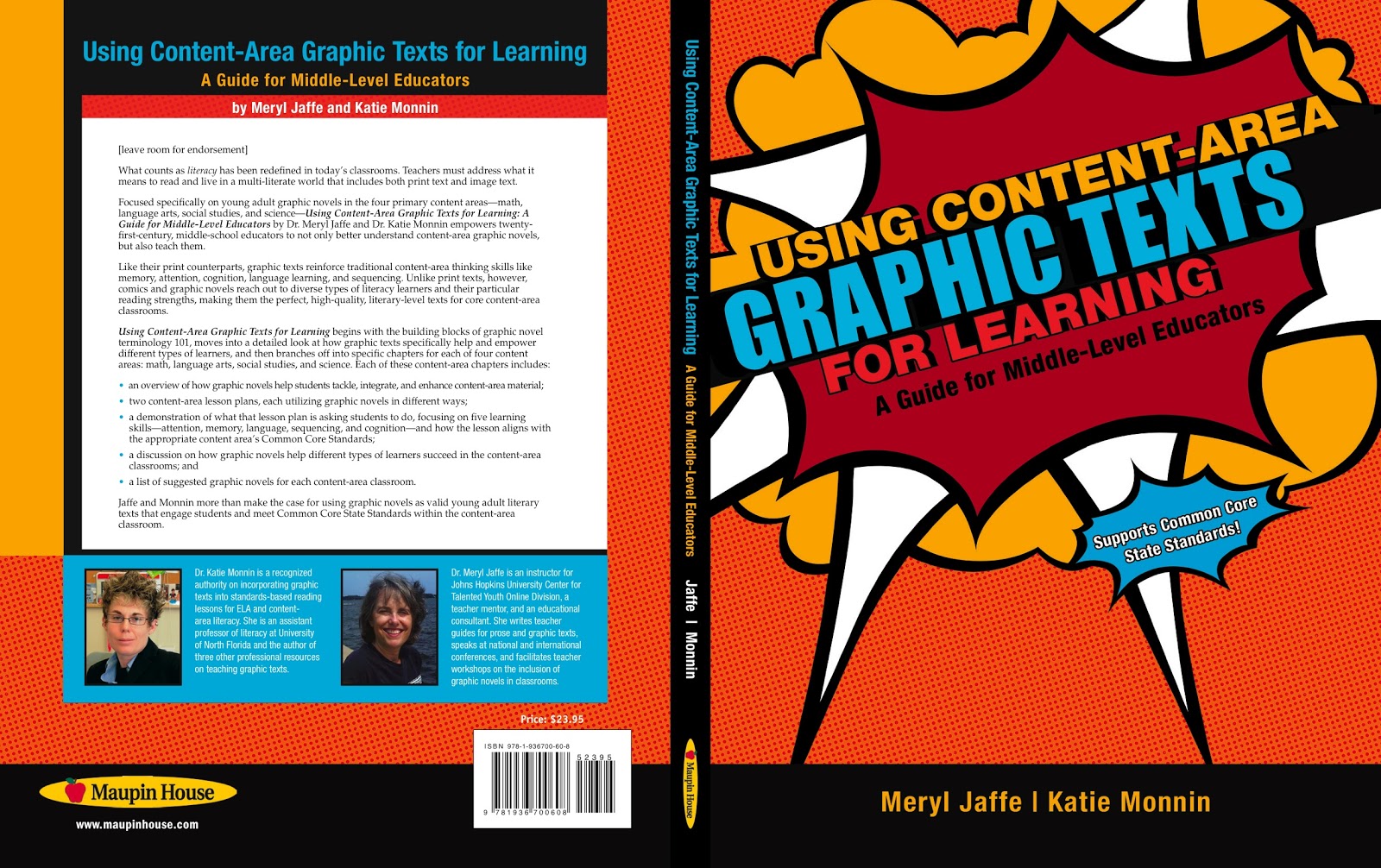
It is "U" week at  ABC Wednesday and with my book now out for two + weeks, I thought it time for a review. And, who to give it a better review than...me!  So with tongue in cheek and a touch of holiday humor, here is the ultimate, unabashedly unique  view of my book, "Using Content Area Graphic Texts for Learning."

The ULTIMATE overview: This book is for educators and parents hoping to integrate graphic novels into their classrooms and libraries.  In this book we detail:
  • how quality graphic novels can be integrated into the language arts, math, social studies AND science curricula - with detailed lesson plans within each middle-school content area;
  • how graphic novels help enhance attention, memory, language, cognition, and sequencing skills;
  • how specific graphic novels and how our suggested lessons fit into the Common Core State Curriculum Standards;
  • and provides lists of recommended graphic novel for students within each of the subject areas (language arts, math, social studies and science).
USAGE: This book is geared for home and school libraries, middle-school classrooms.

UNIQUE and UNABASHED REVIEW: CONTINUING the ABC Wednesday theme, and instead of torturing you for 26 weeks of the alphabet (not to mention exposing you to UNENDING boredom), here is an abridged ultimate, unabashedly unique book review that's as simple as ABC: 
  • A: This is an AMAZING book with an awesome cover (although we probably could have used more ASSISTANCE with the title...LOL). 
  • B: The  BEST book ever BECAUSE it BOLDLY relates how to use graphic novels for learning.
  • C: CATCHY CONCEPTS and CHARTS for CONTENT-AREA subjects with lessons that COMPLY with COMMON CORE Standards
  • D: It DEFINITIVELY and DEFTLY integrates graphic novels into middle-school classrooms.
  • E: EXQUISITELY detailed lessons plans.
  • F: The FABULOUS FACTS about how graphic novels.
  • G: GRAPHICALLY details why GRAPHIC novels help with attention, memory, language, sequencing and cognitive skills.
  • H: HOPING you're still with me on this...
  • I: INDISPENSABLE for teachers INTERESTED IN INTEGRATING mutlti-media INCENTIVES while INCREASING INTELLECTUAL pursuits in the classrooms.
  • J: JUSTIFIABLY a JEWEL for teachers hoping to JUMP-START learning.
  • K: KILLING you softly or KNOCKING you over with my KRYPTIC  KAPTIONS? (OK I know these two words start with a "c" but I couldn't help myself.)
  • L: LAUDABLE treatment of the subject matter...LUGUBRIOUS it is not! And, the book offers suggestions LINKING graphic with the more traditional prose texts.
  • M: MARVELOUS book recommendations with no MENTION of MARVEL and an awesome chapter detailing two very different ways to use graphic novels in MIDDLE SCHOOL MATH classes.
  • N: NIFTY
  • O: ORIGINAL
  • P: PRACTICALLY PERFECT in every way - it worked for Mary Poppins,  it works for me, it will work for you!
  • Q: QUALITY educational materials
  • R: REALLY READABLE
  • S: SUPER SUGGESTIONS for enhancing attention, memory, SEQUENCING. and cognitive reasoning skills in math, SCIENCE, SOCIAL STUDIES, and language arts.
  • T: TERRIFIC TREATMENT of subject matter
  • U: UNDENIABLY the best graphic novel classroom suggestions
  • V: VALUABLE for promoting VISUAL LITERACY
  • W: WITH me still?
  • X: 'Xciting anecdotes
  • Y: YEP, we're almost through
  • Z: ZIP over to Amazon.com for a look at the book or link over to a preview of the book to read the Introduction 
[Note: If you're interested in reviewing this book please let me know, I have a few more copies I can offer for more traditional and objective reviews.]
For those of you who stuck to this all the way through and for those of you who jumped to the end, thank you for humoring me in my ultimate, unabashedly unique review of my book.

Please leave your own "review" suggestions in the comments...maybe I'll use them!!!

In any event, thank you for your visit and have a great week.

Sunday, October 28, 2012

PREVIEW...Using Content Area Graphic Texts for Learning


With a bit over a week until our book hits the stores, I will be previewing selections of the book over the next few weeks.

Here is the introduction which provides an overview of the book.  We will be awarding a few more copies for review.  Please let us know if you're interested in receiving a copy (and why) and please leave your opinions, questions and reactions in the comments below.


Introduction

“We’re here for forty-five minutes. Have fun with the time, but don’t even
THINK about taking out any of those comics or graphic novels!”
-Meryl Jaffe

That is how I used to preface visits to the library or bookstore with my students and children.

In my mind graphic novels were often violent collections about caped crime-fighters, masked madmen, or fictional friends at Riverdale High School.  How did I know this?  That’s what the comic books of my childhood were all about, and I hadn’t seen anything different to change my mind. Admittedly, I hadn’t been looking to change my mind. Johnny Tremain, Of Mice and Men, and The Gammage Cup were just fine for my middle schoolers. These books created worlds of fantasy or historical fiction that made my readers think while incorporating language in inspiring ways. I realize now though that reading lists, like most things in life, can’t remain static. They must be fluid, dynamically bending and adjusting to the time and winds of change.

A few years ago, my children sat me down and passionately argued that in any discussion of literacy, graphic novels had to be included. I reluctantly agreed to read one book of their choice. With the stakes high I advised them to choose wisely, and they did. They selected Joe Kelly’s I Kill Giants, and I was truly blown away. As Kelly’s story opens the reader meets Barbara, a fifth-grade girl who explains that she kills giants. The thing is, it takes most of the book to determine whether this is a metaphor for something bigger, stronger, and scarier in her life or she actually kills giants. He leaves it to you (and your students) to figure out which is the case.

Katie and I come to you from different perspectives. She began her career in the classroom and is now in academia; I began in academia and am now in the classroom. She is a young vibrant rising star, and I am a seasoned parent,  school psychologist, and educator. Although we both came to graphic novels relatively recently in our professional careers, we have become strong advocates for their inclusion in today’s classrooms and libraries.

While Katie and I discuss the movement of graphic novels from comic book shops to the classroom in Part I of this book, there have been three general factors that led us personally, to include them in our classrooms:
1.     There is now a wealth of motivating high-quality graphic novels (be they fiction, science fiction, historical fiction, fantasy, or nonfiction) that lend themselves to content-area classroom use.
2.     With the growth of technology and access to the Internet there is now an increasing need for visual and verbal literacy mastery, emphasized not only in our everyday lives, but also in the Common Core State Standards.
3.     Graphic novels, by their very nature draw the reader into the story because the reader must construct the story by actively integrating visual and verbal components. This is a highly creative and interactive process, which makes learning more meaningful.


Our Goals

While teaching methods and goals are rapidly expanding to meet the demands of our ever shrinking—and yet expanding—worlds we hope to empower you with specific tools to meet those demands. Educators are now mandated to address visual and verbal literacies by incorporating multimodal texts and sources, while fostering greater independent, creative, and analytic thinking. To help address these needs and changes we offer you concrete teaching options in the form of interactive graphic novel suggestions and lesson plans. Graphic novels provide an excellent vehicle to meet curricular standards while incorporating diverse student needs and affinities.

Our goal in this book is to introduce you to today’s graphic novels. We explain how they have matured, how they address learning and curriculum standards, and, finally, how they can be taught in your content-area middle-school classrooms. We also demonstrate how graphic novels and our suggested lessons meet diverse student needs featuring attention, memory, language, sequencing, and cognition skills.


How This Book Is Organized

In the first part of this book, we introduce you to the mechanics of today’s graphic novels and detail how they have changed throughout the years. We also relate why these books are such effective teaching tools for modern classrooms.

The second part of this book takes you to our four content-area classrooms: math, language arts, social studies, and science. Each content-area chapter:
·      Explains how graphic novels can meet your curricular needs;
·      Provides two types of lessons, each using graphic novels in a different way;
·      Demonstrates what each lesson asks students to do—focusing on attention, memory, language, sequencing, and cognition skills;
·      Shows each lesson’s alignment with the Common Core State Standards;
·      Discusses how graphic novels in our lessons help different types of students succeed in the content-area classroom; and
·      Includes a list of other suggested graphic novels you can include in your content-area classroom.

Please note, however, that the lessons and suggested readings we provide are merely suggestions. We encourage you to expand upon these suggested readings and tweak our lessons to meet your own personal teaching preferences and student needs. And, if you are so inclined, we hope you share your explorations and experiences with these lessons and suggested readings with us at www.departingthetext.blogspot.com. Check the blog for new lessons, graphic novel reviews, content-area classroom tips, conference appearances, and more.


For those interested in purchasing the book, if you go to our book page at Maupin House, we are offering the book at a discount if purchased before November 5, 2012.

Thank you for your visit and please leave a note in the comments if you want to receive a free copy for review. Also, as always, please leave your reactions, feedback and any questions you may have in the comments.

Tuesday, April 12, 2011

Memory? What Memory?


Science fact:  Fish Have No Memory!

Quick short-term memory quiz (for those who just watched the video above):
1. How many strike outs were there in the game?
2. How many requests did the yellow fish make for a hot dog?

While the fish above have no memory, they seem to survive just fine in school.  Our kids, though, absolutely need memory to survive and succeed in and out of school. Today I look at memory demands kids face in a typical day, and then show and tell suggestions to help boost memory. 

Part I. Basic school day demands:

Preparing for school our kids must remember what they have to take with them to school (homework, books, lunch, snacks, change of clothes for after school or for gym, the comic they promised to share with friends during recess, etc.).  They must also remember their schedule before, during and after school each day, and how they are going to get to the required destinations.

Arriving in school they must remember what they need for each class for that particular morning or portion of the day before they can get back to their lockers or cubbies.

Regardless of subject matter, students must remember where the class is meeting, what the teacher just said or demonstrated as well as what was said a few minutes ago, last class, last week, and what was read for homework, all while remembering the strings of information they want to relay and how best to relay them.  They also have to remember to take out and hand in any homework due.  In addition, when giving directions, teachers typically give them verbally and students must remember each step of those directions.

Math class demands: Students must remember math facts and formulas (for geometry, converting fractions, etc.). Students also must remember sequences for solving problems (commutative principle, associative principle, when to add and multiply numbers in and out of parentheses, and when and how to do long hand subtraction, division and multiplication, etc.), computation short-cuts, as well as the prompts given in the examples to be solved.

Language arts class demands:
  • When reading students must remember sight vocabulary and phonics in order to recognize and decode the text in front of them.  They must also remember the meaning of the words, sentences, paragraphs, pages, and chapters they just read - all while keeping track of the names, dates, and events, they just read.
  • When talking or writing students must remember what they want to write or say, in the order they want to say it, while remembering the words they need, their spelling and punctuation (when writing), and the best way to say or write it.
  • If responding to a question they also have to keep that question in mind checking and making sure they staying on topic as they answer it.
In science classes, not only do students have to remember all those items of a language arts class (if they are reading or writing anything in class), but they must also remember lab sequences and safety rules to follow.

In social studies classes, not only do students have to remember all those items of a language arts class, they also have to remember sequences of names, dates, and events and their significance to a particular time or times in history.

Then there are memory demands of gym, music, art, and after school programs, and remembering social conversations they had with friends, parents and other adults...but I am assuming you get my point and want to move on to constructive memory training suggestions.


Part II. WAYS TO HELP STUDENTS REMEMBER:

1. Repetition and Rehearsal- teaching students to repeat strings of facts over and over - either chanting to themselves or through songs (my kids learned the state capitals in a song and years later, still remember them).

2. Visualization - sometimes visualizing directions and items helps us remember them and their required sequence.


Here is a video from Sesame Street demonstrating the power of repetition and visualization.

Sesame Street Animation:  Repetition to help memory...visualizing to help memory

3. Rhyming - turning strings of information into rhymes helps kids remember.  It does not work for Grover however in the following Sesame Street clip, but you and your child can watch this together and figure out why.  Different types of strategies work for different types of kids and for different tasks.  You will have to experiment which one works best for you.

Using rhyming to help boost memory.


4. Mnemonics- are finger / hand/ word games, tricks, or rhymes kids can use to help remember sequences or strings of words, numbers or events.  I learned to remember which months of the year had 30 and which had 31 days by reciting the months across my knuckles.  Roy-gee-biv or short sentences with ROYGBIV - represent the visual color spectrum (red, orange, yellow, green, blue, indigo[thank you, Roger], violet).  What are some of the mnemonics you used?  What are some your child uses?

5. Build Associations.  Teach kids to make associations and connections between what they know and have to remember.  The more personal you can make something, the more one thing is associated with another, the more memory connections and channels there are to retrieve the information (see my blog on humor it discusses how humor connects various memory channels).

Let's continue the conversation.  In the comments, please leave your favorite memory strategies or your child's favorite mnemonic device.  Why constantly re-invent the wheel?  Also, please watch these videos with your kids, talk about different strategies she or he can use to remember.  Also talk about how different strategies may work for remembering different types of things.  What works best for you?  What works best for him or her?  These should be ongoing conversations.  Let's learn from each other.