Showing posts with label Katie Monnin. Show all posts

Thursday, December 13, 2012

Eisner Award (the "Oscars" of comics) Judges Announced


Congratulations, Katie (friend and co-author) and all her fellow judges. 

The six judges (introduced below) are all well-deserved and well-respected judges. They will meet in April to decide and announce this year's Eisner nominees.  Industry members will vote and the award ceremony will be held with much celebration and gala at the San Diego Comic Con in July.


The Will Eisner Comic Industry Awards, considered the “Oscars” of comics, turn 25 in 2013. The most prestigious of the industry’s awards, the Eisners are given out at a gala ceremony on the Friday night of Comic-Con International: San Diego.

The Awards encompass more than two-dozen categories covering both works and creators. Nominees are chosen by a blue-ribbon committee of judges, and the winners are chosen by professionals in the comics industry. Started in 1988, the awards are named for Will Eisner, the legendary creator of “The Spirit” and giant of the graphic novel. The Eisner Awards administrator is Jackie Estrada.
Judges Named for 2013 Eisner Awards
The judges will meet in San Diego in early April to select the nominees that will be placed on the Eisner Awards ballot. The nominees will then be voted on by professionals in the comic book industry, and the results will be announced in a gala awards ceremony on Friday, July 19 at Comic-Con in San Diego.

Six Comics Experts Make Up Nominating Committee. This year's judges are:
Dr. Katie Monnin
Dr. Katie Monnin, assistant professor of literacy at the University of North Florida. She has written four books about teaching comic books and graphic novels in 21st-century classrooms: Teaching Graphic Novels (2010, a finalist for ForeWord's Educational Book of the Year Award), Teaching Early Reader Comics and Graphic Novels (2011), Using Content Area Graphic Texts for Learning (2012), and Teaching Reading Comprehension with Graphic Texts (2013).  Her next book, Get Animated! Teaching Children's Cartoons in the Elementary Classroom is set to be released fall 2013.
Michael Cavna
Michael Cavna, award-winning writer, editor, and artist with The Washington Post, for which he writes the popular "Comic Riffs" cartoon blog. As a journalist, his favorite interviews have included Bill Watterson, Neil Gaiman, Tim Burton, Marjane Satrapi ,and Hayao Miyazaki. As a cartoonist, Cavna—a San Francisco native and UCSD alum—began working professionally at age 12 and has drawn for numerous syndicates and national publications. He wrote the main text for the 2012 anthology book Team Cul de Sac: Cartoonists Draw the Line at Parkinson's (Andrews McMeel).
Charles Hatfield
Charles Hatfield, professor of English at California State University, Northridge. Charles is the author of two books, the Eisner Award–winning Hand of Fire: The Comics Art of Jack Kirby (2011) and Alternative Comics: An Emerging Literature (2005). He has written essays on comics for many academic, trade, and fan publications and has written reviews for The Comics Journal and various comics blogs. Charles is co-editor of The Superhero Reader (coming in 2013 from the University Press of Mississippi), and is currently collaborating on two other books. He serves on the Modern Language Association’s Discussion Group on Comics and Graphic Narratives as well as the editorial boards for several academic journals and book series in comics studies. (Photo courtesy photographer Lee Choo & CSU Northridge.)

Adam Healy
Adam Healy, co-owner of Cosmic Monkey Comics in Portland, Oregon. Adam has been in comics retailing since 2003 and became co-owner (with Andy Johnson) of Cosmic Monkey in 2007. The popular store prides itself on the diversity of material it carries and on the comfortable environment it offers its customers. Adam has degrees in Psychology and Sociology, and is most proud of the Science, Foreign Language, and All-Ages sections of his store.
Frank Santoro
Frank Santoro, author of the graphic novel Storeyville (published by Picturebox) and a columnist for The Comics Journal. He co-founded the comics criticism magazine ComicsComics with Dan Nadel and Timothy Hodler. He has also created a correspondence course for comic book makers and has taught drawing at Parsons School of Design. His comics have been published in Kramers Ergot, Mome, and The Ganzfeld. He has exhibited at the Carnegie Museum of Art in Pittsburgh and at The Fumetto Festival in Switzerland. He lives and works in Pittsburgh, Pennsylvania.
John Smith
John Smith, co-coordinator of the Attendee Registration Department, Comic-Con International: San Diego. John is a lifelong comics fan who has been involved with Comic-Con since 1991, when he started as a volunteer in the registration department. He has been co-registrar since 1997. For the last five years he has also been a judge for the Russ Manning Promising Newcomer award. His comics collecting days go back to childhood, when he lived in Los Angeles and regularly went to Cherokee Book Store on Hollywood Boulevard to buy back issues.

Sunday, October 28, 2012

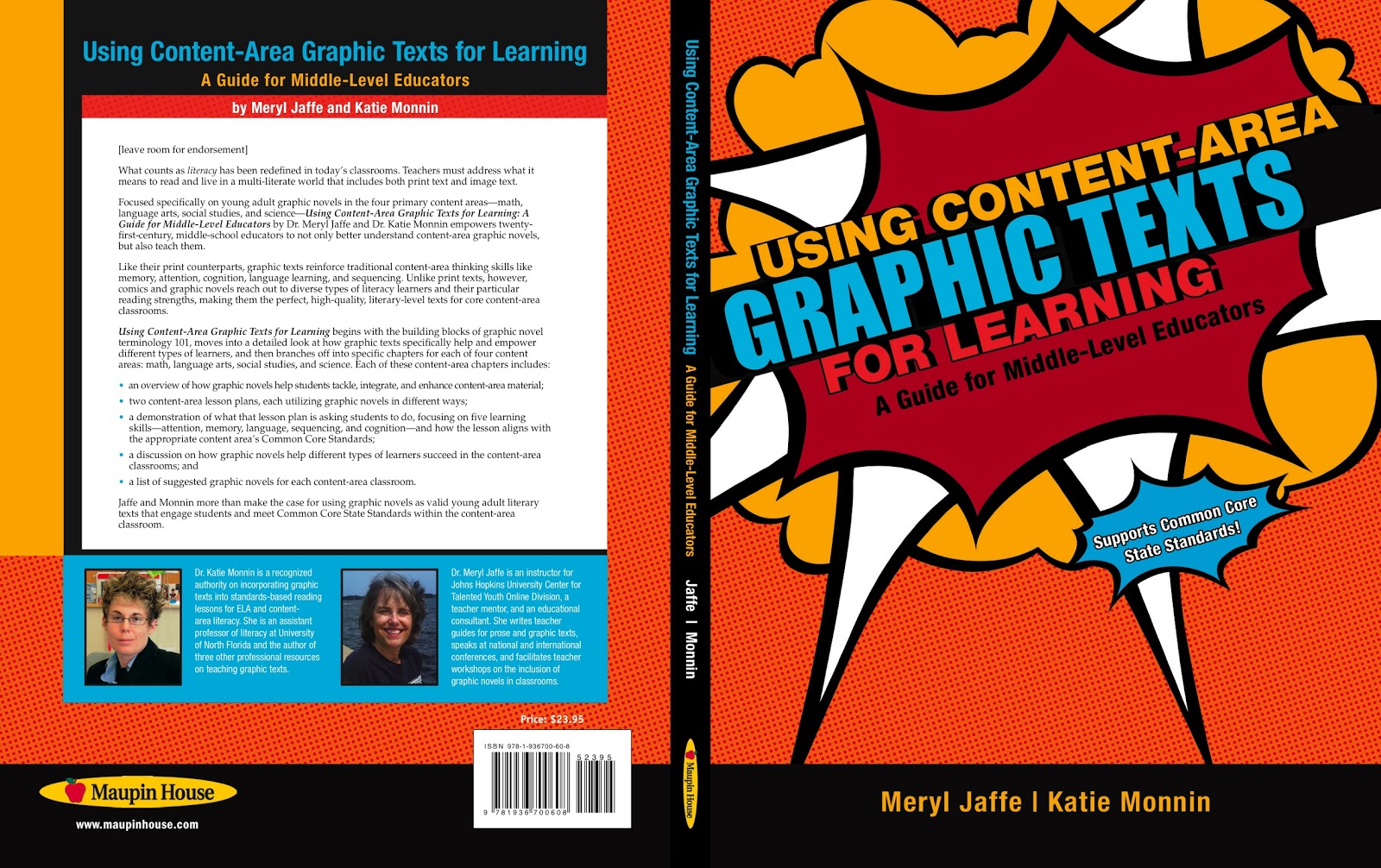
PREVIEW...Using Content Area Graphic Texts for Learning


With a bit over a week until our book hits the stores, I will be previewing selections of the book over the next few weeks.

Here is the introduction which provides an overview of the book.  We will be awarding a few more copies for review.  Please let us know if you're interested in receiving a copy (and why) and please leave your opinions, questions and reactions in the comments below.


Introduction

“We’re here for forty-five minutes. Have fun with the time, but don’t even
THINK about taking out any of those comics or graphic novels!”
-Meryl Jaffe

That is how I used to preface visits to the library or bookstore with my students and children.

In my mind graphic novels were often violent collections about caped crime-fighters, masked madmen, or fictional friends at Riverdale High School.  How did I know this?  That’s what the comic books of my childhood were all about, and I hadn’t seen anything different to change my mind. Admittedly, I hadn’t been looking to change my mind. Johnny Tremain, Of Mice and Men, and The Gammage Cup were just fine for my middle schoolers. These books created worlds of fantasy or historical fiction that made my readers think while incorporating language in inspiring ways. I realize now though that reading lists, like most things in life, can’t remain static. They must be fluid, dynamically bending and adjusting to the time and winds of change.

A few years ago, my children sat me down and passionately argued that in any discussion of literacy, graphic novels had to be included. I reluctantly agreed to read one book of their choice. With the stakes high I advised them to choose wisely, and they did. They selected Joe Kelly’s I Kill Giants, and I was truly blown away. As Kelly’s story opens the reader meets Barbara, a fifth-grade girl who explains that she kills giants. The thing is, it takes most of the book to determine whether this is a metaphor for something bigger, stronger, and scarier in her life or she actually kills giants. He leaves it to you (and your students) to figure out which is the case.

Katie and I come to you from different perspectives. She began her career in the classroom and is now in academia; I began in academia and am now in the classroom. She is a young vibrant rising star, and I am a seasoned parent,  school psychologist, and educator. Although we both came to graphic novels relatively recently in our professional careers, we have become strong advocates for their inclusion in today’s classrooms and libraries.

While Katie and I discuss the movement of graphic novels from comic book shops to the classroom in Part I of this book, there have been three general factors that led us personally, to include them in our classrooms:
1.     There is now a wealth of motivating high-quality graphic novels (be they fiction, science fiction, historical fiction, fantasy, or nonfiction) that lend themselves to content-area classroom use.
2.     With the growth of technology and access to the Internet there is now an increasing need for visual and verbal literacy mastery, emphasized not only in our everyday lives, but also in the Common Core State Standards.
3.     Graphic novels, by their very nature draw the reader into the story because the reader must construct the story by actively integrating visual and verbal components. This is a highly creative and interactive process, which makes learning more meaningful.


Our Goals

While teaching methods and goals are rapidly expanding to meet the demands of our ever shrinking—and yet expanding—worlds we hope to empower you with specific tools to meet those demands. Educators are now mandated to address visual and verbal literacies by incorporating multimodal texts and sources, while fostering greater independent, creative, and analytic thinking. To help address these needs and changes we offer you concrete teaching options in the form of interactive graphic novel suggestions and lesson plans. Graphic novels provide an excellent vehicle to meet curricular standards while incorporating diverse student needs and affinities.

Our goal in this book is to introduce you to today’s graphic novels. We explain how they have matured, how they address learning and curriculum standards, and, finally, how they can be taught in your content-area middle-school classrooms. We also demonstrate how graphic novels and our suggested lessons meet diverse student needs featuring attention, memory, language, sequencing, and cognition skills.


How This Book Is Organized

In the first part of this book, we introduce you to the mechanics of today’s graphic novels and detail how they have changed throughout the years. We also relate why these books are such effective teaching tools for modern classrooms.

The second part of this book takes you to our four content-area classrooms: math, language arts, social studies, and science. Each content-area chapter:
·      Explains how graphic novels can meet your curricular needs;
·      Provides two types of lessons, each using graphic novels in a different way;
·      Demonstrates what each lesson asks students to do—focusing on attention, memory, language, sequencing, and cognition skills;
·      Shows each lesson’s alignment with the Common Core State Standards;
·      Discusses how graphic novels in our lessons help different types of students succeed in the content-area classroom; and
·      Includes a list of other suggested graphic novels you can include in your content-area classroom.

Please note, however, that the lessons and suggested readings we provide are merely suggestions. We encourage you to expand upon these suggested readings and tweak our lessons to meet your own personal teaching preferences and student needs. And, if you are so inclined, we hope you share your explorations and experiences with these lessons and suggested readings with us at www.departingthetext.blogspot.com. Check the blog for new lessons, graphic novel reviews, content-area classroom tips, conference appearances, and more.


For those interested in purchasing the book, if you go to our book page at Maupin House, we are offering the book at a discount if purchased before November 5, 2012.

Thank you for your visit and please leave a note in the comments if you want to receive a free copy for review. Also, as always, please leave your reactions, feedback and any questions you may have in the comments.

Monday, July 9, 2012

ZAP...ZING...ZONK...ZOWIE!!!!

The 2012 San Diego International Comic-con takes place this coming weekend, and I will be moderating a panel of AWESOME educators -Katie Monnin and Bucky Carter and graphic novelists - John Hogan (Graphic Novel Reporter), Joe Kelly (I Kill Giants), Jimmy Gowenly (the Amelia books) Matt and Jennifer Holm (the BabyMouse and Squish books).  Our panel  "Transforming Super-Powered Comic Book Readers into Comic Book Writers" will be on Saturday, 7/14/12 at  5:30p.m. - 6:30p.m., Room: 26AB IF you're there, please come say hello to me.

While I will be posting more about the convention and my panel later, in the spirit of great comics and graphic novels, I dedicate ABC Wednesday "Z" week to  these super awesome fun onomatopoeic Z words: Zap, Zing, Zonk, and Zowie!!!

According to Wikipedia:
onomatopœia (About this sound pronunciation (US) , from the Greek ὀνοματοποιία;[1] ὄνομα for "name"[2] and ποιέω for "I make",[3] adjectival form: "onomatopoeic" or "onomatopoetic") is a word that imitates or suggests the source of the sound that it describes.
Comic strips and comic books made extensive use of onomatopoeia. Popular culture historian Tim DeForest noted the impact of writer-artist Roy Crane (1901–1977), the creator of Captain Easy and Buz Sawyer:
It was Crane who pioneered the use of onomatopoeic sound effects in comics, adding "bam," "pow" and "wham" to what had previously been an almost entirely visual vocabulary. Crane had fun with this, tossing in an occasional "ker-splash" or "lickety-wop" along with what would become the more standard effects. Words as well as images became vehicles for carrying along his increasingly fast-paced storylines.[4]
Aside from using onomatopoeic words when writing because it is simply loads of fun, advertising and marketing experts use it as a mnemonic to help customers and potential clients remember their particular product.  Rice Krispies is one example of a product with an onomatopoeic name, and Alka-Seltzer employed their "Plop, plop, fizz, fizz OH what a relief it is" jingle.

It's even been promoted in song - the chorus of John Prine's song Onomatopoeia is one great example as is Todd Rundgren's Onomatopoeia.
In 1963 Roy Lichtenstein used Whaam! as an early example of pop art and in 2002, DC Comics introduced a villain named Onomatopoeia, an athlete, martial artist and weapons expert who speaks sounds imitating the noises around him and is an enemy of Green Arrow and Batman. Did you ever wonder though about when these words were first used - and how? Let's look at a few...Zingers:

zap/zap/

Verb:
Destroy or obliterate: "zap the enemy's artillery".

Noun:
A sudden effect or event that makes a dramatic impact, esp. a sudden burst of energy or sound
Zap as far as I can tell, is the most used and integrated "Z" onomatopoeic word. There are ZAP electric vehicles, ZAP! comics, Zap skimboards, games, cleaners, photographic tools, and music. According to Wikipedia "A zap is an onomatopoetic word for a discharge of electricity or an electric shock." Regarding its origin, Dictionary.com notes that it was used as a sound effect in 1929 and as a verb in 1942 as a comic strip word in Buck Rogers in the Twenty-Fifth Century. 
*******

zow·ie/ˈzou-ē/

Exclamation:
Expressing astonishment or admiration.
According to merriam-webster.com Zowie was first known to be used in 1902 as an onomatopoeic sound used it imitate a speeding vehicle. I remember it in Batman many years later. Zowie was the Riddler's henchman in Batman: The Animated Series. He was sent by the Riddler to steal goods but was defeated by the caped crusader! It is also the name of aNew Zealand singer-songwriter and drummer, and the name of a fashion accessories company.

*******

zonk/zäNGk/

Verb:
  1. Hit or strike.
  2. Fall or cause to fall suddenly and heavily asleep or lose consciousness: "I always just zonk out"
Zonk has also been somewhat integrated into our culture.  There are "zonks" in the popular TV show Let's Make a Deal, it is a dice game, and the name of a production company. According to dictionary.com it was first used 1950 as an onomatopoeic term to mean "hit hard."

*******

zing/ziNG/

Noun:
Energy, enthusiasm, or liveliness.

Verb:
Move swiftly: "an arrow zinging through the air".
Zing is now the name of a cutting machine, the name of an ultralight aircraft, and a technology company that makes collaborative team learning and meeting systems. Random House Dictionary dates its origin to 1910-1925 as 'imitative' and according to Online Etymology Dictionary, zing was used in 1911 to mean 'high pitched sound,' and in 1918 as slang for 'energy, zest.'


*******

In preparing this post, I realize how powerful pop culture and word play are, how widely comics books and the graphic arts have influenced and continue to influence our world, how word play is not only fun but it can be quite lucrative, and simply how much fun words can be and how easy it is to get lost in their world.  These are all important lessons to share with our kids - especially the reluctant readers and learners.

So in closing, here are some great ways to make learning and words fun:
  • Look at word origins and how the way the use them has changed over time;
  • Make up your own fun onomatopoeic words
  • Draw words to reflect their meaning
  • See how many sentence strings you can generate using onomatopoeia
Personally, 'splat' is one of my favorite onomatopoeic words (but this post I focused on "Z"). Please share your opinions or your favorite onomatopoeic words in the comments and have a great week. In the meantime, enjoy this music video, compliments of Zowie!!!

Wednesday, March 23, 2011

My Jaunt at C2E2 2011...Departing the Text: Teaching Inference with Graphic Novels

I just got back from  C2E2 2011.  Not only did the panel go well,  I love conventions...walking around...getting free books...and pitching mine. It's all about books (at least for me).  I own a kindle and read it (and love it when traveling), but there is something about the touch, feel and smell of books and paper in your hand...

At the request of some of my readers, let me tell you about the presentation Talia Hurwich and I made, "Departing the Text:  Teaching Inference With Graphic Novels." (Katie Monnin who also contributed could not make it).  The turnout was good and the audience was as passionate about teaching kids,  reaching kids, reaching teachers and introducing the right graphic novels into classrooms as we were. 

Presentation highlights:
Getting to know the page: While I'm not sure there is a 'typical' graphic novel page since page design is actually part of the art, each page contains the following elements:
  • Panels - boxes of various shape, size and borders that contain varying amounts of text and art.
  • Text varies in size, shape and in presentations. Typically, the text is presented in narrative or dialogue form (and dialogue is often in a 'text bubble').
  • When there is more than one panel to a page (which is usually the case), the panels are separated by lines or space called "gutters." Gutters are actually important.
Gutters are where a lot of critical thinking takes place.  For one, they provide opportunities to pause,  reflect and digest the previous panel and "fill in" the gaps of time, action and emotion.  Gutters also allow readers to pause and fill chunks of 'data' that the author/illustrator did not provide which are also necessary for comprehension.

In order to read and comprehend graphic novels, readers must:
  • Attend to the text's content;
  • Attend to details in art - the foreground and the background, facial expressions, spacing and placing of objects;
  • Attend to the shape, size and presentation of  text (in and out of) the panels; and
  • Attend to the panel borders and the choice of color in the backgrounds.
Learning is most effective when it is personal, meaningful and interactive. Here's how graphic novels can play a huge role:
  • Graphic novels are particularly suited for learning because they involve the reader as s/he constantly engages with the medium - switching from verbal to visual stimuli and constructing his/her level of understanding.
  • Aside from the art often being literally stunning, it pops out at you and invites the reader to participate in the action.  TRIBES:  The Dog Years (by Michael Geszel, Peter Spinetta; art by Inaki Miranda - IDW Publishers) is one example. 
  • Readers are constantly making inferences when they read graphic novels.  
  •  Critical to reading and learning from graphic novels is that information is given everywhere, and "art" can include the use of illustrations, the design of the page, the font, size, shape, and presentation of the text.
Readers Must make INFERENCES in order to comprehend:

  • We make them when we leap - figuring out what happened within and between panels.
  • We must infer character emotions from faces,  from the color of the panel background, from body stances, from text (content, shape, size), and from panel borders and shapes.
  • We must infer motives from faces, body posture, text (content, shape, size) and from panel borders and shapes.
  • We make inferences in the use of figure/ground and foreground/background.
  • We make inferences about author/illustrator 'choices'.
  • Time is often 'weird' in graphic novels.  The art and design allows the author/illustrator to jump from one period of time to another, often with no formal 'direction'.  As a result, readers must infer 'where' they are 'when' integrating the art, the shading, the panel borders, the color and the text provided.
A special note about teaching social cognition - how to read faces, understand boundaries and personal space, validate emotions... graphic novels are a power house:  In social interactions, reading verbal and nonverbal cues is essential.  Graphic novels clearly can help. The facial expressions, how people are standing or interacting together, the color of the background, the tension in the bodies, smooth or jagged panel borders, text size-shape-and font, ALL show and teach us how one expression, word, stance can lead to a particular emotion or reaction in others.  SEEING is often so much more power than just reading or being told, and graphic novels do both.


Talia outlined a sample lesson plan for introducing Greek mythology using Athena: Grey-Eyed Goddess by George O'Connor, published by First Second. For anyone interested, please let me know, we can email a copy to you.

Questions/concerns from the audience [Note each bullet is a topic for an upcoming post so stay tuned]:
  • How do parents, teachers, librarians know what to buy?  As with prose novels, there are junk and gems all around.  How do we know what to buy/read/recommend?
  • How can parent/teachers learn more about using and reading graphic novels to build inference skills?
  • Can I provide further examples of how to read graphic novel panels, pointing out opportunities for inference?
  • Do you have questions?  Please let me know in the comments.
Conclusion: 
Graphic novels are rife with teaching opportunities for kids with all kinds of strengths and weaknesses and they should be integrated in classrooms and read at home.  The key is finding the right ones to use.  I have made some recommendations in previous posts, and will continue to do so.

What do you think?  Any questions?  Do you want any particular information?  Please let me know.