Showing posts with label Joe Kelly. Show all posts

Sunday, December 16, 2012

The Power of Words

Confluence...synchronicity...alignment... Ever feel your worlds aligning?  This post is the result of such a feeling...

From: blog.omegazadvisors.com
It is "W" week for ABCWednesday, my good friend Karin posted the powerful YouTube video (below) on Facebook, and it is the end of the year...we reflect and make resolutions for 2013, and a colleague totally misunderstood an email of mine and was hurt (you know who you are - and I am sorry)... So what am I writing about this week?

The Power of Words 

It seems like such a simple thing - words. We use them all the time, often not really thinking about our choices or their indirect effect. Writing emails, letters, speaking with friends... word choices can make such a huge difference, and so often we forget this.

Choosing words wisely and contemplating their significance takes time and consideration. And, while essential, EDITING is often a quick afterthought. Truth is, editing is a skill - and one that most of my students are so reluctant to do. They hate it and in truth, I often do too.  But,we all need to remember to look at spelling, grammar, keeping the content in one consistent tense, and most importantly, word choice (one of my 2013 resolutions).

I have a friend and colleague who is young, single, and dating.  She advises her single girl-friends that before emailing a guy they're interested in, to send it off first to a girl-friend (whom she calls a 'gate keeper')  for two reasons. One to pause and reconsider even sending it (is she sounding too eager, too harsh, too sassy, too cute....) and if she should send it, does it convey the message she wants. She's smart!

So here is my gift to you, my loyal friends, followers, and valued guests...


 The Gift of Words -in three parts
  •  a video
  •  editing guidelines / advice
  • suggested links or editing resources and for illustrating lighter side of word power

Here is a video "Change Your Words - Change your Worlds." While this ironically also emphasizes the power of image (visual literacy), it is provides a powerful punch at the end emphasizing how the words we chose to use can make a huge difference.  Enjoy - it's worth the time!

So what can we do? Here or some suggestions I give to students and revisit myself.

From: languagelog.ldc.upenn.edu
Editing advice:
  • Write a draft in a "Word" document. When finished look for red squiggly lines (that point out spelling errors) and green squiggly lines (pointing out grammar and tense errors).  Work on getting rid of those lines. Often the word program will give suggestions (especially with the spelling).
  • Once you've taken care of the red and green lines (spelling, grammar and formatting), go back and re-read your piece. Read it OUT LOUD.  This way you can hear as well as see awkward, incomplete, or over-burdened sentences.  IF you have trouble reading the sentence or passage smoothly, your readers will too - so change it!
  • Now reread it another time with these guidelines in mind:
    • Trim long sentences
    • focus on word choices - are they used correctly? Do they convey what you want to convey?
    • Do your sentences and paragraphs flow one into the other or do you need a sentence here and there to bridge your thoughts/points?
    • Check that names are spelled correctly, check that you are using the appropriate synonym, homophone and tense.
  • Take a rest but don't send it yet.  Come back after some time and read it over one more time. Read it one final time:
    • Does it say exactly what you want it to say? 
    •  Is the message clear and succinct? Will your readers understand the intent, inferences and content? 
    • If yes, you're ready. If not, rework it a bit.
My favorite books for kids illustrating the power of words:
  • Douglas Fredericks and the House of They written by Joe Kelly, illustrated by Ben Roman is about a boy who wants to do so many creative things but "They Say" it can't be done.  This is a wonderful book about language and the power of creativity and determination. (Ages 6+)
  • Frindle by Andrew Clemens is an awesome book about what makes a word a word. (Ages 6+)
  • Many Luscious Lollipops (a vibrantly illustrated kids' book about adjectives and rhyming); A Cache of Jewels (a vibrantly illustrated book about collective nouns); Kites Sail High (all about verbs) ---by Ruth Heller are three of her books about words (ages 5-8)


Awesome word-related links:
  • For laughs on POOR word choices that could not be retrieved here are some sadly funny political gaffes and "Quayleisms:
  • For more laughs emphasizing the power and need of proofreading and editing, here is an awesome video of Taylor Mali's slam poem "The The Impotence of Proof Reading"
  • Here is a post on how to "Understand Spelling Errors to Raise Better Writers"
  • Here is a with a nice editing checklist
  • From: pingler.com


  • This is a SUPER handout from the University of North Carolina at Chapel Hill's Writing Center on Word Choice. It discusses misused words, jargon, 'loaded language', wordiness, cliches, writing for an academic audience, repetition vs. redundancy, building clear thesis statements, strategies for successful word choice, final editing questions to ask yourself, and it contains additional references.


Thank you all for your visit.  Please leave some of your editing tips or word of reflection or kindness in the comments.
From: languagegarden.wordpress.com

Sunday, October 28, 2012

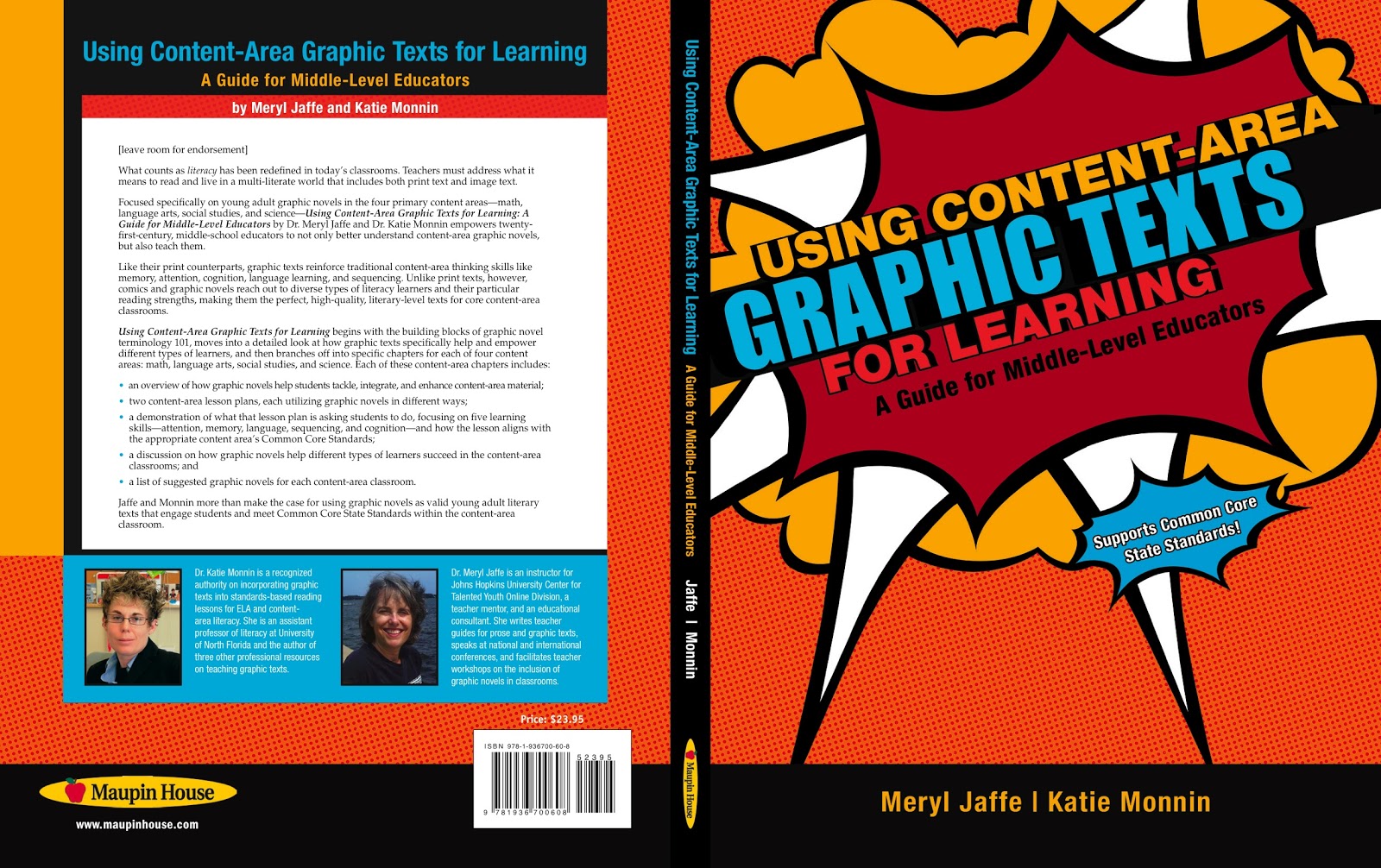
PREVIEW...Using Content Area Graphic Texts for Learning


With a bit over a week until our book hits the stores, I will be previewing selections of the book over the next few weeks.

Here is the introduction which provides an overview of the book.  We will be awarding a few more copies for review.  Please let us know if you're interested in receiving a copy (and why) and please leave your opinions, questions and reactions in the comments below.


Introduction

“We’re here for forty-five minutes. Have fun with the time, but don’t even
THINK about taking out any of those comics or graphic novels!”
-Meryl Jaffe

That is how I used to preface visits to the library or bookstore with my students and children.

In my mind graphic novels were often violent collections about caped crime-fighters, masked madmen, or fictional friends at Riverdale High School.  How did I know this?  That’s what the comic books of my childhood were all about, and I hadn’t seen anything different to change my mind. Admittedly, I hadn’t been looking to change my mind. Johnny Tremain, Of Mice and Men, and The Gammage Cup were just fine for my middle schoolers. These books created worlds of fantasy or historical fiction that made my readers think while incorporating language in inspiring ways. I realize now though that reading lists, like most things in life, can’t remain static. They must be fluid, dynamically bending and adjusting to the time and winds of change.

A few years ago, my children sat me down and passionately argued that in any discussion of literacy, graphic novels had to be included. I reluctantly agreed to read one book of their choice. With the stakes high I advised them to choose wisely, and they did. They selected Joe Kelly’s I Kill Giants, and I was truly blown away. As Kelly’s story opens the reader meets Barbara, a fifth-grade girl who explains that she kills giants. The thing is, it takes most of the book to determine whether this is a metaphor for something bigger, stronger, and scarier in her life or she actually kills giants. He leaves it to you (and your students) to figure out which is the case.

Katie and I come to you from different perspectives. She began her career in the classroom and is now in academia; I began in academia and am now in the classroom. She is a young vibrant rising star, and I am a seasoned parent,  school psychologist, and educator. Although we both came to graphic novels relatively recently in our professional careers, we have become strong advocates for their inclusion in today’s classrooms and libraries.

While Katie and I discuss the movement of graphic novels from comic book shops to the classroom in Part I of this book, there have been three general factors that led us personally, to include them in our classrooms:
1.     There is now a wealth of motivating high-quality graphic novels (be they fiction, science fiction, historical fiction, fantasy, or nonfiction) that lend themselves to content-area classroom use.
2.     With the growth of technology and access to the Internet there is now an increasing need for visual and verbal literacy mastery, emphasized not only in our everyday lives, but also in the Common Core State Standards.
3.     Graphic novels, by their very nature draw the reader into the story because the reader must construct the story by actively integrating visual and verbal components. This is a highly creative and interactive process, which makes learning more meaningful.


Our Goals

While teaching methods and goals are rapidly expanding to meet the demands of our ever shrinking—and yet expanding—worlds we hope to empower you with specific tools to meet those demands. Educators are now mandated to address visual and verbal literacies by incorporating multimodal texts and sources, while fostering greater independent, creative, and analytic thinking. To help address these needs and changes we offer you concrete teaching options in the form of interactive graphic novel suggestions and lesson plans. Graphic novels provide an excellent vehicle to meet curricular standards while incorporating diverse student needs and affinities.

Our goal in this book is to introduce you to today’s graphic novels. We explain how they have matured, how they address learning and curriculum standards, and, finally, how they can be taught in your content-area middle-school classrooms. We also demonstrate how graphic novels and our suggested lessons meet diverse student needs featuring attention, memory, language, sequencing, and cognition skills.


How This Book Is Organized

In the first part of this book, we introduce you to the mechanics of today’s graphic novels and detail how they have changed throughout the years. We also relate why these books are such effective teaching tools for modern classrooms.

The second part of this book takes you to our four content-area classrooms: math, language arts, social studies, and science. Each content-area chapter:
·      Explains how graphic novels can meet your curricular needs;
·      Provides two types of lessons, each using graphic novels in a different way;
·      Demonstrates what each lesson asks students to do—focusing on attention, memory, language, sequencing, and cognition skills;
·      Shows each lesson’s alignment with the Common Core State Standards;
·      Discusses how graphic novels in our lessons help different types of students succeed in the content-area classroom; and
·      Includes a list of other suggested graphic novels you can include in your content-area classroom.

Please note, however, that the lessons and suggested readings we provide are merely suggestions. We encourage you to expand upon these suggested readings and tweak our lessons to meet your own personal teaching preferences and student needs. And, if you are so inclined, we hope you share your explorations and experiences with these lessons and suggested readings with us at www.departingthetext.blogspot.com. Check the blog for new lessons, graphic novel reviews, content-area classroom tips, conference appearances, and more.


For those interested in purchasing the book, if you go to our book page at Maupin House, we are offering the book at a discount if purchased before November 5, 2012.

Thank you for your visit and please leave a note in the comments if you want to receive a free copy for review. Also, as always, please leave your reactions, feedback and any questions you may have in the comments.

Monday, July 16, 2012

Anti-Heroe's...Is it Time for Superman to Roll Over?

The San Diego Comi-con 2012 is over and it was an awesome event and my panel "Transforming Graphic Novel Readers into Graphic Novel Writers" was a blast! Leading kids/adult graphic novelists Jenni and Matt Holm (Babymouse  and Squish),  Jimmy Gownley (Amelia) and Joe Kelly (I Kill Giants, Superman vs. The Elite, Ultimate Spider-Man, and many more) all spoke about tools and skills they needed to successfully publish their works and gave suggestions for aspiring graphic novelists. Educators Katie Monnin, PhD., and James Bucky Carter, PhD., related how education can help. What sticks out most is that:
  • Written work is rarely successful the first draft, or even the first try.  NEVER get discouraged.  Just stay open to constructive criticism and constant editing;
  • Structure is really important in writing graphic novels.  Writers/illustrators must structure the story, the panels, the pages, and they must structure their working time and day;
  • Panelists agreed that developing 'real' characters was the trick to successful work and readers must be able to relate to them;
  • While writing the story is important, equally important is being able to 'lay out the story' so art, text and panels flow smoothly.
  • Classroom attention should be directed not only to literacy building (both visual and verbal literacy), but to teaching executive functions such as structure and organization, attention to detail, and the encouragement of creativity and creative alternatives.
We also discussed the changing role of 'hero' in popular culture, and how the anti-hero is growing in importance and popularity. The big question which was posed by Joe Kelly years ago and developed in his new film, Superman vs. The Elite:   
  •  Is Superman out of date? Has his role of super-hero been replaced by awesome but ego-centric, crime-fighting anti-heroes?
  • Why is it that we frequently ask about  Superman's place in our culture today, but Spidey, Batman ("The Dark Knight"), XMen, and so many other superheroes' 'potency' in our world of fantasy and fiction are rarely questioned?
According to http://en.wikipedia.org/wiki/Antihero
In fiction, an antihero[1] (sometimes antiheroine as the feminine) is generally considered to be a protagonist whose character is an "everyman" type of character, in contrast to the larger-than-life qualities of an archetypal hero. The term dates to 1714,[2] although literary criticism identifies the term in earlier literature...[3]
Unlike traditional heroes, antiheroes are not as fabulous as the traditional ones. They may be corrupt, oppressive, etc., or may merely have no unusual qualities whatsoever (the common definition). They are not villains but not necessarily heroes. They may do bad things but are not evil. They may fight villains, but not for the reason of justice, or if it is for the cause of justice will take an "ends justify the means" stance. Their actions are motivated by their own personal desires, such as revenge. 

In my teaching (and as a parent) I have found that kids do like heroes.  They like heroes such as Harry Potter .... but, they also enjoy villains.

But by age 12, I think something happens, young adults today, in my experience, actually are drifting more towards the anti-heroes.  The Twilight characters, Hunger Games, are full of anti-heroes. Furthermore we love Spidy and Batman who are vigilates - who take punishing crime into their own hands and have no qualms about murdering 'the bad guys' without trial by jury. For further thought and discussion, please leave your opinions in the comments and go watch Joe Kelly's Superman vs. The Elite which addresses this question with grace and humor, action and reflection.

Joe Kelly's Superman vs. The Elite, which came out last month and is available on Blue Ray  and streaming on the web. It puts the question of hero vs. anti-hero out in the open for full question and evaluation. He empowers Superman to wrestle with his goody-two-shoes image and enables him to rise as a more modern but true-to-self hero.

To whet your taste buds, here's a super interview with Joe Kelly - a truly AWESOME superhero in my humble opinion - who claims his work is dark, while I find it wonderfully empowering and uplifting:
And, a trailer...
As a leaning optimist, I'd like to think Superman and true-blooded "good" heroes are not dead.  And, while some flaws are essential to make them real, I believe that not only is there a place for these role models, there is a vital need for them.  I find so many of us floundering in lives of  cynicism, frustrated with our leaders, with politics and economics and need the larger-than-life fluffy role models to aspire to.... That's my take...what's yours?
Both the interview and the film are well worth the visits and views and I'd love to hear what you think about them and the changing role of today's super-heroes.  Please leave your views and takes on this subject (and tell us who your favorite heroes/anti-heroes are) in the comments.
Thanks for the visit, please come again!


Thanks for

Monday, July 9, 2012

ZAP...ZING...ZONK...ZOWIE!!!!

The 2012 San Diego International Comic-con takes place this coming weekend, and I will be moderating a panel of AWESOME educators -Katie Monnin and Bucky Carter and graphic novelists - John Hogan (Graphic Novel Reporter), Joe Kelly (I Kill Giants), Jimmy Gowenly (the Amelia books) Matt and Jennifer Holm (the BabyMouse and Squish books).  Our panel  "Transforming Super-Powered Comic Book Readers into Comic Book Writers" will be on Saturday, 7/14/12 at  5:30p.m. - 6:30p.m., Room: 26AB IF you're there, please come say hello to me.

While I will be posting more about the convention and my panel later, in the spirit of great comics and graphic novels, I dedicate ABC Wednesday "Z" week to  these super awesome fun onomatopoeic Z words: Zap, Zing, Zonk, and Zowie!!!

According to Wikipedia:
onomatopœia (About this sound pronunciation (US) , from the Greek ὀνοματοποιία;[1] ὄνομα for "name"[2] and ποιέω for "I make",[3] adjectival form: "onomatopoeic" or "onomatopoetic") is a word that imitates or suggests the source of the sound that it describes.
Comic strips and comic books made extensive use of onomatopoeia. Popular culture historian Tim DeForest noted the impact of writer-artist Roy Crane (1901–1977), the creator of Captain Easy and Buz Sawyer:
It was Crane who pioneered the use of onomatopoeic sound effects in comics, adding "bam," "pow" and "wham" to what had previously been an almost entirely visual vocabulary. Crane had fun with this, tossing in an occasional "ker-splash" or "lickety-wop" along with what would become the more standard effects. Words as well as images became vehicles for carrying along his increasingly fast-paced storylines.[4]
Aside from using onomatopoeic words when writing because it is simply loads of fun, advertising and marketing experts use it as a mnemonic to help customers and potential clients remember their particular product.  Rice Krispies is one example of a product with an onomatopoeic name, and Alka-Seltzer employed their "Plop, plop, fizz, fizz OH what a relief it is" jingle.

It's even been promoted in song - the chorus of John Prine's song Onomatopoeia is one great example as is Todd Rundgren's Onomatopoeia.
In 1963 Roy Lichtenstein used Whaam! as an early example of pop art and in 2002, DC Comics introduced a villain named Onomatopoeia, an athlete, martial artist and weapons expert who speaks sounds imitating the noises around him and is an enemy of Green Arrow and Batman. Did you ever wonder though about when these words were first used - and how? Let's look at a few...Zingers:

zap/zap/

Verb:
Destroy or obliterate: "zap the enemy's artillery".

Noun:
A sudden effect or event that makes a dramatic impact, esp. a sudden burst of energy or sound
Zap as far as I can tell, is the most used and integrated "Z" onomatopoeic word. There are ZAP electric vehicles, ZAP! comics, Zap skimboards, games, cleaners, photographic tools, and music. According to Wikipedia "A zap is an onomatopoetic word for a discharge of electricity or an electric shock." Regarding its origin, Dictionary.com notes that it was used as a sound effect in 1929 and as a verb in 1942 as a comic strip word in Buck Rogers in the Twenty-Fifth Century. 
*******

zow·ie/ˈzou-ē/

Exclamation:
Expressing astonishment or admiration.
According to merriam-webster.com Zowie was first known to be used in 1902 as an onomatopoeic sound used it imitate a speeding vehicle. I remember it in Batman many years later. Zowie was the Riddler's henchman in Batman: The Animated Series. He was sent by the Riddler to steal goods but was defeated by the caped crusader! It is also the name of aNew Zealand singer-songwriter and drummer, and the name of a fashion accessories company.

*******

zonk/zäNGk/

Verb:
  1. Hit or strike.
  2. Fall or cause to fall suddenly and heavily asleep or lose consciousness: "I always just zonk out"
Zonk has also been somewhat integrated into our culture.  There are "zonks" in the popular TV show Let's Make a Deal, it is a dice game, and the name of a production company. According to dictionary.com it was first used 1950 as an onomatopoeic term to mean "hit hard."

*******

zing/ziNG/

Noun:
Energy, enthusiasm, or liveliness.

Verb:
Move swiftly: "an arrow zinging through the air".
Zing is now the name of a cutting machine, the name of an ultralight aircraft, and a technology company that makes collaborative team learning and meeting systems. Random House Dictionary dates its origin to 1910-1925 as 'imitative' and according to Online Etymology Dictionary, zing was used in 1911 to mean 'high pitched sound,' and in 1918 as slang for 'energy, zest.'


*******

In preparing this post, I realize how powerful pop culture and word play are, how widely comics books and the graphic arts have influenced and continue to influence our world, how word play is not only fun but it can be quite lucrative, and simply how much fun words can be and how easy it is to get lost in their world.  These are all important lessons to share with our kids - especially the reluctant readers and learners.

So in closing, here are some great ways to make learning and words fun:
  • Look at word origins and how the way the use them has changed over time;
  • Make up your own fun onomatopoeic words
  • Draw words to reflect their meaning
  • See how many sentence strings you can generate using onomatopoeia
Personally, 'splat' is one of my favorite onomatopoeic words (but this post I focused on "Z"). Please share your opinions or your favorite onomatopoeic words in the comments and have a great week. In the meantime, enjoy this music video, compliments of Zowie!!!

Saturday, March 26, 2011

Kicking back a bit...What's all this about Inference?

In my last post I summarized my C2E2 presentation.  What I would like to do this week is kick back, discuss some of the comments and take them a bit further, talking about the nearly unlimited opportunities you can make to read with your kids, talk with them and help them learn to think critically and evaluate the world around them.

What's all this about inference?
Inference is the act of drawing a conclusion by deductive reasoning.  Inferences are assumptions or images we connect or construe when reading, when talking with others, even watching television or movies.  Reading and writing poetry is an example of making inferences.  In poetry the reader provides images, similes, metaphors that the reader must interpret in order to fully comprehend the author's intent. Some people describe making inferences as 'reading between the lines' which is SO appropriate when talking about reading graphic novels.

We make inferences all the time - at work, at home, talking to colleagues and friends, in school, at play, when reading, when thinking about the world around us.  The thing about inference, though is that it is actually hard to teach and hard to learn.  Graphic novels are so helpful because they provide so many cues - text, art, and even page design all provide the reader with important information.

Types of inferences we make when reading graphic novels:
When we read regular novels, we typically make inferences about what the characters, places, events look like.  We are almost always told what the protagonist is thinking and feeling, and motives are often included by the narrator or third-person voice.  In graphic novels that is not the case.  When reading graphic novels we typically must infer:
  • Character motives and intent;
  • Emotions;
  • Time sequences;
  • What is happening 'beween' scenes (and in the gutters) that is not 'given' or provided by author/artist.
Kicking back with an example of the awesome power of graphic novels and making inferences:
This image s taken from I Kill Giants by Joe Kelly (Image comics).

Story Background:  Barbara is a fifth grader who tells anyone who will listen that she kills giants.  The reader is uncertain at this point if she really kills giants, if she lives in a world of her own, out of touch with others, or if this is one giant metaphor for her having to face huge scary issues in her life.

On this page, Barbara is arguing with her sister.  Barbara hit the school counselor and her sister was called to pick her up.  The sister is really upset.

Inferences we must make:
  • Why does Barabaras's sister have to 'do this on her own'?
  • Where is their dad?
  • Where is their mom?
  • Why are there words inked out?
  • What might Barabara's sister be saying?
  • Why can't Barabara hear them?
  • What is with the eye thing in the middle panel on the bottom?
  • Why is there a shadow over Barbara's face in the last panel?
This is just one page from one graphic novel.  Each graphic novel is different in part, because the stories, the art, and the page design are different for each book.  That is part of the thrill or reading these new books and formats.  As always, the quality and appropriateness of these books vary.  While I recommend reading them at home and in school, I strongly recommend that adults look through the books before giving them to kids to check for appropriateness of story and vocuabulary.  That said, graphic novels are well worth the effort.

How else can you help your kids learn to make inferences?
  • Talk about books you and your kids read (graphic novels, poetry, prose).  Ask them what the author intended when she/she wrote something vague or something different. 
  • When reading graphic novels:
    • Talk about how the art and the visual details add to the story.
    • Talk about how the choice of color palate helps explain depict emotion.
    • Discuss how the choice of text font and shape add to the story detail.
  • Talk about the titles of books and chapters.  After reading them, would you have chosen those titles?  Why?  Can you think of different titles?
  • Talk about metaphors and similes.  They are such graphic means of expression.  When you come across them, talk about them.
  • When going for walks talk and think about the things you see around you.  Why are they that way?  Why do you  think squirrels have busy tails?  What color do you think is the most popular one for the outside of a house?  Why?  
  • Design scenes and worlds for dolls/lego designs, trains, dinosaurs as you play together.  Talk about the choices your child makes when designing the scenes.
  • What is so great about jello - the taste, the texture, the fact that it jiggles?
These questions go on and on.  The point is to notice things around you, to notice things others say or write and to think and further analyze and understand them.  The more you model and practice critical thinking and inference, the easier it will be for your child to tackle the world around them.

What are some of the ways you practice making inferences together?  I'd love to hear some of your ideas or questions!